Dwell Times Reveal Effects of Abstract Event Type on Attention Allocation
Jamie Yuen, Sarah Hye‐yeon Lee, Anna Papafragou

TL;DR
This study shows that how events are structured (bounded vs. unbounded) influences where people focus their attention during the event.
Contribution
The paper introduces the novel idea that abstract event structure, specifically boundedness, affects attention allocation patterns.
Findings
Event endpoints attract more attention than midpoints, especially in bounded events.
Attention at endpoints is higher than at beginnings, with an interaction based on event boundedness.
Results held even when participants had a linguistic preview of the events.
Abstract
The human mind can segment continuous streams of activity in the world into meaningful, discrete units known as events. However, not all events are created equal. We draw a distinction between bounded events (e.g., folding a handkerchief) that have a predictable structure that develops in distinct stages (i.e., a beginning, middle, and end) and a well‐defined endpoint, and unbounded events (e.g., waving a handkerchief) that lack such a well‐defined structure and endpoint. We predict that event boundedness affects attention allocation patterns over the course of the event. Here, we tested this prediction using a dwell time paradigm by measuring the time participants spent on each still frame of an activity. We found that event endpoints attracted increased attention compared to midpoints; importantly, this increase was significantly greater when people viewed bounded events compared to…
Genes, proteins, chemicals, diseases, species, mutations and cell lines named across the full text — each resolved to its canonical identifier and authoritative record.
Click any figure to enlarge with its caption.
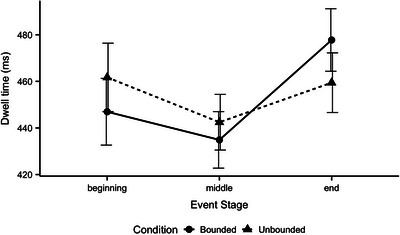 Figure 1
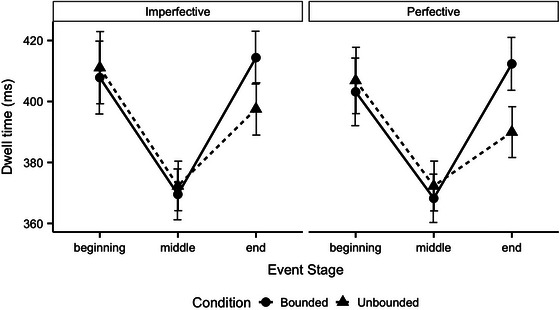 Figure 2
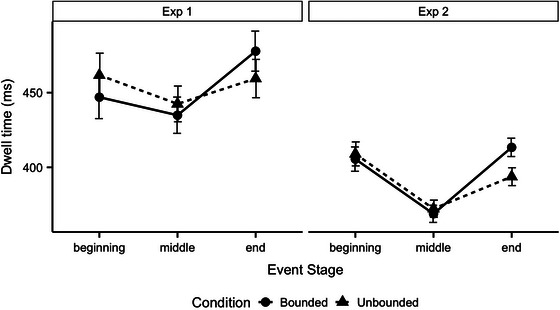 Figure 3
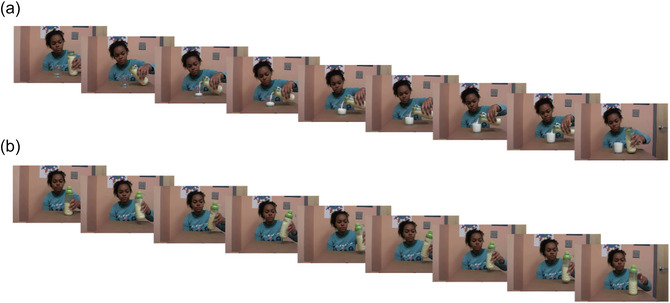 Figure 4
Peer Reviews
No public reviews on file for this paper yet. If you reviewed it on a platform where reviews are public (OpenReview, ICLR, NeurIPS, ICML), you can paste yours below so the community can read it here.
Videos
No videos yet. Explain this paper in a talk, walkthrough, or lecture? Add one.
Taxonomy
TopicsAction Observation and Synchronization · Neurobiology of Language and Bilingualism · Neural and Behavioral Psychology Studies