Association between social and built environment characteristics and maternal mortality in 340 Latin America cities: an ecological study from the SALURBAL study
Camila Teixeira Vaz, Uriel M Silva, Ana Ortigoza, Monica Serena Perner, Marcio Alazraqui, Ariela Braverman-Bronstein, Duane Alexander Quistberg, Amélia Augusta de Lima Friche, Waleska T Caiaffa

TL;DR
This study explores how urban environments in Latin American cities affect maternal mortality, finding that better living conditions and infrastructure are linked to lower maternal deaths.
Contribution
The study is the first to examine the association between social and built environment characteristics and maternal mortality across 340 Latin American cities.
Findings
Cities with better living conditions and services had lower maternal mortality ratios.
Higher population density and urban isolation were linked to higher maternal mortality.
Improved infrastructure and mobility policies may reduce maternal deaths in Latin American cities.
Abstract
Maternal mortality ratio (MMR) is a key indicator of maternal health, but heterogeneity across cities has been infrequently explored. We aimed to investigate variation in MMR across cities and the association between social and built environment features of urban areas and MMR in Latin American countries. This ecological study used harmonised data from the Salud Urbana en América Latina study comprising 340 cities across eight countries (Argentina, Brazil, Chile, Colombia, Costa Rica, Guatemala, Mexico and Panama). MMRs were calculated for each city using vital statistics registries for the years 2012–2016 and a correction factor applied for under-reporting of maternal deaths. Predictors of interest included city social environment characteristics (living conditions, services provision and population educational attainment), built environment characteristics (isolation of urban…
Genes, proteins, chemicals, diseases, species, mutations and cell lines named across the full text — each resolved to its canonical identifier and authoritative record.
Click any figure to enlarge with its caption.
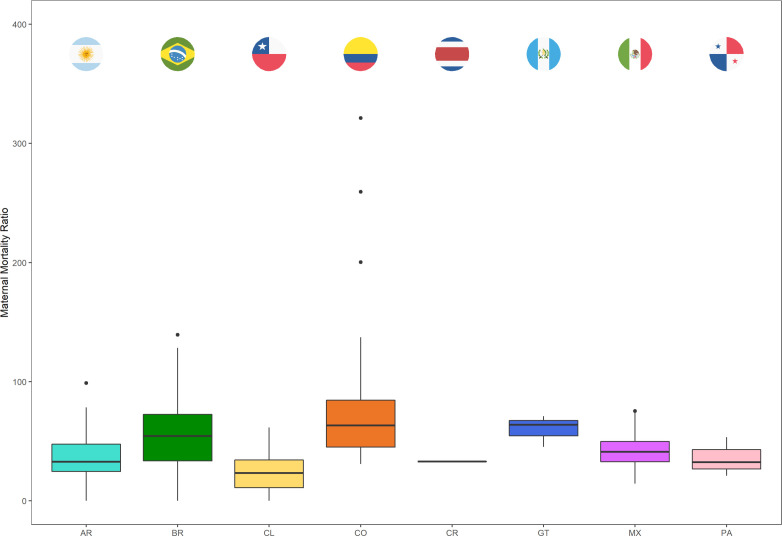 Figure 1
Peer Reviews
No public reviews on file for this paper yet. If you reviewed it on a platform where reviews are public (OpenReview, ICLR, NeurIPS, ICML), you can paste yours below so the community can read it here.
Videos
No videos yet. Explain this paper in a talk, walkthrough, or lecture? Add one.
Taxonomy
TopicsGlobal Maternal and Child Health · Maternal and Neonatal Healthcare · Health disparities and outcomes