Socio‐Economic Determinants and Regional Prevalence of Disorders of Gut‐Brain Interaction in the Netherlands: Results From the Rome Foundation Global Epidemiology Study
F. Veldman, F. Innocenti, M. A. Benninga, A. D. Sperber, O. S. Palsson, S. I. Bangdiwala, D. Keszthelyi

TL;DR
This study finds that gut-brain interaction disorders affect about a third of Dutch adults, with no regional differences, and suggests that limited healthcare access and unemployment are risk factors.
Contribution
The study provides new regional prevalence data for gut-brain interaction disorders in the Netherlands and identifies socio-economic risk factors.
Findings
DGBI prevalence in the Netherlands is 30.63%, with no significant regional differences.
Limited healthcare access and unemployment are associated with higher odds of DGBI.
Female sex, younger age, underweight, and obesity are also linked to increased DGBI risk.
Abstract
Disorders of gut‐brain interaction (DGBI) impose significant burdens worldwide, yet reliable regional prevalence estimates are lacking, limiting insight into potential geographic variation. Socio‐economic status (SES) may contribute but remains underexplored. Data were obtained from the Dutch cohort of the Rome Foundation Global Epidemiology Study, including the Rome IV Adult Diagnostic Questionnaire, sociodemographic items, and SES indicators. The Netherlands was divided into three regions (Region 1: South; Region 2: West; Region 3: North‐East). Regional prevalence was calculated for any DGBI, groups, and subtypes. Associations with SES were examined using logistic regression. 2008 participants (50% female; age: 48 years [IQR: 31]; BMI: 25.25 kg/m2 [IQR: 5.98]) were included. Overall DGBI prevalence was 30.63% (95% CI: 28.65–32.68), with no significant regional differences (Region 1:…
Genes, proteins, chemicals, diseases, species, mutations and cell lines named across the full text — each resolved to its canonical identifier and authoritative record.
Click any figure to enlarge with its caption.
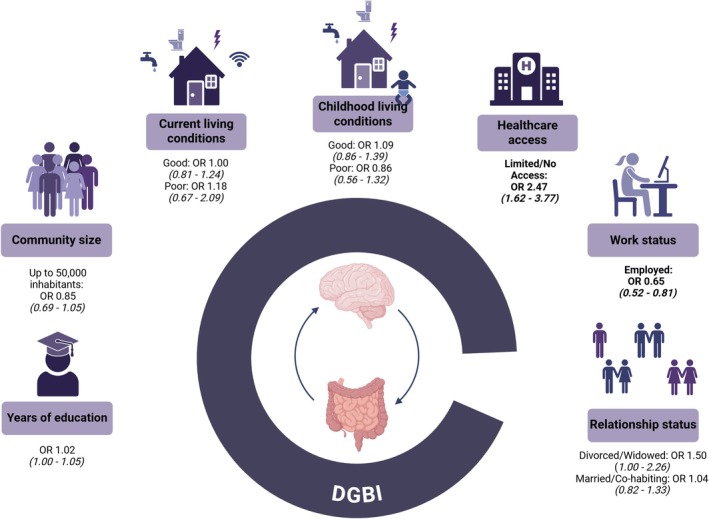 Figure 1
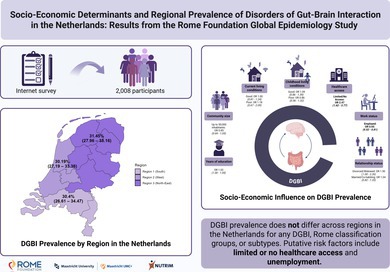 Figure 2
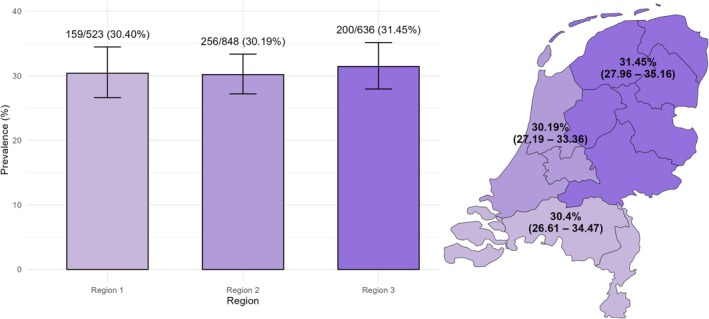 Figure 3
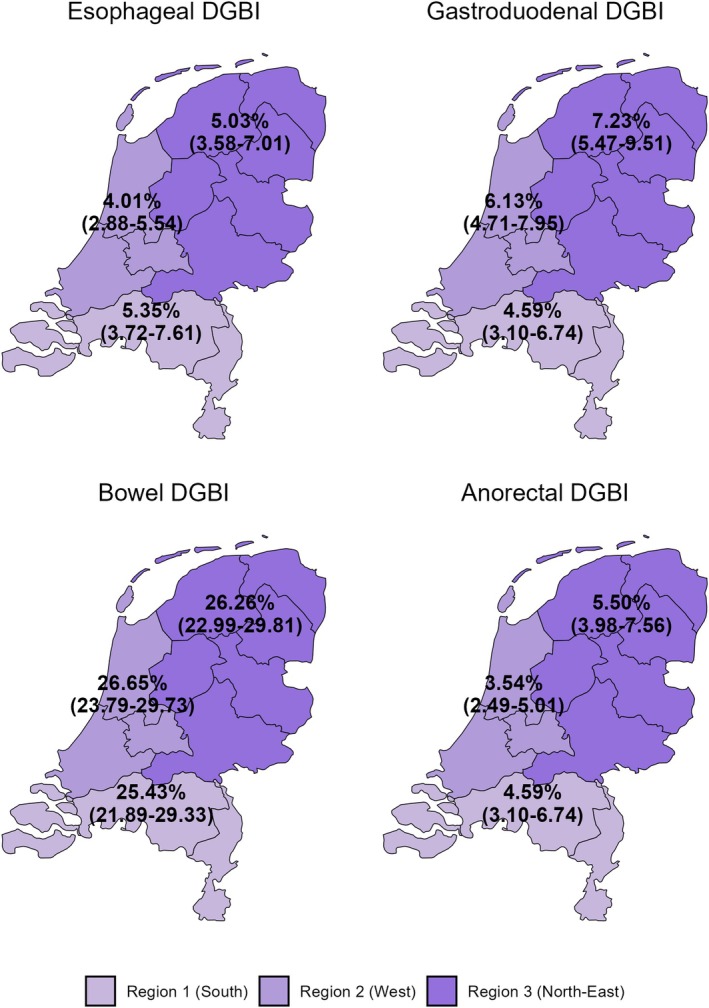 Figure 4
Peer Reviews
No public reviews on file for this paper yet. If you reviewed it on a platform where reviews are public (OpenReview, ICLR, NeurIPS, ICML), you can paste yours below so the community can read it here.
Videos
No videos yet. Explain this paper in a talk, walkthrough, or lecture? Add one.
Taxonomy
TopicsGastrointestinal motility and disorders · Dysphagia Assessment and Management · Gastroesophageal reflux and treatments