Relationship Between Intragastric Meal Distribution, Gastric Emptying, and Gastric Neuromuscular Dysfunction in Chronic Gastroduodenal Disorders
Chris Varghese, Armen A. Gharibans, Daphne Foong, Gabriel Schamberg, Stefan Calder, Vincent Ho, Reena Anand, Christopher N. Andrews, Alan H. Maurer, Thomas Abell, Henry P. Parkman, Greg O'Grady

TL;DR
This study shows that how food is distributed in the stomach relates to delayed emptying and worse symptoms in patients with chronic digestive issues.
Contribution
The study introduces a multimodal approach combining gastric emptying and neuromuscular mapping to better understand chronic gastroduodenal disorders.
Findings
Proximal food retention correlates with delayed gastric emptying and abnormal neuromuscular rhythms.
Patients with multiple motor abnormalities experience more severe dyspeptic symptoms.
Abnormal intragastric meal distribution was found in 7.5% of patients and linked to delayed motility responses.
Abstract
Chronic gastroduodenal symptoms arise from heterogeneous gastric motor dysfunctions. This study applied multimodal physiological testing using gastric emptying scintigraphy (GES) with intragastric meal distribution (IMD) and Gastric Alimetry body surface gastric mapping (BSGM) to define motility and symptom associations. Patients with chronic gastroduodenal symptoms underwent simultaneous supine GES and BSGM with a 30 m baseline, 99mTC‐labeled egg meal, and 4 h postprandial recording. IMD (ratio of counts in the proximal half of the stomach to the total gastric counts) was calculated immediately after the meal (IMD0), with < 0.568 defining abnormal IMD. BSGM phenotyping followed a consensus approach, based on normative spectral reference intervals. Among 67 patients (84% female, median age 40 years, median BMI 24 kg/m2), median IMD0 was 0.76 (IQR: 0.69–0.86) with 5 (7.5%) meeting…
Genes, proteins, chemicals, diseases, species, mutations and cell lines named across the full text — each resolved to its canonical identifier and authoritative record.
Click any figure to enlarge with its caption.
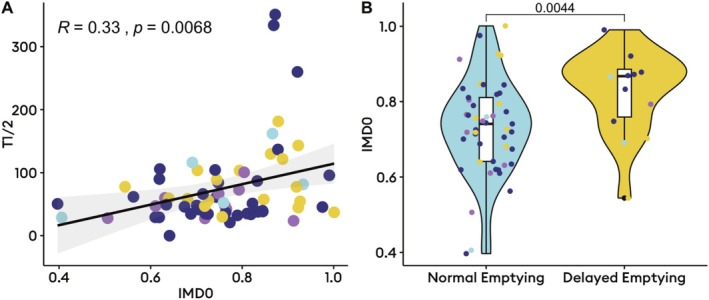 Figure 1
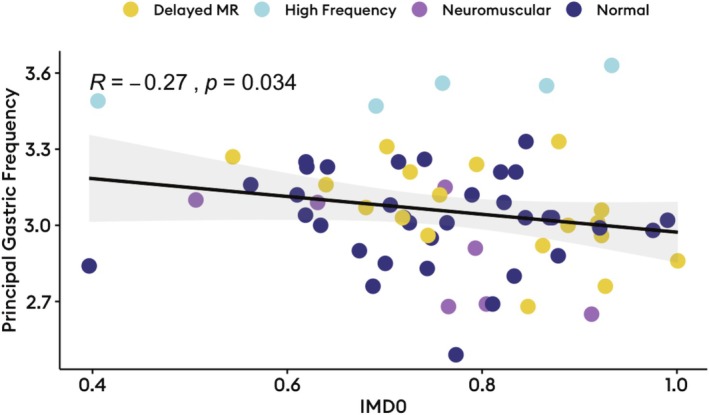 Figure 2
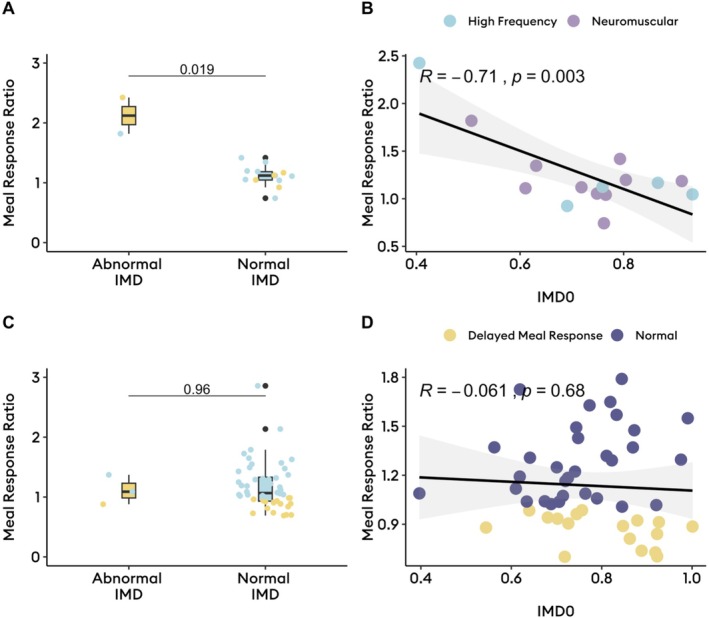 Figure 3
 Figure 4
Peer Reviews
No public reviews on file for this paper yet. If you reviewed it on a platform where reviews are public (OpenReview, ICLR, NeurIPS, ICML), you can paste yours below so the community can read it here.
Videos
No videos yet. Explain this paper in a talk, walkthrough, or lecture? Add one.
Taxonomy
TopicsGastrointestinal motility and disorders · Congenital gastrointestinal and neural anomalies · Helicobacter pylori-related gastroenterology studies