Learning to explore tree neighbourhoods for phylogenetic inference
Federico Julian Camerota Verdù, Andrea Gasparin, Luca Bortolussi, Lorenzo Castelli

TL;DR
This paper introduces a reinforcement learning approach to solve the phylogenetic inference problem more efficiently and effectively.
Contribution
A novel reinforcement learning framework for the balanced minimum evolution problem in phylogenetics is proposed.
Findings
The RL agent solves instances with up to 100 taxa and outperforms greedy heuristics.
The method matches state-of-the-art algorithms and adapts well to distributional shifts.
A search-based framework improves performance during evaluation.
Abstract
Phylogenetic inference is a key challenge in computational biology, with applications ranging from evolutionary analysis to comparative genomics. The balanced minimum evolution problem (BMEP) offers a well-established formulation of this problem, but remains computationally intractable for large instances. In this work, we propose a reinforcement learning (RL) framework to tackle the BMEP through local search in the space of phylogenetic trees. Our contributions are three-fold: (i) we introduce an improved RL formulation tailored to the structure of phylogenetic inference in the context of the BMEP; (ii) we train an RL agent capable of solving instances with up to 100 taxa; and (iii) we investigate the generalization capabilities of the learned policy across different substitution models, instance sizes, and datasets. To address the limitations of relying solely on the learned policy at…
Genes, proteins, chemicals, diseases, species, mutations and cell lines named across the full text — each resolved to its canonical identifier and authoritative record.
Click any figure to enlarge with its caption.
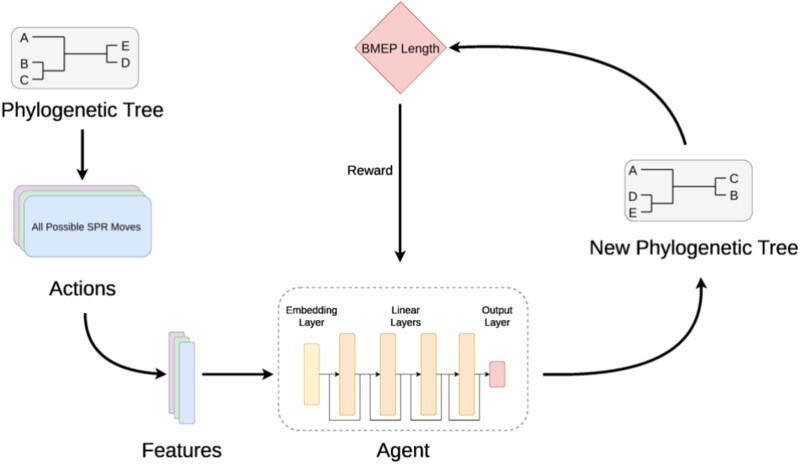 Figure 1
Peer Reviews
No public reviews on file for this paper yet. If you reviewed it on a platform where reviews are public (OpenReview, ICLR, NeurIPS, ICML), you can paste yours below so the community can read it here.
Videos
No videos yet. Explain this paper in a talk, walkthrough, or lecture? Add one.
Taxonomy
TopicsGenome Rearrangement Algorithms · Genomics and Phylogenetic Studies · Genomics and Rare Diseases