Vivid imagery is reported faster than weak imagery
Benjy Barnett, Matan Mazor, Giulia Cabbai, Nadine Dijkstra

TL;DR
People take longer to report weak mental images, suggesting a shared process between perception and imagery.
Contribution
A novel inverse correlation between imagery vividness and reaction time is identified across multiple datasets.
Findings
Participants report weak mental images more slowly than vivid ones.
Individual differences in detection asymmetry and trait imagery predict the vividness-response time relationship.
The results suggest a shared mechanism for evaluating visual experience in perception and imagery.
Abstract
Visual imagery and external perception rely on similar representations. However, whether the same processes underpin the subjective appraisal of both percepts and mental images is not yet known. One well-known effect in perceptual detection tasks is that people take longer to report perceptions of absence compared to presence. Vividness reports are detection-like in that participants report the presence or absence of a mental image. We therefore asked whether reports of low vividness share commonalities with reports of target absence. Across five pre-existing datasets, we report a robust inverse correlation between imagery vividness ratings and reaction times: participants take longer to report the vividness of mental images when they are weak. In addition, in one of the two datasets that included detection tasks and trait imagery questionnaires we find that individual differences in…
Genes, proteins, chemicals, diseases, species, mutations and cell lines named across the full text — each resolved to its canonical identifier and authoritative record.
Click any figure to enlarge with its caption.
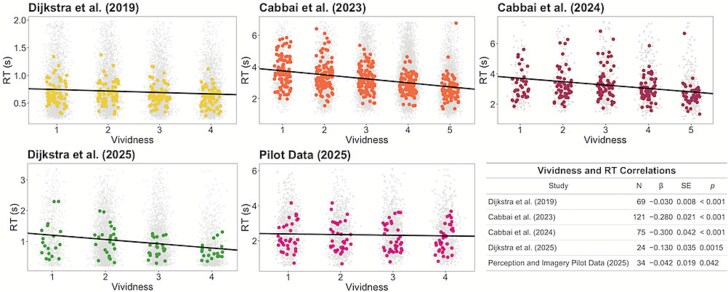 Figure 1
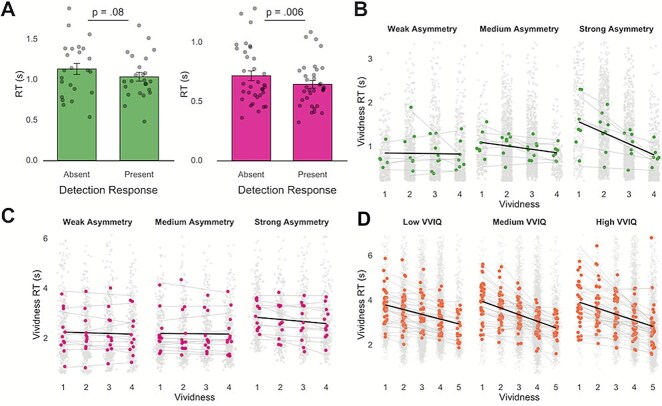 Figure 2
Peer Reviews
No public reviews on file for this paper yet. If you reviewed it on a platform where reviews are public (OpenReview, ICLR, NeurIPS, ICML), you can paste yours below so the community can read it here.
Videos
No videos yet. Explain this paper in a talk, walkthrough, or lecture? Add one.
Taxonomy
TopicsFace Recognition and Perception · Visual perception and processing mechanisms · Neural and Behavioral Psychology Studies