Molten salt-directed catalytic synthesis of room-temperature ferromagnetic transition-metal nitride nanosheets
Wei Hu, Ruiqi Liu, Yunlai Zhu, Chao Wang

TL;DR
A new method creates ultrathin molybdenum nitride nanosheets that show strong magnetism at room temperature, promising for future electronic devices.
Contribution
A three-step molten salt-directed catalytic method to synthesize intrinsic room-temperature ferromagnetic γ-Mo2N nanosheets.
Findings
γ-Mo2N nanosheets show ferromagnetism with a Curie temperature of about 360 K.
Ferromagnetism is attributed to 4d electrons of Mo atoms with itinerant characteristics.
Extensive characterization confirms structural stability and absence of magnetic impurities.
Abstract
The next generation of low-power electronic/spintronic devices based on two-dimensional (2D) magnetic materials has great application prospects. However, so far, the numbers of intrinsic room-temperature magnetic 2D materials is limited. Here, we report a simple and effective three-step molten salt-directed catalytic method for obtaining intrinsic room-temperature ferromagnetic gamma-Mo2N (γ-Mo2N) nanosheets. The γ-Mo2N nanosheets with high crystallization and ultra-thin 2D layered structure characteristics show obvious ferromagnetism and Curie temperature (Tc) up to about 360 K. Meanwhile, ICP-AES measurement excludes the possibility of ferromagnetic impurities. Extensive synchrotron radiation X-ray absorption fine structure (XAFS) spectra characterizations confirm the bonding configuration of Mo–N coordination around Mo atoms as well as the structural stability of the samples.…
Genes, proteins, chemicals, diseases, species, mutations and cell lines named across the full text — each resolved to its canonical identifier and authoritative record.
Click any figure to enlarge with its caption.
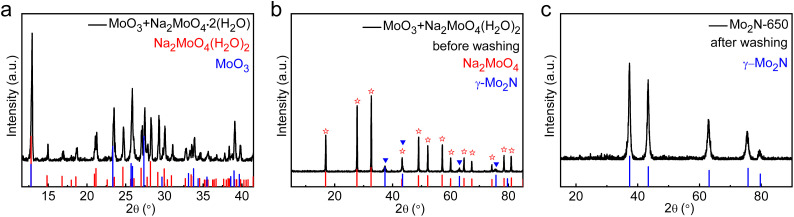 Figure 1
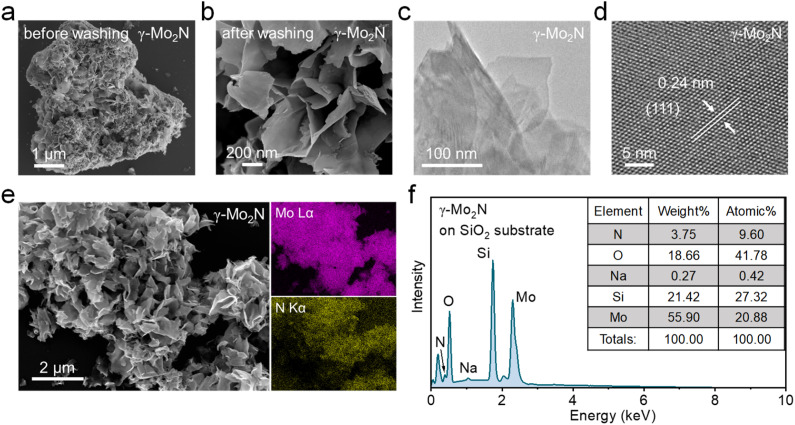 Figure 2
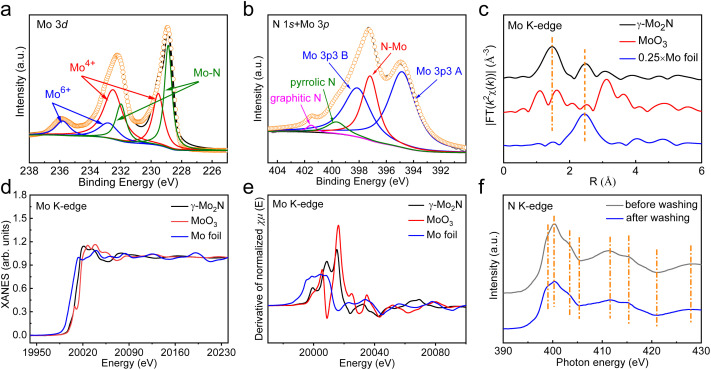 Figure 3
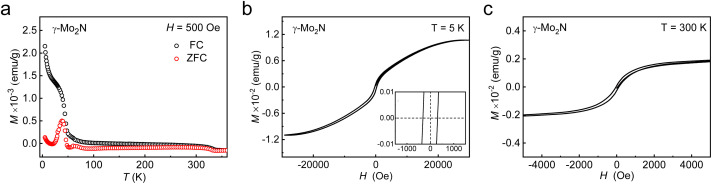 Figure 4
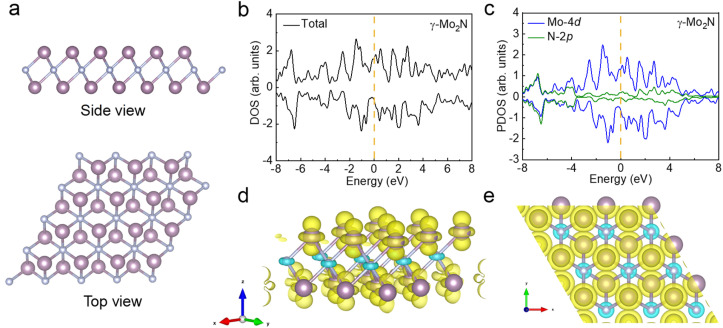 Figure 5
 Figure 6
Peer Reviews
No public reviews on file for this paper yet. If you reviewed it on a platform where reviews are public (OpenReview, ICLR, NeurIPS, ICML), you can paste yours below so the community can read it here.
Videos
No videos yet. Explain this paper in a talk, walkthrough, or lecture? Add one.
Taxonomy
TopicsMXene and MAX Phase Materials · Boron and Carbon Nanomaterials Research · 2D Materials and Applications