Force Transmission by Minimal Focal Adhesion Complexes Induces Synthetic Cell Deformation
Natalie Huhn, Chiao-Peng Hsu, Timon Nast-Kolb, Arsenii Hordeichyk, Andreas R. Bausch

TL;DR
Researchers created a synthetic system to study how cells transmit forces through focal adhesion proteins, showing that minimal components can deform cell-like structures.
Contribution
A minimal synthetic system reconstituting focal adhesion complexes in GUVs to study force transmission and mechanosensing.
Findings
Defined protein-membrane interactions can nucleate actin networks and anchor them to membranes.
Actomyosin contraction leads to structural alignment and deformation of GUVs.
The system remains stable under load, demonstrating force transmission and mechanosensing capabilities.
Abstract
Cells sense and respond to mechanical cues through focal adhesions–dynamic, multiprotein assemblies linking the actin cytoskeleton to the extracellular matrix. These complexes are essential to processes from cell migration to tissue morphogenesis, yet the minimal physical requirements for their force-transmitting and mechanosensing functions remain unclear. Here, we reconstitute minimal focal adhesion-like complexes in giant unilamellar vesicles (GUVs) using kindlin-2, talin-1, FAK, paxillin, zyxin, and VASP anchored to membranes containing PIP2 and integrin β1 tails. These assemblies nucleate and anchor actin filaments into networks spanning the vesicle surface. Upon addition of nonmuscle myosin IIa, actomyosin contraction thickens filament bundles, aligns the complexes, and deforms the GUVs, while the assemblies remain stably membrane-bound. Our findings show that actin recruitment,…
Genes, proteins, chemicals, diseases, species, mutations and cell lines named across the full text — each resolved to its canonical identifier and authoritative record.
Click any figure to enlarge with its caption.
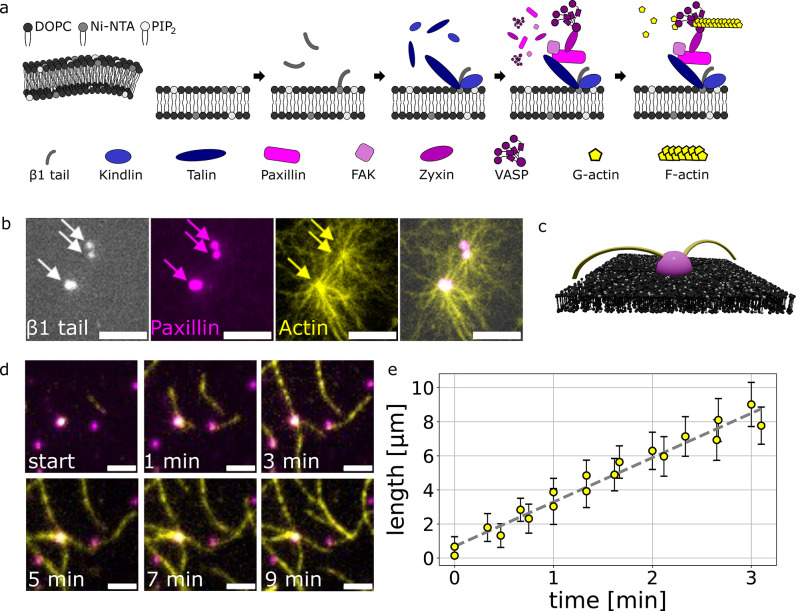 Figure 1
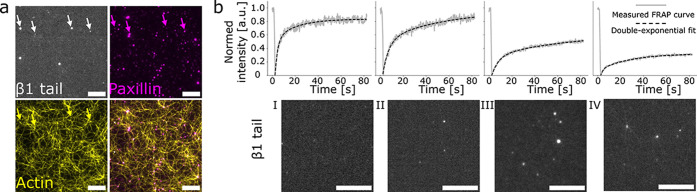 Figure 2
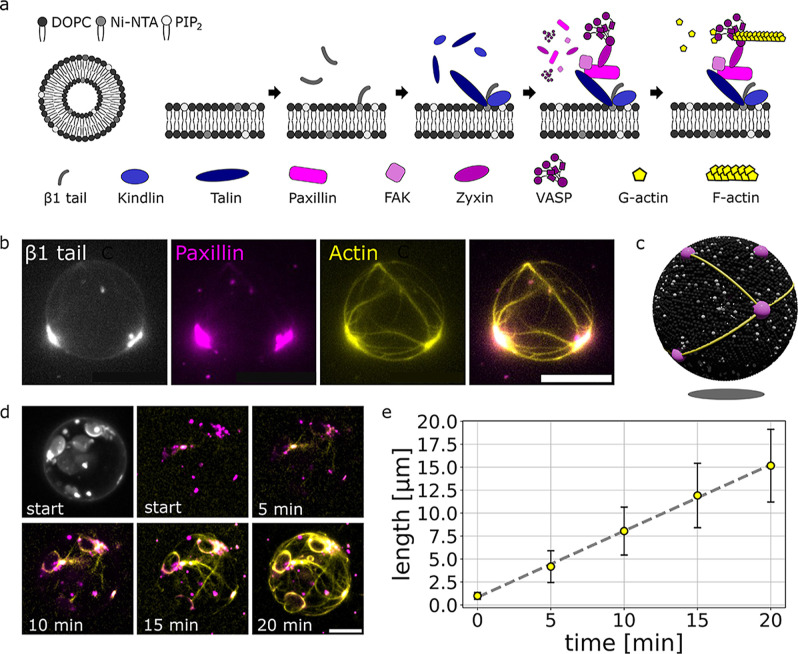 Figure 3
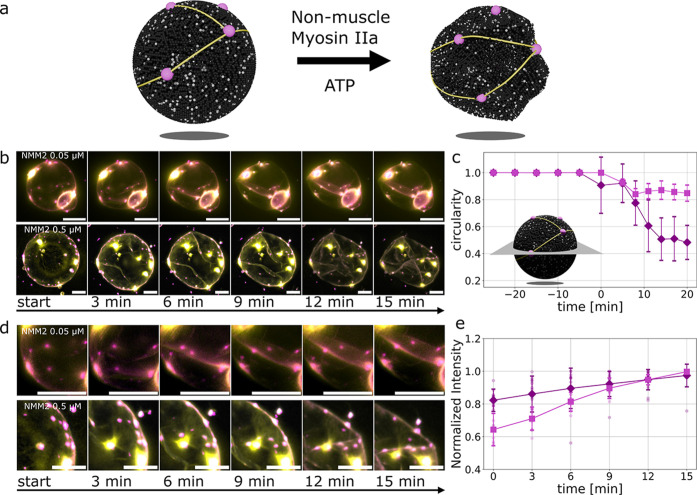 Figure 4
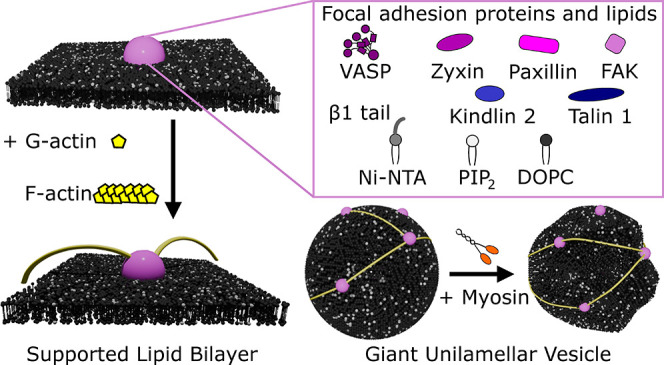 Figure 5
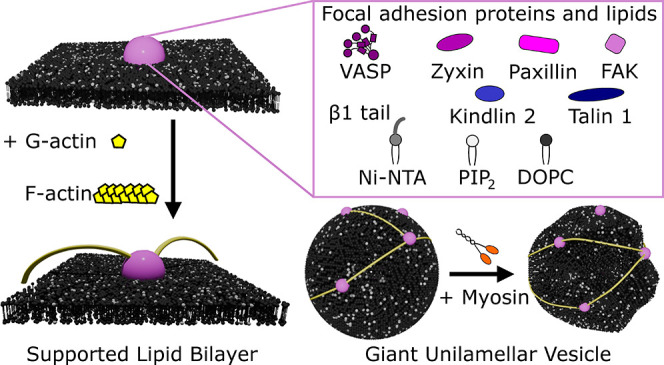 Figure 6
 Figure 7
 Figure 8
Peer Reviews
No public reviews on file for this paper yet. If you reviewed it on a platform where reviews are public (OpenReview, ICLR, NeurIPS, ICML), you can paste yours below so the community can read it here.
Videos
No videos yet. Explain this paper in a talk, walkthrough, or lecture? Add one.
Taxonomy
TopicsCellular Mechanics and Interactions · Cell Adhesion Molecules Research · Force Microscopy Techniques and Applications