High-Throughput Detection of Cyanobacterial Form I Rubisco Assembly
Jackson W. Wysocki, ByungUk Lee, Tina Wang

TL;DR
Scientists developed a biosensor to study how changes in Rubisco protein affect its assembly, finding that most mutations hinder the process.
Contribution
A genetically encoded biosensor was engineered to enable high-throughput detection of cyanobacterial Rubisco assembly in E. coli.
Findings
The biosensor detects RbcS-dependent assembly of cyanobacterial Rubisco orthologs and chaperone-stabilized RbcL intermediates.
Most RbcL mutations in a large mutant library negatively affect Rubisco assembly, constraining its evolution and engineering.
The biosensor was adapted for phage-assisted noncontinuous selection to screen thousands of RbcL mutants efficiently.
Abstract
Rubisco catalyzes the CO2 fixation step in the dark reactions of photosynthesis. Transgenic expression of better-performing Rubisco orthologs in plants or discovery of improved mutants of Rubisco via protein engineering could theoretically accelerate plant growth and improve crop yields. However, efforts to heterologously express or engineer Rubisco are frequently stymied by the chaperone-dependent folding and assembly of the Rubisco holoenzyme, a process that can be disrupted by changes to Rubisco’s sequence. Elucidation of the effects that alterations to Rubisco’s sequence impose upon its biogenesis is hampered by reliance upon low-throughput methods for verification of Rubisco assembly. Here, we report the engineering of a genetically encoded biosensor to sense the assembly of Form I Rubiscos in E. coli. We show that the biosensor can detect the RbcS-dependent assembly of…
Genes, proteins, chemicals, diseases, species, mutations and cell lines named across the full text — each resolved to its canonical identifier and authoritative record.
Click any figure to enlarge with its caption.
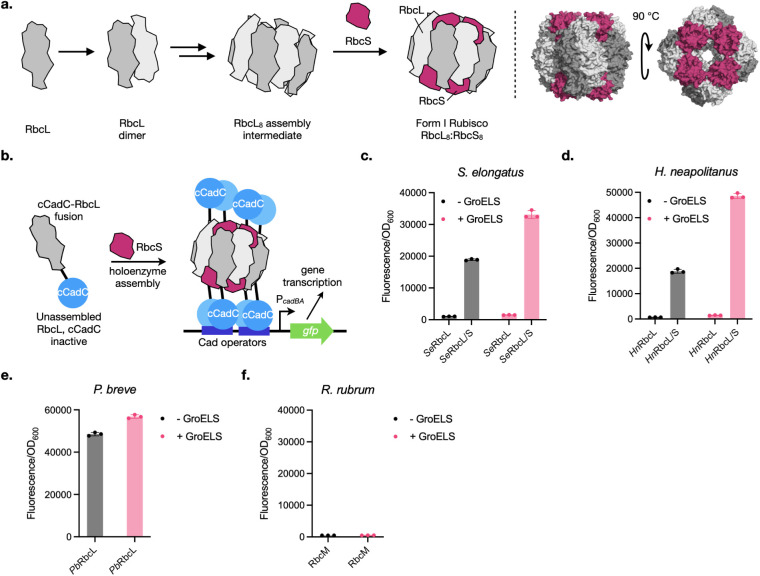 Figure 1
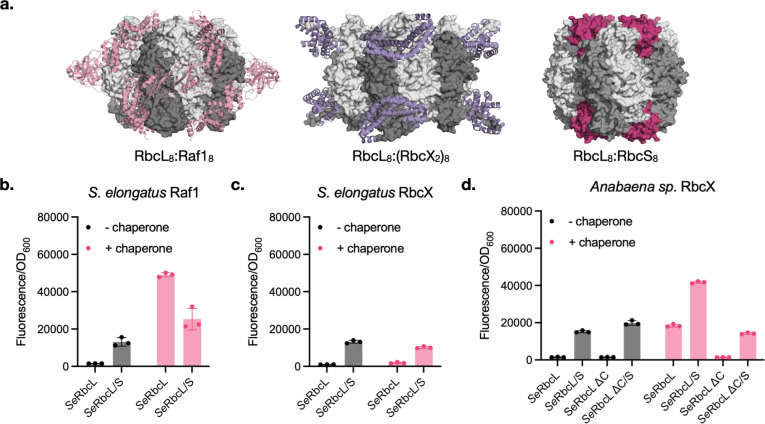 Figure 2
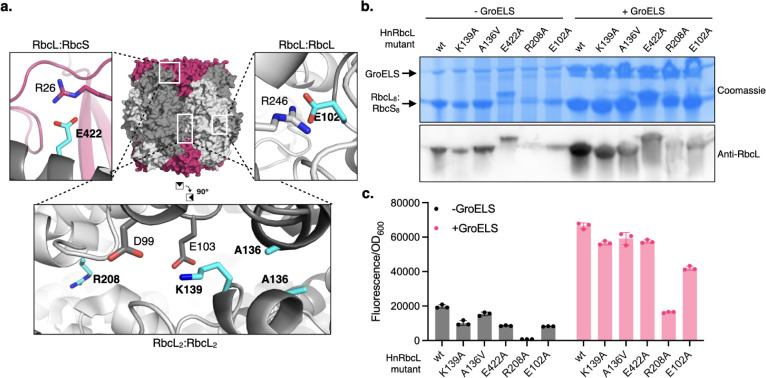 Figure 3
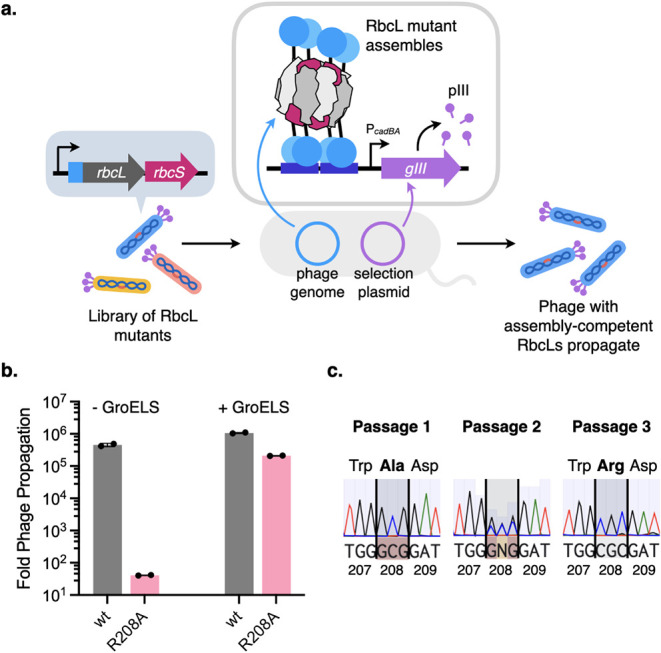 Figure 4
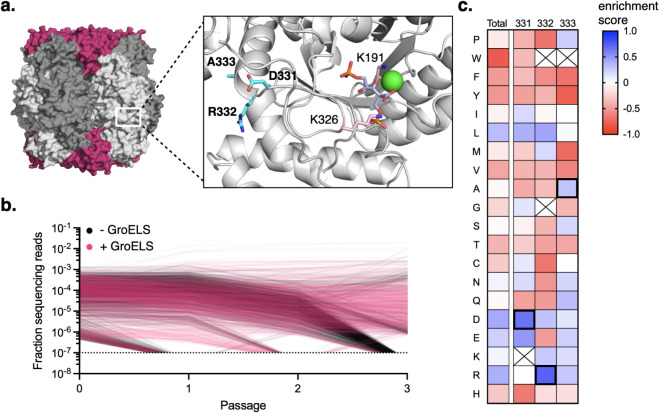 Figure 5
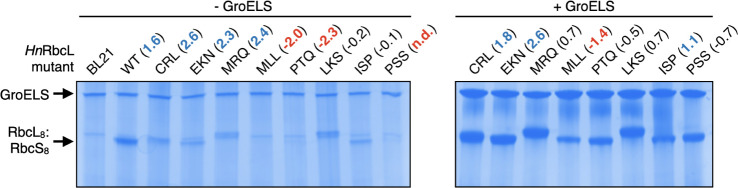 Figure 6
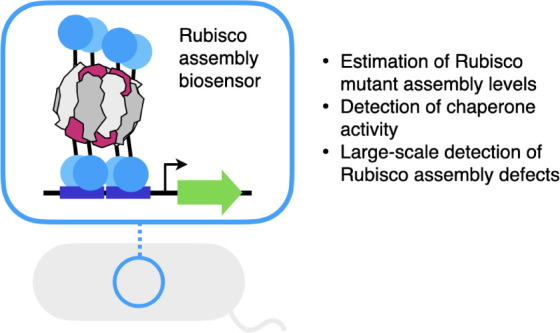 Figure 7
 Figure 8
Peer Reviews
No public reviews on file for this paper yet. If you reviewed it on a platform where reviews are public (OpenReview, ICLR, NeurIPS, ICML), you can paste yours below so the community can read it here.
Videos
No videos yet. Explain this paper in a talk, walkthrough, or lecture? Add one.
Taxonomy
TopicsPhotosynthetic Processes and Mechanisms · Light effects on plants · Advanced Electron Microscopy Techniques and Applications