Computation-Guided Placement of Nonfullerene Acceptor Core Halogenation for High-Performance Organic Solar Cells
Yao Chen, Hongliang Lei, Seunglok Lee, Peihao Huang, Gengsui Tian, Lei Liu, Tianyu Zeng, Changduk Yang, Tainan Duan, Huanyu Zhou, Zeyun Xiao, Tobin J. Marks, Antonio Facchetti

TL;DR
This paper shows how placing bromine on a key part of a molecule improves the efficiency of organic solar cells.
Contribution
A new series of brominated nonfullerene acceptors is designed and shown to significantly boost solar cell performance.
Findings
Brominated NFAs achieved a power conversion efficiency of 17.58%, outperforming fluorinated and chlorinated variants.
Bromination improved film morphology, exciton dissociation, and charge mobility in organic solar cells.
Ternary solar cells with brominated NFAs reached a record 20.14% efficiency.
Abstract
The strategic molecular design of nonfullerene acceptors (NFAs) plays a crucial role in enhancing the efficiency of organic solar cells (OSCs). Here, working from first-principles theoretical computation, we report a new series of quinoxaline-based NFAs (Qx-PhHal, where Hal = F, Cl, or Br) with varying halogen substitution on the central acceptor core of the molecules to investigate their impact on OSC performance. Notably, OSCs incorporating the brominated NFA demonstrate a significantly higher power conversion efficiency (PCE = 17.58%) than those with fluorinated or chlorinated NFAs (∼14%). Theoretical and experimental analyses reveal that bromination enhances electrostatic interactions, donor–acceptor miscibility, crystallinity, and fibrillar film morphology versus the other halogenated NFAs, thereby enhancing exciton dissociation efficiency, more balanced hole/electron mobility, and…
Genes, proteins, chemicals, diseases, species, mutations and cell lines named across the full text — each resolved to its canonical identifier and authoritative record.
Click any figure to enlarge with its caption.
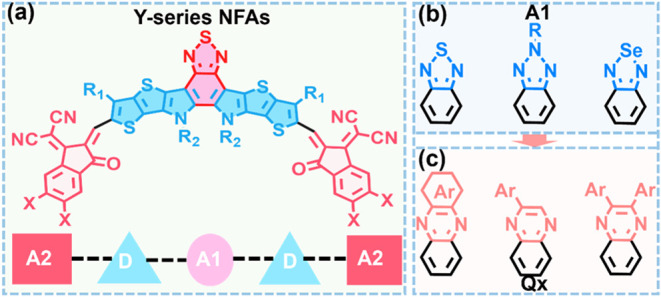 Figure 1
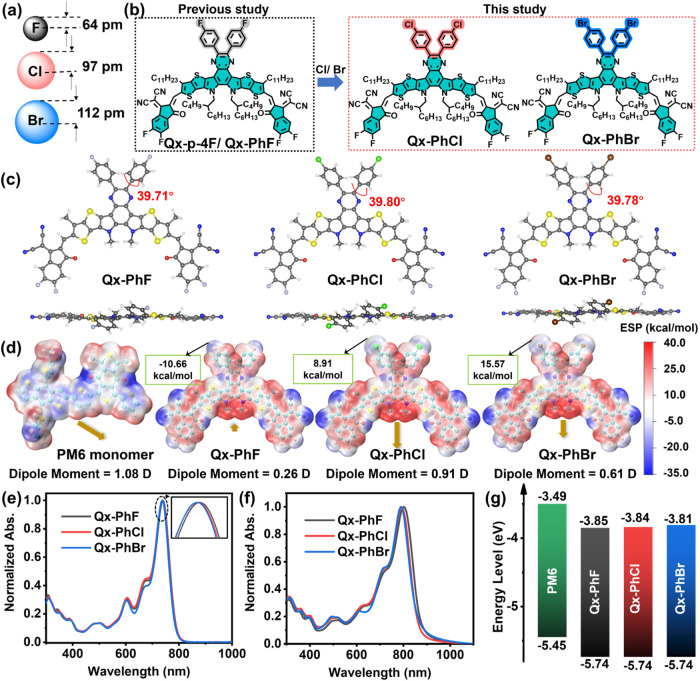 Figure 2
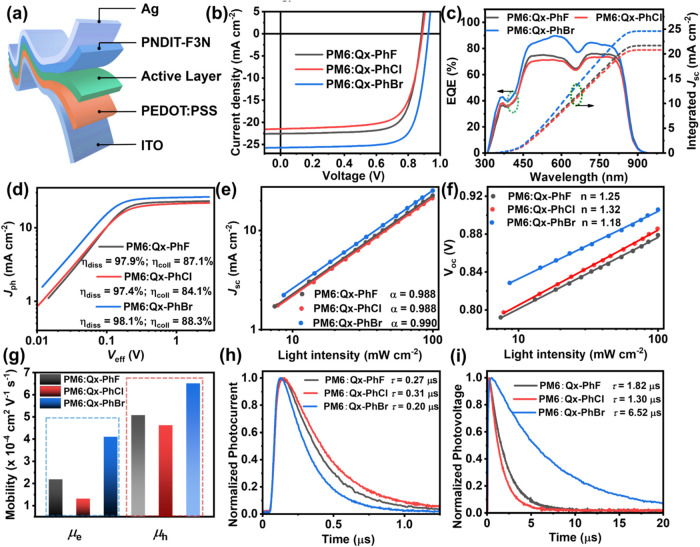 Figure 3
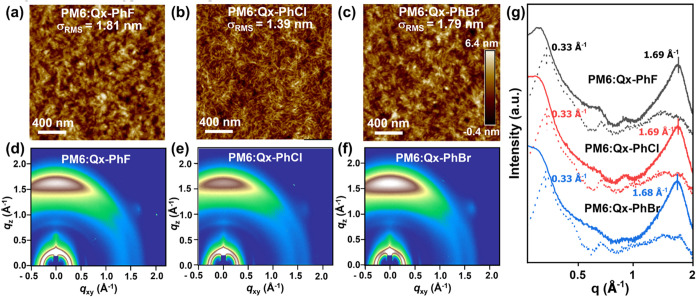 Figure 4
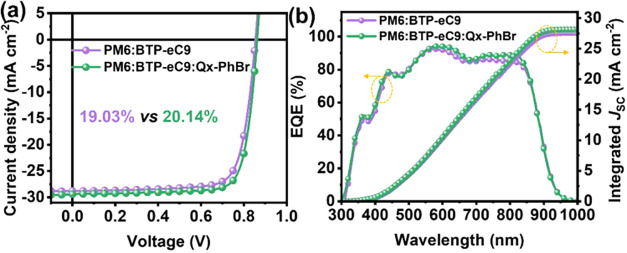 Figure 5
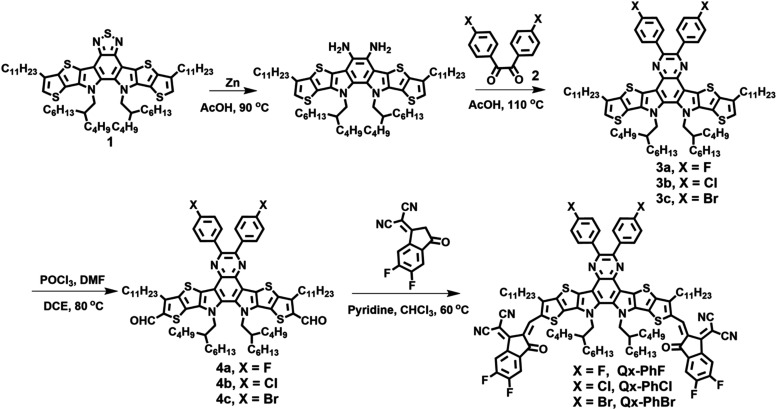 Figure 6
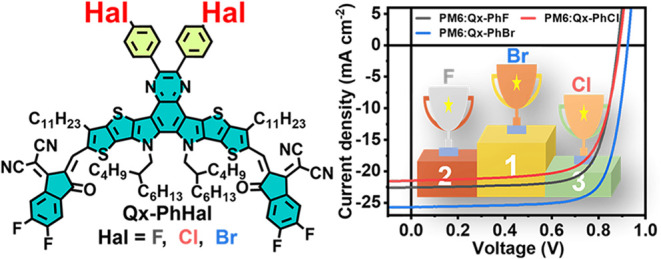 Figure 7
 Figure 8
Peer Reviews
No public reviews on file for this paper yet. If you reviewed it on a platform where reviews are public (OpenReview, ICLR, NeurIPS, ICML), you can paste yours below so the community can read it here.
Videos
No videos yet. Explain this paper in a talk, walkthrough, or lecture? Add one.
Taxonomy
TopicsOrganic Electronics and Photovoltaics · Perovskite Materials and Applications · Conducting polymers and applications