Evaluation of drug-induced lymphocyte stimulation test in mesalazine-associated allergic drug reaction
Naoto Fukasawa, Hiroki Kiyohara, Takeya Adachi, Shinya Sugimoto, Yusuke Yoshimatsu, Soichiro Murakami, Ichiro Mizushima, Yuta Kaieda, Kaoru Takabayashi, Junya Tsunoda, Nobuhiro Nakamoto, Koichi Fukunaga, Masataka Taguri, Yohei Mikami, Takanori Kanai

TL;DR
This study evaluates the drug-induced lymphocyte stimulation test (DLST) to predict successful treatment rotation in patients with ulcerative colitis experiencing adverse reactions to mesalazine.
Contribution
The study provides the largest cohort analysis of DLST for predicting mesalazine hypersensitivity and treatment rotation outcomes.
Findings
Mesalazine formulations showed a 22.0% DLST positivity rate, with 45.1% of patients positive for at least one 5-ASA formulation.
Cross-reactivity between mesalazine and SASP was low at 12.2%, likely due to structural differences.
DLST-negative patients had an 8/12 success rate in tolerating rotation to SASP, while failures were linked to positive DLST results.
Abstract
5-Aminosalicylic acid (5-ASA) is a fundamental drug for UC management; however, adverse reactions can lead to poor clinical outcomes and increased health care costs. No objective tests currently exist to predict adverse reactions. This study thus investigated 5-ASA across 4 formulations and addressed a key issue in the treatment of mild to moderate ulcerative colitis (UC). We aimed to examine the utility of the drug-induced lymphocyte stimulation test (DLST) in predicting successful rotation from mesalazine to sulfasalazine (SASP) in patients with UC. We retrospectively analyzed the largest cohort to date of patients with UC who were suspected of 5-ASA–associated adverse reactions and underwent DLST. We evaluated the DLST positivity rate for the suspected formulation, cross-reactivity to nonsuspected formulations, and clinical outcomes after rotation from mesalazine to SASP.…
Genes, proteins, chemicals, diseases, species, mutations and cell lines named across the full text — each resolved to its canonical identifier and authoritative record.
Click any figure to enlarge with its caption.
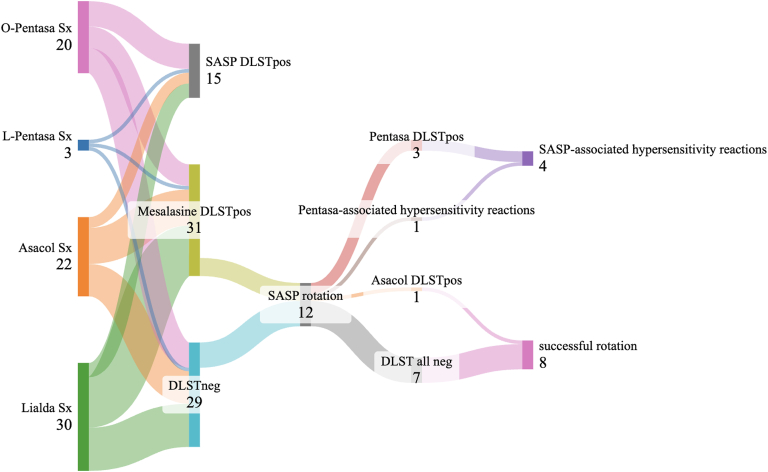 Figure 1
Peer Reviews
No public reviews on file for this paper yet. If you reviewed it on a platform where reviews are public (OpenReview, ICLR, NeurIPS, ICML), you can paste yours below so the community can read it here.
Videos
No videos yet. Explain this paper in a talk, walkthrough, or lecture? Add one.
Taxonomy
TopicsDrug-Induced Adverse Reactions · Food Allergy and Anaphylaxis Research · Mast cells and histamine