Validity and reliability of the French version of the quick‐FAAM (Q‐FAAM‐F) among patients undergoing anatomic ankle ligament reconstruction
Ibrahim Saliba, Olivier Grimaud, Vincent Fontanier, Brice Picot, Frederic Khiami, Gregoire Rougereau, Yoann Bohu, Nicolas Lefevre, Alexandre Hardy

TL;DR
The French version of the Quick Foot and Ankle Ability Measure is valid and reliable for assessing patients with ankle instability after surgery.
Contribution
The study confirms the validity and reliability of the French version of the Q-FAAM for chronic lateral ankle instability patients.
Findings
The Q-FAAM-F showed excellent internal consistency (α = 0.96) and strong correlations with other validated measures.
High ROC AUC values indicate the Q-FAAM-F can effectively distinguish between patients with residual instability and those who have returned to sport.
The study provides specific cut-off scores for clinical decision-making at six months post-surgery.
Abstract
To evaluate the validity and reliability of the French version of the Quick Foot and Ankle Ability Measure (Q‑FAAM‑F) in French‑speaking patients with chronic lateral ankle instability (CLAI). We conducted a prospective observational cohort in a sports surgery centre with repeated assessments preoperatively, and at 3 and 6 months postoperatively; the primary analysis was cross‑sectional at 6 months. Consecutive CLAI patients undergoing anatomic lateral ankle ligament reconstruction (AALR) were included. Patients completed the Q‑FAAM‑F (12 items derived from the validated French FAAM) alongside the full FAAM, FAOS, ALR‑RSI, CAIT and VAS‑pain. Internal consistency (Cronbach's α), item–total and inter‑item correlations, and construct validity (Pearson's r) were calculated. Discriminant validity used ROC analyses for CLAI status (CAIT < 24) and return to sport (RTS), defined on the RTS…
Genes, proteins, chemicals, diseases, species, mutations and cell lines named across the full text — each resolved to its canonical identifier and authoritative record.
Click any figure to enlarge with its caption.
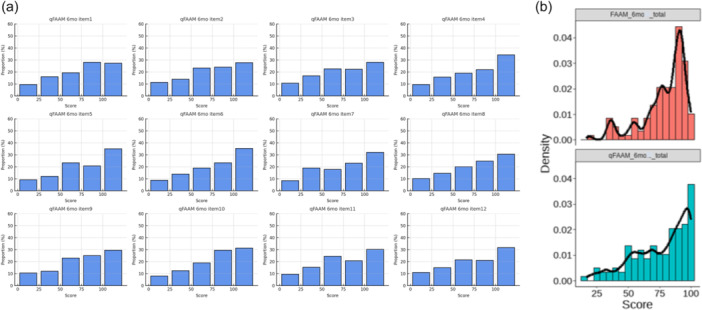 Figure 1
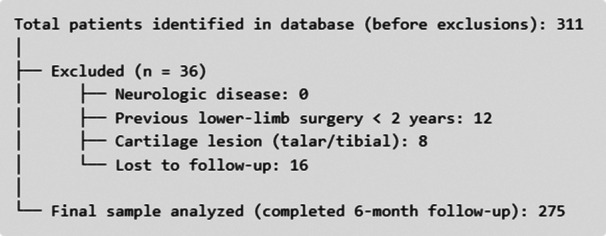 Figure 2
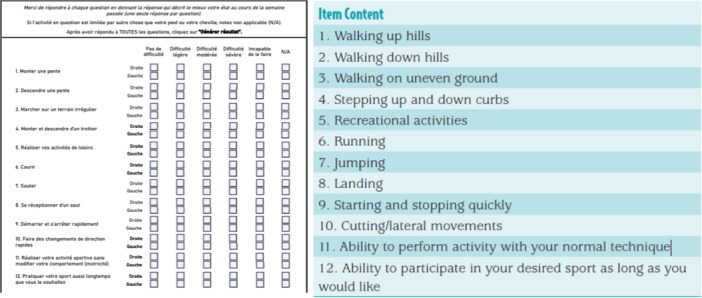 Figure 3
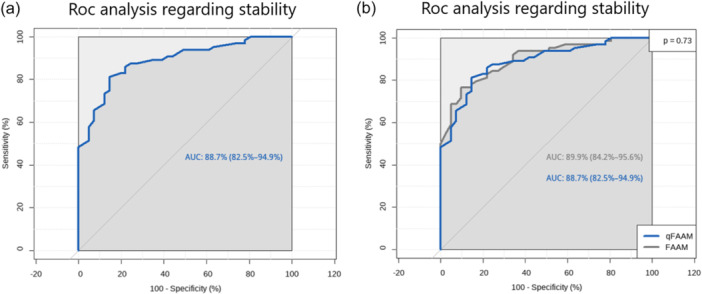 Figure 4
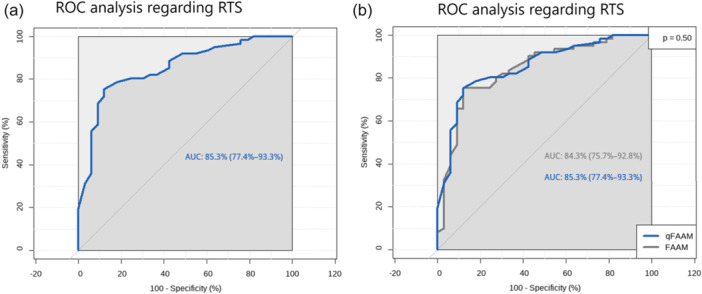 Figure 5
Peer Reviews
No public reviews on file for this paper yet. If you reviewed it on a platform where reviews are public (OpenReview, ICLR, NeurIPS, ICML), you can paste yours below so the community can read it here.
Videos
No videos yet. Explain this paper in a talk, walkthrough, or lecture? Add one.
Taxonomy
TopicsFoot and Ankle Surgery · Knee injuries and reconstruction techniques · Lower Extremity Biomechanics and Pathologies