Anterior cruciate ligament remnant morphology is associated with preoperative rotational knee instability: A multicenter cohort study
Nobuaki Hayashi, Shotaro Watanabe, Tsuyoshi Hamada, Manato Horii, Masahiko Saito, Yuta Muramatsu, Takuya Sakamoto, Yusuke Sato, Taisuke Fukawa, Ryuichiro Akagi, Takuro Moriya, Ryosuke Nakagawa, Seiji Kimura, Satoshi Yamaguchi, Seiji Ohtori, Takahisa Sasho

TL;DR
This study finds that the shape of the remaining anterior cruciate ligament after injury is linked to knee instability before surgery, especially for rotational movement.
Contribution
The study demonstrates a novel association between ACL remnant morphology and rotational knee instability after adjusting for multiple preoperative factors.
Findings
Crain Type 3 ACL remnants were associated with lower odds of high-grade pivot shift compared to Type 4.
Lateral meniscal tears and Tegner Activity Scale score were significant predictors of high-grade Lachman test results.
Rotational instability was more strongly associated with ACL remnant morphology than with other preoperative factors.
Abstract
To investigate the association between anterior cruciate ligament (ACL) remnant morphology, classified by Crain, and preoperative rotational knee instability after adjusting for preoperative and anatomical factors including time from injury to surgery and meniscal status. It was hypothesised that remnant morphology would be associated with rotational knee instability. This retrospective multicenter cohort study was conducted between October 2022 and June 2025. Arthroscopic assessment categorised ACL remnants according to the Crain classification. Under anaesthesia, the Lachman and pivot‐shift tests were graded and dichotomised as high‐grade or low‐grade. Univariate comparisons were performed using the chi‐square test. Multivariate logistic regression identified predictors of high‐grade Lachman (L‐HG) and pivot‐shift (PS‐HG), adjusting for age, sex, body mass index, time from injury to…
Genes, proteins, chemicals, diseases, species, mutations and cell lines named across the full text — each resolved to its canonical identifier and authoritative record.
Click any figure to enlarge with its caption.
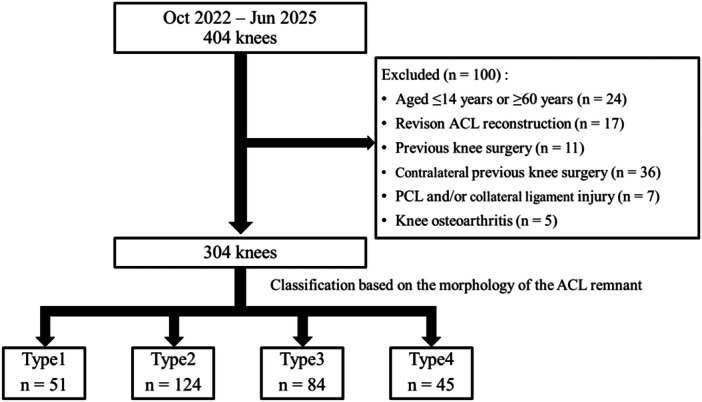 Figure 1
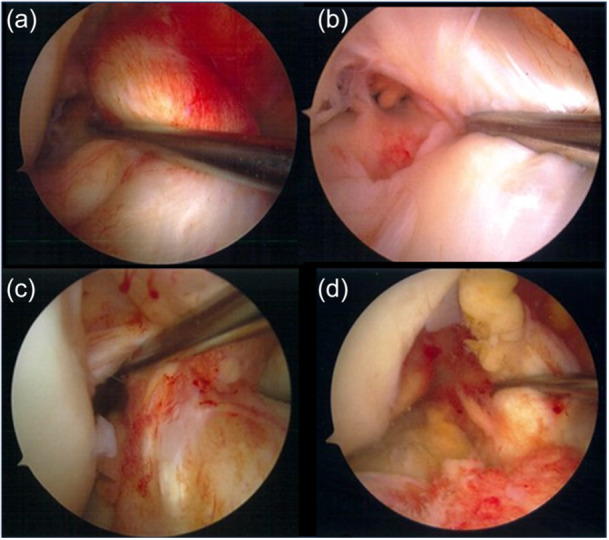 Figure 2
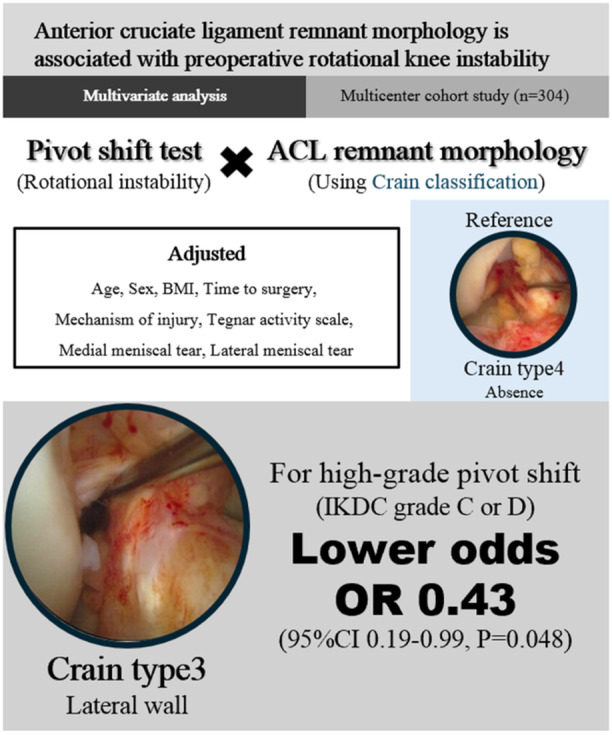 Figure 3
Peer Reviews
No public reviews on file for this paper yet. If you reviewed it on a platform where reviews are public (OpenReview, ICLR, NeurIPS, ICML), you can paste yours below so the community can read it here.
Videos
No videos yet. Explain this paper in a talk, walkthrough, or lecture? Add one.
Taxonomy
TopicsKnee injuries and reconstruction techniques · Total Knee Arthroplasty Outcomes · Shoulder Injury and Treatment