Mindfulness Level Influences the Frequency, Amplitude and Duration of Awake Bruxism Episodes During Standardised Mental Capacity Tasks
Rafael Chadud Matoso‐Filho, Caio Sberni Pinheiro Souza, Nykolas Jorge Silva Castaldi, Melissa Oliveira Melchior, Fabiane Carneiro Lopes‐Olhê, Simone Cecílio Hallak Regalo, Laís Valencise Magri, Jardel Francisco Mazzi‐Chaves

TL;DR
This study shows that people with awake bruxism have less adaptable jaw muscle activity during mental tasks, and higher mindfulness is linked to fewer and shorter bruxism episodes.
Contribution
The study introduces a novel link between dispositional mindfulness and the modulation of awake bruxism during cognitive tasks.
Findings
AB individuals showed persistent muscle activity across tasks, unlike controls who adapted to task complexity.
Higher mindfulness in AB participants correlated with fewer and shorter bruxism episodes, especially at higher muscle contraction thresholds.
Controls exhibited increased bruxism frequency at lower thresholds as task complexity increased.
Abstract
Awake bruxism (AB) is characterised by repetitive or sustained masticatory muscle activity during wakefulness, including clenching, grinding, or mandibular bracing. Recent consensus defines AB as a motor behaviour influenced by psychological and contextual factors. Among these, dispositional mindfulness may play a modulatory role in the frequency and intensity of AB episodes. This study aimed to evaluate how standardised cognitive tasks of varying complexity modulate awake bruxism (AB) and to investigate whether dispositional mindfulness is associated with the frequency, duration, and amplitude of AB episodes measured by surface electromyography. A cross‐sectional study was conducted with 68 dental students (18–40 years) from the School of Dentistry of Ribeirão Preto, University of São Paulo. Participants were classified into AB and control groups based on self‐report and Ecological…
Genes, proteins, chemicals, diseases, species, mutations and cell lines named across the full text — each resolved to its canonical identifier and authoritative record.
Click any figure to enlarge with its caption.
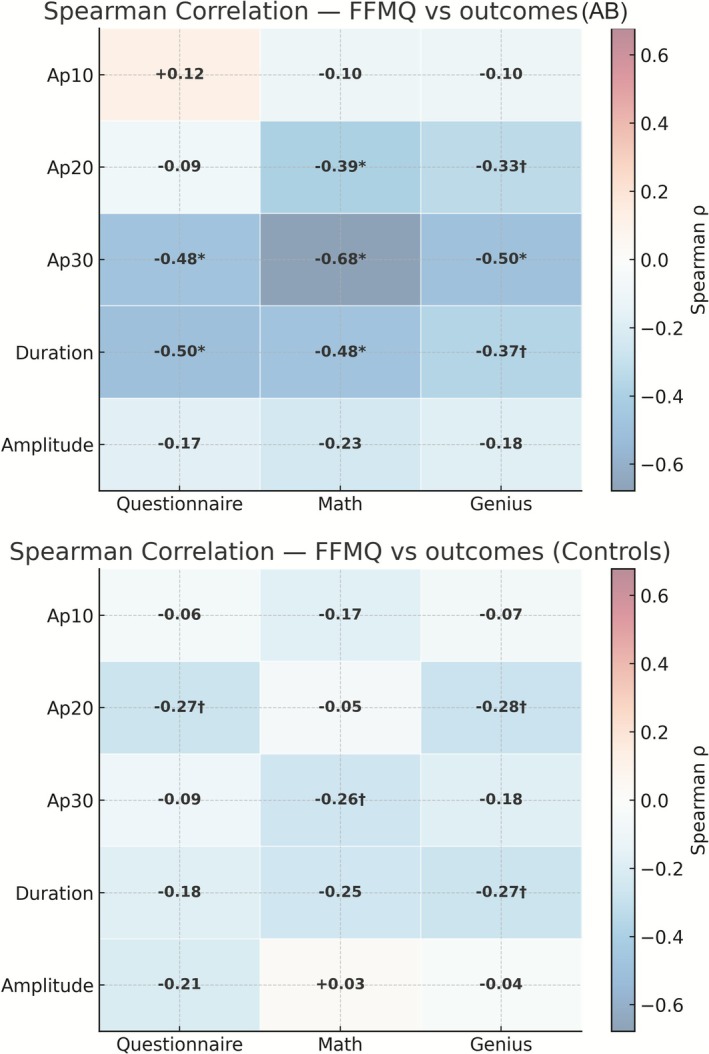 Figure 1
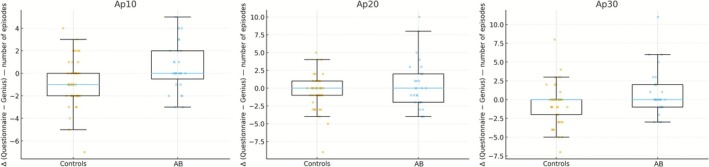 Figure 2
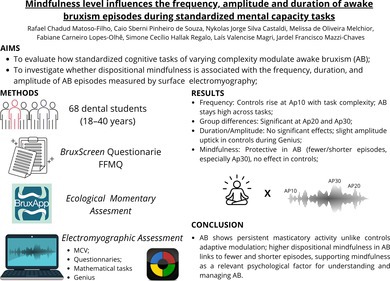 Figure 3
Peer Reviews
No public reviews on file for this paper yet. If you reviewed it on a platform where reviews are public (OpenReview, ICLR, NeurIPS, ICML), you can paste yours below so the community can read it here.
Videos
No videos yet. Explain this paper in a talk, walkthrough, or lecture? Add one.
Taxonomy
TopicsTemporomandibular Joint Disorders · Musicians’ Health and Performance · Pain Mechanisms and Treatments