Prevalence of Emotional Factors and Pain in Temporomandibular Disorder and Correlation With Different Diagnoses: A Cross‐Sectional Study
Gabriela Caovilla Felin, Cassiano Mateus Forcelini, Alvaro Della Bona

TL;DR
This study finds that emotional factors and pain are common in temporomandibular disorder, particularly in women, and are linked to quality of life and jaw function.
Contribution
The study reports the prevalence of emotional factors in TMD and their correlation with pain and jaw function in a South American population.
Findings
Emotional factors and pain are highly prevalent in TMD patients, especially among women.
Psychological factors did not differ significantly across TMD subtypes but were common.
Women showed higher pain levels and more functional limitations compared to men.
Abstract
Temporomandibular disorder (TMD) is a leading cause of orofacial pain, often associated with psychosocial factors that affect quality of life. Although these factors are well documented, the association with pain intensity and jaw function remains understudied. This cross‐sectional observational study aimed to report the prevalence of emotional factors in patients with TMD and to correlate TMD with psychological factors, pain intensity and functional limitation of the jaw in a sample of the regional population. This study used data from a TMD outpatient clinic in South America. Assessments included the DC‐TMD, chronic pain scale, GAD‐7 (anxiety), PHQ‐9 (depression), PHQ‐15 (somatic symptoms) and JFLS‐8 (jaw function) instruments. Sociodemographic data and the diagnosis of TMD were also reported. Data were statistically analysed using Kolmogorov–Smirnov, two‐tailed chi‐square, Fisher's…
Genes, proteins, chemicals, diseases, species, mutations and cell lines named across the full text — each resolved to its canonical identifier and authoritative record.
Click any figure to enlarge with its caption.
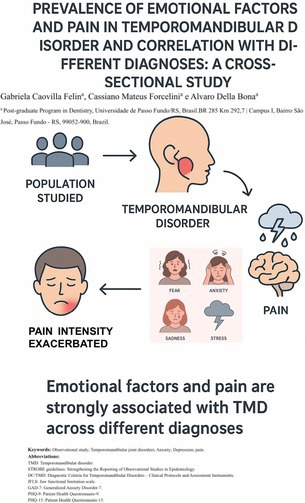 Figure 1
Peer Reviews
No public reviews on file for this paper yet. If you reviewed it on a platform where reviews are public (OpenReview, ICLR, NeurIPS, ICML), you can paste yours below so the community can read it here.
Videos
No videos yet. Explain this paper in a talk, walkthrough, or lecture? Add one.
Taxonomy
TopicsTemporomandibular Joint Disorders · Pain Mechanisms and Treatments · Botulinum Toxin and Related Neurological Disorders