Early Surgery or Conservative Management for Adhesive Small Bowel Obstruction: A Comprehensive Systematic Review of Short- and Long-Term Outcomes
Fahd Al Abbood, Omar Altamimi, Ibrahim Altamimi, AlJouhrah M AlAbdullah, Fatimah A Alkhars, Abdulrahim Bamagos, Rawiyah A Alkabkabi, Rahaf A Alharthi, Abdulkreem Al-Juhani

TL;DR
This study compares early surgery versus conservative treatment for adhesive small bowel obstruction, finding that while non-operative management is safe in the short term, early surgery reduces long-term recurrence.
Contribution
The study provides a comprehensive systematic review comparing long-term outcomes of early surgery versus conservative management for adhesive small bowel obstruction.
Findings
Non-operative management in stable adults has comparable short-term outcomes to early surgery but increases recurrence risk.
Early surgery reduces long-term recurrence by 40-60% compared to conservative management.
In infants under one year, conservative management is less effective, with higher surgery rates if delayed beyond 48 hours.
Abstract
Adhesive small bowel obstruction (aSBO) is a common cause of emergency surgical admission, and the optimal initial management between early surgery and conservative non-operative management (NOM) remains debated, particularly regarding recurrence and short-term safety. This systematic review aimed to evaluate short- and long-term outcomes of early operative management compared with conservative treatment for aSBO in adult and paediatric populations. A systematic search of MEDLINE, Embase, Scopus, and Cochrane CENTRAL was conducted from inception to 2025 in accordance with PRISMA guidelines. Nine studies were included. In stable adults, NOM was generally safe with comparable short-term complication and mortality rates to early surgery; however, prolonged delays following NOM failure were associated with increased morbidity and bowel resection. Long-term outcomes consistently favoured…
Genes, proteins, chemicals, diseases, species, mutations and cell lines named across the full text — each resolved to its canonical identifier and authoritative record.
Click any figure to enlarge with its caption.
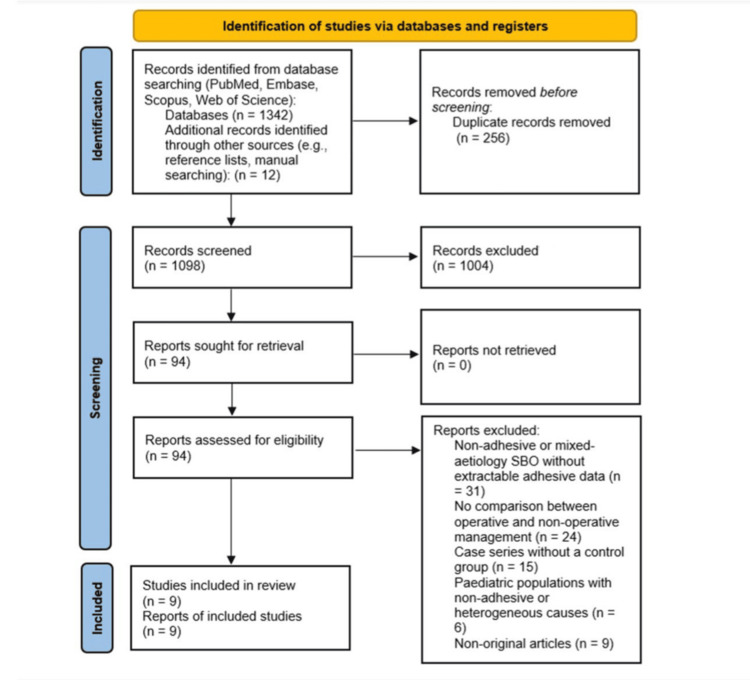 Figure 1
Peer Reviews
No public reviews on file for this paper yet. If you reviewed it on a platform where reviews are public (OpenReview, ICLR, NeurIPS, ICML), you can paste yours below so the community can read it here.
Videos
No videos yet. Explain this paper in a talk, walkthrough, or lecture? Add one.
Taxonomy
TopicsIntestinal and Peritoneal Adhesions · Appendicitis Diagnosis and Management · Biliary and Gastrointestinal Fistulas