Enhancing Description and Interpretation of Qualitative Interviews With People With Intellectual Disabilities Through Nonverbal and Paraverbal Data Collection and Analysis
Lynette Harper, Rob Burton, Ian Walshe, Ann Ooms

TL;DR
This paper introduces a method to enhance qualitative research with people with intellectual disabilities by analyzing nonverbal and paraverbal communication alongside verbal data.
Contribution
The paper presents a novel method for transcribing and analyzing nonverbal and paraverbal data to enrich qualitative research outcomes.
Findings
Nonverbal and paraverbal data added depth and accuracy to the interpretation of participants' experiences.
Triangulating verbal, nonverbal, and paraverbal data revealed new insights and expanded understanding.
Using symbols and descriptions to capture nonverbal communication improved the richness of research data.
Abstract
Qualitative research involving interviews typically includes transcribing verbal data. However, insights about meaning can also be ascertained from nonverbal and paraverbal communications. Transcribing nonverbal data allows researchers to include and analyze this additional data whilst ensuring participants' confidentiality. Six participants with intellectual disabilities were interviewed using Talking Mats as a communication tool to support data collection. The verbal, nonverbal, and paraverbal data were transcribed using a notation system and analysed using triangulation. Most of the nonverbal communications corroborated the spoken word; however, nonverbal and paraverbal communication also captured additional information, which added depth, shared understanding, and expanded the insights into the research process or refuted the spoken word, which in turn provided new insights. This…
Genes, proteins, chemicals, diseases, species, mutations and cell lines named across the full text — each resolved to its canonical identifier and authoritative record.
Click any figure to enlarge with its caption.
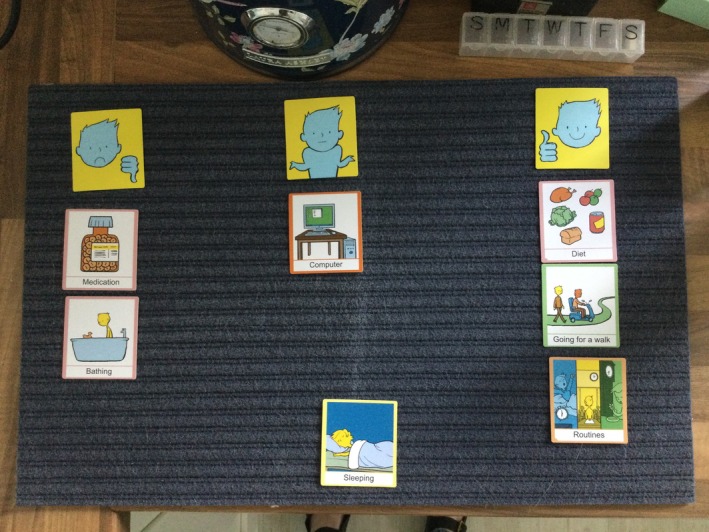 Figure 1
Peer Reviews
No public reviews on file for this paper yet. If you reviewed it on a platform where reviews are public (OpenReview, ICLR, NeurIPS, ICML), you can paste yours below so the community can read it here.
Videos
No videos yet. Explain this paper in a talk, walkthrough, or lecture? Add one.
Taxonomy
TopicsDown syndrome and intellectual disability research · Assistive Technology in Communication and Mobility · Hearing Impairment and Communication