Neoadjuvant endocrine therapy with sequential palbociclib and chemotherapy based on Ki67 status in stage II-III breast cancer: An open-label, phase II study
Christina Engebrethsen, Synnøve Yndestad, Mari E. Rasmussen, Emiel A.M. Janssen, Bjørnar Gilje, Egil S. Blix, Helge Espelid, Steinar Lundgren, Jürgen Geisler, Laura Minsaas, Reidun Lillestøl, Hildegunn S. Aase, Turid Aas, Per E. Lønning, Hans P. Eikesdal, Stian Knappskog

TL;DR
This study shows that combining endocrine therapy with palbociclib can effectively reduce tumor activity in most patients with certain breast cancers, avoiding chemotherapy for many.
Contribution
The study introduces a sequential treatment strategy using Ki67 response to guide adding palbociclib or chemotherapy in hormone receptor-positive breast cancer.
Findings
82% of patients achieved more than 50% Ki67 reduction after sequential endocrine therapy with or without palbociclib.
70% of patients achieved an objective pre-surgical response with the treatment strategy.
61% of patients completed neoadjuvant treatment without needing chemotherapy.
Abstract
While neoadjuvant endocrine therapy (NET), with or without a CDK4/6 inhibitor, is an established treatment option for estrogen receptor-positive breast cancers, optimal patient selection and second-line treatment for non-responders remain uncertain. In the open-label, phase 2 PETREMAC trial (NCT02624973), pre- and postmenopausal patients with large T2 (>4 cm) or locally advanced ER/PGR>50 %, HER2-, and TP53 wild-type breast cancers received NET (tamoxifen + goserelin for premenopausal and letrozole for postmenopausal patients). Palbociclib was added if the Ki67 reduction was ≤50 % after 14 days. Neoadjuvant chemotherapy (NAC) was introduced if NET ± palbociclib failed to reduce Ki67 sufficiently or if there was no objective response on MRI after 24 weeks. Tumor biopsies underwent targeted sequencing of 360 cancer-related genes and subsequent gene expression profiling. Among 88…
Genes, proteins, chemicals, diseases, species, mutations and cell lines named across the full text — each resolved to its canonical identifier and authoritative record.
Click any figure to enlarge with its caption.
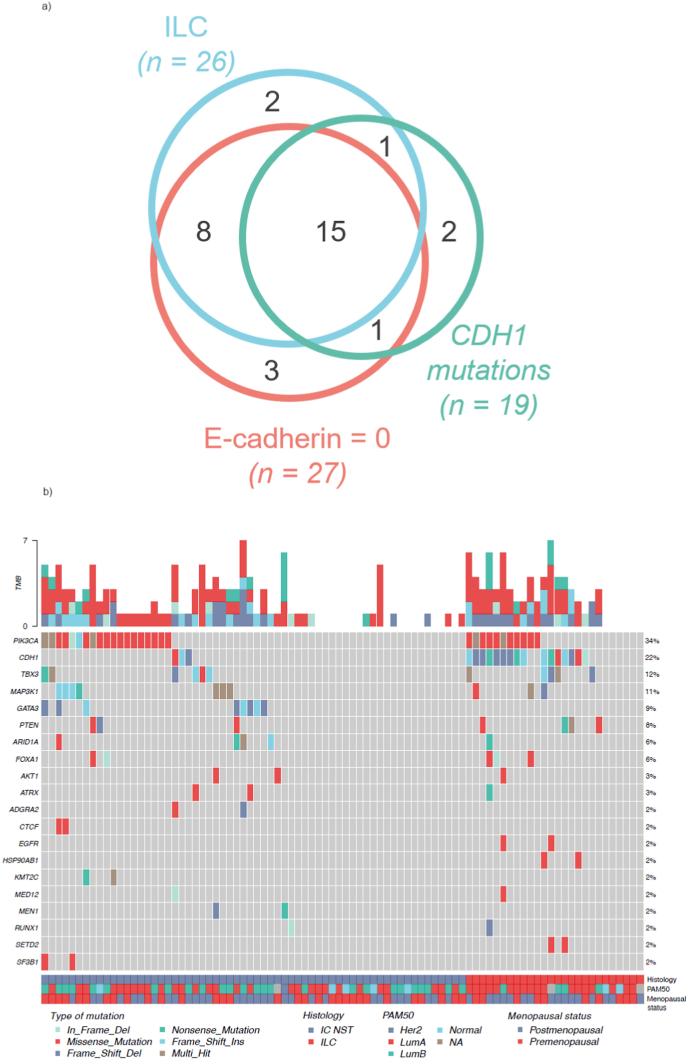 Figure 1
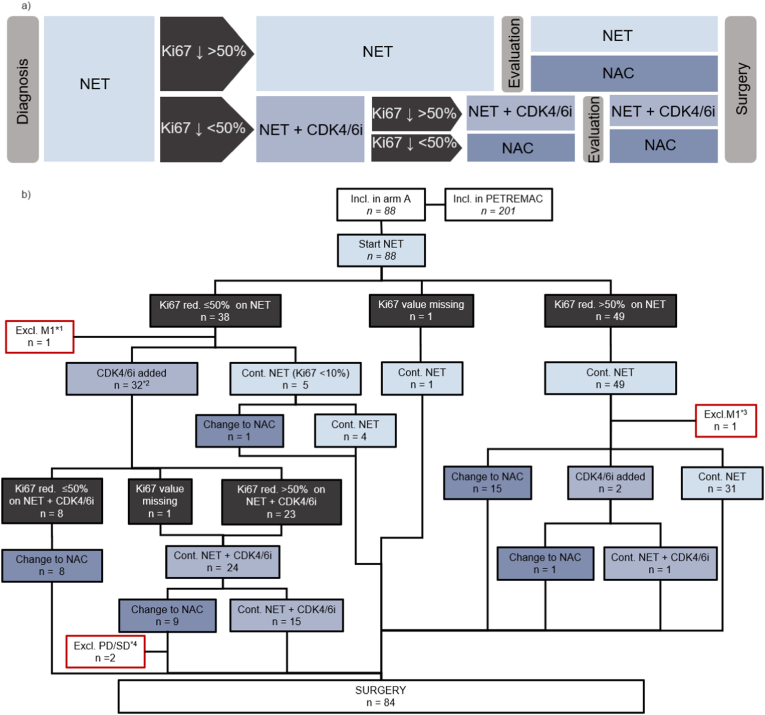 Figure 2
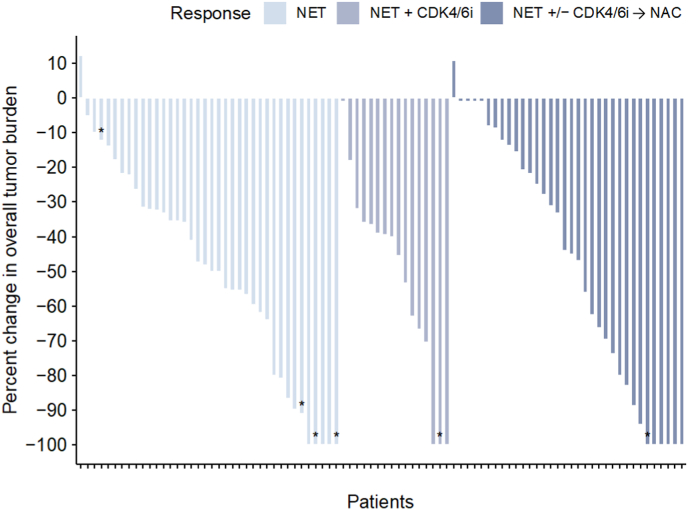 Figure 3
Peer Reviews
No public reviews on file for this paper yet. If you reviewed it on a platform where reviews are public (OpenReview, ICLR, NeurIPS, ICML), you can paste yours below so the community can read it here.
Videos
No videos yet. Explain this paper in a talk, walkthrough, or lecture? Add one.
Taxonomy
TopicsAdvanced Breast Cancer Therapies · Cancer-related Molecular Pathways · HER2/EGFR in Cancer Research