Diuretic resistance in cardiorenal syndrome: mechanisms, monitoring and phenotype-tailored management
Georgios Aletras, Maria Bachlitzanaki, Maria Stratinaki, Emmanuel Foukarakis, Ioannis Petrakis, Yannis Pantazis, Michalis Hamilos, Kostas Stylianou

TL;DR
This paper reviews the causes and management of diuretic resistance in heart failure patients, emphasizing tailored approaches based on patient phenotypes.
Contribution
The paper provides a comprehensive review of mechanisms, monitoring, and phenotype-specific strategies for managing diuretic resistance in cardiorenal syndrome.
Findings
Diuretic resistance is strongly linked to prolonged hospitalization and adverse outcomes in heart failure.
Impaired renal perfusion and chloride depletion are key contributors to diuretic resistance.
Phenotype-tailored strategies, including newer agents like SGLT2i and MRAs, can improve management of diuretic resistance.
Abstract
Congestion drives most hospitalizations for acute and chronic heart failure (HF), reflecting the pivotal role of sodium and water retention in disease progression. Loop diuretics remain the first-line decongestive therapy, yet up to one-third of patients exhibit an inadequate natriuretic response—defined as diuretic resistance (DR)—which is strongly associated with prolonged hospitalization, readmissions and adverse outcomes. DR is a multifactorial phenomenon arising from pharmacokinetic limitations, tubular adaptations, neurohormonal activation, and hemodynamic disturbances. Impaired renal perfusion, elevated venous pressures, and chloride depletion are key contributors that mutually reinforce one another and blunt diuretic efficacy. Early recognition through urinary sodium measurement and urine output monitoring is essential to guide therapy before resistance becomes entrenched.…
Genes, proteins, chemicals, diseases, species, mutations and cell lines named across the full text — each resolved to its canonical identifier and authoritative record.
Click any figure to enlarge with its caption.
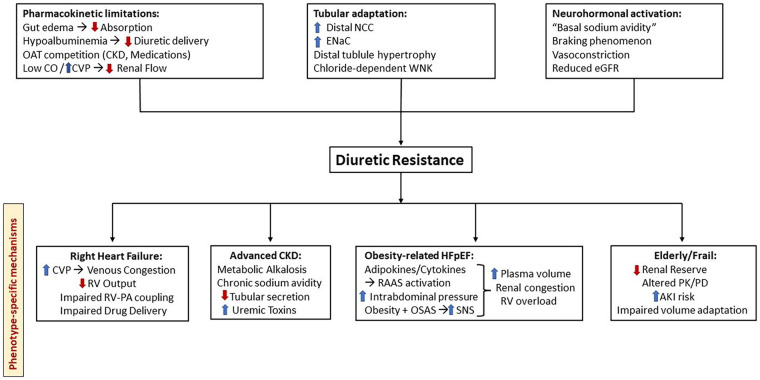 Figure 1
 Figure 2
Peer Reviews
No public reviews on file for this paper yet. If you reviewed it on a platform where reviews are public (OpenReview, ICLR, NeurIPS, ICML), you can paste yours below so the community can read it here.
Videos
No videos yet. Explain this paper in a talk, walkthrough, or lecture? Add one.
Taxonomy
TopicsHeart Failure Treatment and Management · Electrolyte and hormonal disorders · Acute Kidney Injury Research