Association between insulin resistance and coronary microcirculatory function and adverse cardiovascular events after PCI in non-diabetic STEMI patients
Jinrong Zhong, Liming Tang, Yuanfeng Zhang

TL;DR
This study finds that insulin resistance in non-diabetic heart attack patients is linked to poor coronary microcirculation and higher risk of future heart problems.
Contribution
The study establishes a novel link between insulin resistance and microcirculatory dysfunction in non-diabetic STEMI patients.
Findings
Higher HOMA-IR levels correlate with increased IMR and decreased CFR in non-diabetic STEMI patients.
Elevated HOMA-IR is an independent predictor of microcirculatory dysfunction and MACE after PCI.
Patients with higher insulin resistance have a significantly higher 1-year MACE incidence.
Abstract
Hyperglycemia and insulin resistance (IR) are common in patients with acute ST-segment elevation myocardial infarction (STEMI). However, the impact of IR on coronary microcirculatory function in non-diabetic STEMI patients remains unclear. This study aimed to investigate the relationship between IR and coronary microcirculation function and the incidence of major adverse cardiovascular events (MACE) at one year after Percutaneous Coronary Intervention (PCI) in non-diabetic STEMI patients. A total of 298 non-diabetic STEMI patients who underwent emergency PCI between 2022 and 2024 were retrospectively enrolled. Patients were divided into low, medium, and high groups based on Homeostasis Model Assessment of Insulin Resistance (HOMA-IR tertiles). Coronary microcirculation function was assessed using the index of microcirculatory resistance (IMR) and coronary flow reserve (CFR). IMR, CFR,…
Genes, proteins, chemicals, diseases, species, mutations and cell lines named across the full text — each resolved to its canonical identifier and authoritative record.
Click any figure to enlarge with its caption.
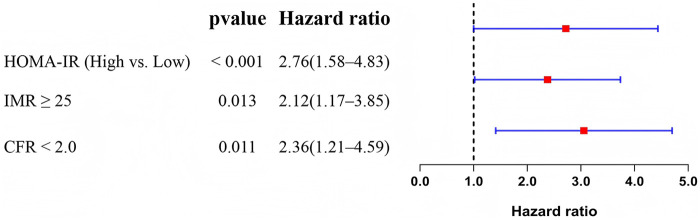 Figure 1
| Variable | Low HOMA-IR ( | Medium HOMA-IR ( | High HOMA-IR ( | F/ | |
|---|---|---|---|---|---|
| Age (years) | 60.2 | 61.4 | 62.1 | 0.80 | 0.426 |
| Male (%) | 72 (72.7%) | 74 (74.0%) | 75 (75.8%) | 0.25 | 0.882 |
| BMI (kg/m2) | 24.8 | 25.1 | 25.6 | 0.83 | 0.412 |
| Smoking history (%) | 51 (51.5%) | 55 (55.0%) | 56 (56.6%) | 0.46 | 0.633 |
| Hypertension (%) | 46 (46.5%) | 50 (50.0%) | 52 (52.5%) | 0.62 | 0.537 |
| Admission glucose (mmol/L) | 6.1 | 6.3 | 6.5 | 1.08 | 0.281 |
| HbA1c(%) | 5.7 | 5.8 | 5.9 | 0.89 | 0.372 |
| Total cholesterol (mmol/L) | 4.3 | 4.5 | 4.6 | 0.97 | 0.334 |
| LDL-C (mmol/L) | 2.6 | 2.7 | 2.8 | 1.06 | 0.291 |
| Creatinine (μmol/L) | 83.2 | 85.1 | 86.7 | 0.82 | 0.439 |
| LVEF (%) | 53.4 | 52.8 | 52.2 | 0.73 | 0.468 |
| Indicator | Low HOMA-IR ( | Medium HOMA-IR ( | High HOMA-IR ( | Bonferroni comparison | ||
|---|---|---|---|---|---|---|
| IMR | 21.8 ± 7.2 | 25.7 ± 8.4 | 29.6 ± 9.1 | 14.89 | <0.001 | High > Medium ( |
| CFR | 21.8 ± 7.2 | 2.39 ± 0.51 | 2.01 ± 0.49 | 22.17 | <0.001 | High < Medium ( |
| Indicator | Correlation coefficient ( | Direction | Clinical interpretation | |
|---|---|---|---|---|
| HOMA-IR vs. IMR | 0.436 | < 0.001 | Positive | Higher HOMA-IR → Higher microvascular resistance |
| HOMA-IR vs. CFR | −0.408 | < 0.001 | Negative | Higher HOMA-IR → Lower coronary flow reserve |
| Dependent variable | Independent variable | Adjusted factors | OR | 95% CI | |
|---|---|---|---|---|---|
| IMR ≥ 25 | HOMA-IR (High vs. Low) | Age, sex, LVEF, Killip class | 2.84 | 1.52–5.29 | 0.001 |
| CFR < 2.0 | HOMA-IR (High vs. Low) | Age, sex, LVEF, Killip class | 2.41 | 1.28–4.55 | 0.006 |
| HOMA-IR group | MACE cases (%) | All-cause death | Recurrent MI | HF hospitalization | Revascularization |
|---|---|---|---|---|---|
| Low | 13 (13.1%) | 3 | 2 | 5 | 3 |
| Medium | 21 (21.0%) | 6 | 4 | 9 | 2 |
| High | 32 (32.3%) | 9 | 6 | 12 | 5 |
| Variable | HR | 95% CI | |
|---|---|---|---|
| HOMA-IR (High vs. Low) | 2.76 | 1.58–4.83 | <0.001 |
| IMR ≥ 25 | 2.12 | 1.17–3.85 | 0.013 |
| CFR < 2.0 | 2.36 | 1.21–4.59 | 0.011 |
Peer Reviews
No public reviews on file for this paper yet. If you reviewed it on a platform where reviews are public (OpenReview, ICLR, NeurIPS, ICML), you can paste yours below so the community can read it here.
Videos
No videos yet. Explain this paper in a talk, walkthrough, or lecture? Add one.
Taxonomy
TopicsAcute Myocardial Infarction Research · Blood properties and coagulation · Sepsis Diagnosis and Treatment
Introduction
1
Acute ST-segment elevation myocardial infarction (STEMI) is a severe form of acute coronary syndrome characterized by rapid onset and high mortality. Emergency percutaneous coronary intervention (PCI) has been widely adopted to reduce the extent of myocardial necrosis and improve both short- and long-term outcomes (1–4). However, even after successful recanalization of the infarct-related artery, a substantial proportion of patients still experience coronary microcirculatory dysfunction post-PCI. This is often manifested as poor myocardial perfusion or the no-reflow phenomenon, which significantly compromises therapeutic efficacy (5–7). Coronary microvascular dysfunction is not only a critical pathophysiological mechanism but has also been strongly associated with adverse cardiovascular events (MACE) following PCI (8).
In recent years, studies have shown that insulin resistance (IR) is prevalent not only in diabetic populations but also in non-diabetic patients with acute myocardial infarction. Moreover, the underlying metabolic disturbances associated with IR may exacerbate ischemia-reperfusion injury and further impair microvascular function (9–11). Although IR is common among STEMI patients, its impact on coronary microcirculation and clinical outcomes has not been thoroughly studied. Particularly in non-diabetic individuals, the clinical significance of “latent IR” has been underrecognized, underscoring the need for further exploration through both mechanistic and retrospective clinical investigations (12–14).
It is worth noting that although some studies suggest that IR may affect coronary perfusion and myocardial repair through various mechanisms (15), systematic research on the relationship between IR, microcirculatory function, and clinical prognosis in non-diabetic STEMI patients remains limited. This study addresses this gap with several innovative aspects. First, it focuses specifically on non-diabetic STEMI patients, thereby eliminating confounding effects of diabetes and its treatments on insulin metabolism and vascular function, and allowing a more accurate assessment of true IR as reflected by the Homeostasis Model Assessment of Insulin Resistance (HOMA-IR) index. Second, the study uses the index of microcirculatory resistance (IMR) and coronary flow reserve (CFR) for evaluation, which are more sensitive and quantitative than traditional TIMI flow grading, providing a more precise assessment of microcirculatory perfusion post-PCI. Third, by examining both immediate microcirculatory function and 1-year MACE during follow-up, the study offers a comprehensive view of the short-term pathophysiology and long-term clinical outcomes associated with IR, adding practical clinical relevance.
Therefore, this study retrospectively enrolled non-diabetic STEMI patients who underwent emergency PCI between 2022 and 2024. IR status was assessed using the HOMA-IR index. We investigated the association between IR and post-PCI coronary microcirculation (as measured by IMR and CFR), as well as 1-year MACE. Multivariate logistic regression and Cox proportional hazards models were used to determine whether IR is an independent predictor of microvascular dysfunction and adverse cardiovascular outcomes, with the aim of providing clinical evidence for early risk stratification and individualized intervention strategies in this patient population.
Methods
2
Study design and participants
2.1
This was a single-center, retrospective cohort study. A total of 298 hospitalized patients diagnosed with STEMI who underwent emergency PCI at our hospital between January 2022 and December 2024 were enrolled.
Inclusion criteria: (1) STEMI was diagnosed by trained clinicians according to the Fourth Universal Definition of Myocardial Infarction; (2) completion of emergency PCI within 24 h of admission; (3) Fasting blood glucose and insulin measured within 48 h after admission were used to calculate the HOMA-IR index, minimizing the influence of stress hyperglycemia; (4) All patients were non-diabetic, with no history of diabetes or use of hypoglycemic agents; abnormal blood glucose (ABG) was defined as fasting glucose ≥7.0 mmol/L or random glucose ≥11.1 mmol/L according to the Fourth Universal Definition of Myocardial Infarction.
Exclusion criteria: (1) a prior diagnosis of diabetes or HbA1c ≥ 6.5%; (2) chronic inflammatory disease, malignancy, or renal insufficiency (eGFR < 30 mL/min·1.73 m^2^, calculated by the CKD-EPI equation); (3) Cardiogenic shock or need for mechanical circulatory support; prior myocardial infarction (MI), PCI, or CABG; emergency PCI for NSTEMI or variant angina; or unstable angina and elective angiography for stable CAD were excluded to ensure a homogeneous population of first-onset STEMI patients treated with emergency PCI; (4) incomplete clinical data or loss to follow-up.
Patients were stratified into three groups based on admission HOMA-IR (Homeostasis Model Assessment of Insulin Resistance) tertiles: low HOMA-IR group, medium HOMA-IR group, and high HOMA-IR group.
This study was conducted in accordance with the ethical principles of the Declaration of Helsinki and its amendments and was approved by the institutional ethics committee. All data were anonymized and used solely for academic research. The original data were obtained from the hospital's electronic medical records and coronary physiology measurement platform.
Measurement of variables and grouping
2.2
Fasting blood glucose (FBG) and fasting insulin (FINS) data were retrieved retrospectively from the hospital's electronic laboratory records. All tests had been performed as part of routine clinical assessments within 48 h of admission, according to standardized institutional laboratory procedures. Fasting venous blood samples, obtained the morning after admission following the hospital's standard fasting protocol (≥8 h), were used for laboratory analyses. Glucose and insulin were measured in the hospital's central laboratory using automated biochemical analyzers, and the results were expressed in mmol/L and μU/mL, respectively.
Values considered implausible (e.g., due to data entry or assay errors) were verified against original laboratory reports by two independent investigators before inclusion. The HOMA-IR index was calculated using the formula: The HOMA-IR index was calculated using the formula: HOMA-IR = FINS (μU/mL) × FBG (mmol/L)/22.5.
Immediately after PCI, coronary microcirculatory function was assessed using a pressure/temperature sensor-tipped guidewire (PressureWire X, Abbott, USA). The following parameters were measured: Index of Microcirculatory Resistance (IMR): calculated as distal coronary pressure multiplied by mean transit time; IMR ≥ 25 was defined as elevated microvascular resistance. Coronary Flow Reserve (CFR): defined as the ratio of hyperemic to baseline coronary blood flow; CFR < 2.0 was considered reduced microvascular reserve. All assessments were performed immediately after PCI by experienced technicians using a standard adenosine-induced hyperemia protocol.
Follow-up and observational indicators
2.3
All patients were followed for at least one year. Follow-up data were collected via outpatient visits or telephone interviews. MACE included all-cause death, recurrent myocardial infarction, rehospitalization for heart failure, and target vessel revascularization. The first occurrence of any of these events was recorded as MACE.
Primary study endpoints included: immediate post-PCI IMR and CFR values; presence of microcirculatory dysfunction (IMR ≥ 25 and/or CFR < 2.0); and incidence of MACE within one year.
Statistical analysis
2.4
All statistical analyses were performed using SPSS version 26.0 (IBM Corporation, USA). Continuous variables were tested for normality and expressed as mean ± standard deviation. One-way analysis of variance (ANOVA) was used for comparison among the three groups, with Bonferroni correction for pairwise comparisons. Categorical variables were presented as counts and percentages and compared using the chi-square test or Fisher's exact test as appropriate. Pearson correlation coefficients were used to assess linear relationships between HOMA-IR and IMR/CFR. Multivariate logistic regression was used to evaluate the predictive value of HOMA-IR for microcirculatory dysfunction (defined as IMR ≥ 25 and/or CFR < 2.0), with variables selected based on clinical relevance and univariate analysis results. Cox proportional hazards models were used to analyze the relationships between HOMA-IR, IMR, CFR, and 1-year MACE, with hazard ratios (HRs) and 95% confidence intervals (CIs) calculated after adjustment for potential confounders. A two-tailed P value < 0.05 was considered statistically significant.
Results
3
Baseline characteristics across HOMA-IR tertiles
3.1
A total of 298 non-diabetic STEMI patients were included in this study and divided into three groups based on HOMA-IR tertiles: low (n = 99), medium (n = 100), and high (n = 99). There were no statistically significant differences among the three groups in terms of age, sex, BMI, smoking history, hypertension, admission glucose, HbA1c, lipid profile, creatinine, or left ventricular ejection fraction (LVEF) (all P > 0.05), indicating good comparability across groups (Table 1).
Coronary microcirculatory function by HOMA-IR level
3.2
To explore the effect of insulin resistance on coronary microcirculatory function, we compared post-PCI IMR and CFR values among the three groups. IMR was significantly higher, and CFR significantly lower, in the high HOMA-IR group (P < 0.001 for both) (Table 2). Bonferroni post hoc comparisons revealed that IMR was significantly higher in the high HOMA-IR group than in the medium (P = 0.004) and low groups (P < 0.001). Similarly, CFR was significantly lower in the high group than in the other two (both P < 0.001), suggesting that higher IR is associated with increased microvascular resistance and decreased coronary flow reserve.
Correlation between HOMA-IR and microcirculatory parameters
3.3
We further analyzed the correlation between HOMA-IR and microvascular indicators. As shown in Table 3, HOMA-IR was significantly positively correlated with IMR (r = 0.436, P < 0.001), and negatively correlated with CFR (r = –0.408, P < 0.001). These findings support a strong association between higher IR and impaired coronary microcirculatory function.
Logistic regression: predictive value of HOMA-IR for microvascular dysfunction
3.4
Based on the established correlation between HOMA-IR and microcirculatory parameters, we further explored whether HOMA-IR serves as an independent predictor of coronary microvascular dysfunction. According to previous literature and clinical guidelines, IMR ≥ 25 and CFR < 2.0 were defined as the thresholds for microcirculatory dysfunction. Univariate analysis revealed that the incidence of dysfunction was significantly higher in the high HOMA-IR group (61.6%) than in the low HOMA-IR group (28.3%) (χ^2^ = 21.76, P < 0.001). After adjusting for age, sex, LVEF, and Killip classification, multivariate logistic regression showed that high HOMA-IR was an independent risk factor for elevated IMR (P = 0.001) and a significant predictor of reduced CFR (P = 0.006) (Table 4). These findings suggest that not only is insulin resistance linearly associated with microvascular injury, but its elevation is also an independent risk factor for coronary microcirculatory dysfunction, highlighting its potential value for clinical risk identification.
One-year MACE incidence and Its association with HOMA-IR
3.5
To further assess the impact of insulin resistance on long-term clinical outcomes, we conducted a 12-month follow-up for all three HOMA-IR groups to monitor MACE, including all-cause mortality, recurrent myocardial infarction (MI), heart failure hospitalization, and target vessel revascularization. As shown in Table 5, a total of 68 MACE events (22.8%) occurred during follow-up, including 18 deaths, 12 recurrent MIs, 26 heart failure hospitalizations, and 12 revascularizations. The incidence of MACE significantly differed among the three groups (χ^2^ = 14.82, P = 0.001), with the highest occurrence in the high HOMA-IR group. Kaplan–Meier survival curves demonstrated that patients in the high HOMA-IR group had the lowest event-free survival, and the difference was statistically significant (Log-rank P < 0.001). These results indicate that elevated HOMA-IR levels are associated with increased risk of MACE in non-diabetic STEMI patients within 1 year post-PCI and may serve as a potential biomarker for long-term risk stratification.
Cox regression analysis: HOMA-IR as an independent predictor of MACE
3.6
To determine whether HOMA-IR is an independent predictor of long-term adverse cardiovascular outcomes, we constructed a multivariate Cox proportional hazards model, adjusting for potential confounders including age, Killip class, LVEF, peak troponin levels, and pre-procedural TIMI flow grade. The analysis revealed that high HOMA-IR was an independent predictor of MACE (HR = 2.76, P < 0.001). In addition, IMR ≥ 25 (P = 0.013) and CFR < 2.0 (P = 0.011) were also independently associated with higher MACE risk (Table 6). These results underscore the prognostic value of HOMA-IR in non-diabetic STEMI patients and emphasize the importance of assessing coronary microvascular function in postoperative risk stratification. The multivariate Cox regression outcomes are visually summarized in Figure 1, showing that elevated HOMA-IR, IMR ≥ 25, and CFR < 2.0 were all independently associated with increased risk of MACE.
Forest plot of multivariate Cox regression analysis for predictors of 1-year major adverse cardiovascular events (MACE).
Discussion
4
This study demonstrated that in non-diabetic patients with STEMI, elevated insulin IR, as measured by HOMA-IR, was closely associated with coronary microcirculatory dysfunction after PCI. Specifically, higher HOMA-IR levels correlated with increased IMR and decreased CFR. Further analyses confirmed that HOMA-IR was an independent predictor of both microvascular dysfunction and 1-year MACE, indicating that IR has important prognostic implications even in the absence of overt diabetes.
Our findings highlight several potential pathophysiological mechanisms linking IR to microcirculatory dysfunction in non-diabetic STEMI patients. IR is known to reduce endothelial nitric oxide (NO) bioavailability and impair vasodilation, which may lead to coronary microvascular constriction and reperfusion deficits (16). Moreover, IR activates oxidative stress and the NF-κB signaling pathway, promoting the release of proinflammatory cytokines such as IL-6 and TNF-α, thereby exacerbating myocardial apoptosis and microvascular damage (17, 18). Elevated IR also increases levels of plasminogen activator inhibitor-1 (PAI-1) and enhances platelet aggregation, fostering a prothrombotic state that may hinder effective reperfusion and contribute to increased IMR and reduced CFR (19). Additionally, under insulin-resistant conditions, the myocardium shifts its primary energy source from glucose to fatty acids, which increases oxygen consumption and perpetuates a “metabolism-perfusion mismatch,” further impairing reperfusion quality and myocardial recovery (20, 21). Unlike previous studies that primarily focused on diabetic populations, our study is among the first to confirm these mechanisms' impact on microvascular function and clinical outcomes in non-diabetic individuals, underscoring the need to recognize and manage IR as a “hidden metabolic risk”.
This study suggests that HOMA-IR could serve as a potential biomarker for evaluating microvascular function and long-term prognosis in non-diabetic STEMI patients. In clinical practice, patients with elevated IR may benefit from early lifestyle interventions and possibly insulin-sensitizing therapies to improve microvascular perfusion and reduce MACE risk. Future research should focus on prospective interventional trials to evaluate the clinical benefits of targeting IR in STEMI populations. Furthermore, advanced imaging techniques such as cardiac MRI may help clarify the structural basis and evolution of microvascular dysfunction. The development of combined predictive models incorporating IR and other metabolic biomarkers (e.g., SII, NLR) also holds promise for future exploration.
Despite the important clinical implications of our findings, several limitations should be acknowledged. First, this was a single-center retrospective study, which may introduce selection bias and limit the generalizability of the results. Future multicenter prospective investigations are warranted to confirm these observations. Second, insulin resistance was assessed solely using the HOMA-IR index. Although this measure is widely accepted in clinical research, it is subject to assay variability and lacks the ability to track longitudinal changes over time. Third, detailed quantitative coronary angiographic data (e.g., the number of vessels with ≥50% stenosis or lesion complexity) were not systematically available, as the primary focus of this study was microcirculatory physiology rather than epicardial anatomy. Nonetheless, all included patients had angiographically confirmed culprit lesion occlusion consistent with STEMI, ensuring a homogeneous study population. Finally, noninvasive endothelial assessments (e.g., reactive hyperemia index), inflammatory markers (e.g., C-reactive protein, fibrinogen), and metabolic indicators (e.g., waist circumference, waist-to-hip ratio) were not analyzed, and the role of fractional flow reserve (FFR) in assessing stable plaques was beyond the study's scope. Future prospective studies integrating inflammatory, metabolic, endothelial, and angiographic parameters are needed to further elucidate the interplay among insulin resistance, endothelial dysfunction, and coronary microcirculatory impairment.
Conclusion
5
In summary, elevated HOMA-IR levels in non-diabetic patients with ST-segment elevation myocardial infarction (STEMI) were significantly associated with coronary microcirculatory dysfunction after PCI and predicted an increased risk of 1-year major adverse cardiovascular events (MACE). HOMA-IR was not only an independent predictor of microvascular impairment but also a strong indicator of long-term adverse prognosis. These findings emphasize the clinical importance of routine assessment of insulin resistance in non-diabetic patients and provide a potential reference for early risk stratification and individualized secondary prevention strategies in STEMI management.
The reference list from the paper itself. Each links out to its DOI / PubMed record.
- 1Mignatti A Echarte-Morales J Sturla M Latib A. State of the art of primary PCI: present and future. J Clin Med. (2025) 14(2):653. 10.3390/jcm 1402065339860658 PMC 11765626 · doi ↗ · pubmed ↗
- 2Guan J Xu Y Liu L Su M Ma J. Assessment of postoperative prognosis in patients with acute ST-segment elevation myocardial infarction after PCI using LRP 1. Front Cardiovasc Med. (2025) 12:1520696. 10.3389/fcvm.2025.152069640083817 PMC 11903468 · doi ↗ · pubmed ↗
- 3Ye Z Xu Y Tang L Wu M Wu B Zhu T Predicting long-term prognosis after percutaneous coronary intervention in patients with new onset ST-elevation myocardial infarction: development and external validation of a nomogram model. Cardiovasc Diabetol. (2023) 22(1):87. 10.1186/s 12933-023-01820-937055777 PMC 10103457 · doi ↗ · pubmed ↗
- 4Huang S Yu LJ Sun GF Zhang Z-X. Short-term predictive value of s ST 2 in patients with STEMI following primary PCI: a prospective observational study. BMC Cardiovasc Disord. (2025) 25(1):21. 10.1186/s 12872-025-04488-z 39819309 PMC 11737151 · doi ↗ · pubmed ↗
- 5Pantea-Roșan LR Pantea VA Bungau S Tit DM Behl T Vesa CM No-Reflow after PPCI—a predictor of short-term outcomes in STEMI patients. J Clin Med. (2020) 9(9):2956. 10.3390/jcm 909295632932736 PMC 7563881 · doi ↗ · pubmed ↗
- 6Li J Xie P Hu Y Zhou Y Zhao W Xu X Predictive value of combining angio-based Index of microcirculatory resistance and fractional flow reserve in patients with STEMI. Can J Cardiol. (2025) 41(7):1363–71. 10.1016/j.cjca.2025.02.00339922306 · doi ↗ · pubmed ↗
- 7Canu M Khouri C Marliere S Vautrin E Piliero N Ormezzano O Prognostic significance of severe coronary microvascular dysfunction post-PCI in patients with STEMI: a systematic review and meta-analysis. P Lo S One. (2022) 17(5):e 0268330. 10.1371/journal.pone.026833035576227 PMC 9109915 · doi ↗ · pubmed ↗
- 8Caullery B Riou L Marliere S Vautrin E Piliero N Ormerzzano O Prognostic impact of coronary microvascular dysfunction in patients with myocardial infarction evaluated by new angiography-derived index of microvascular resistance. Int J Cardiol Heart Vasc. (2025) 56:101575. 10.1016/j.ijcha.2024.10157539717159 PMC 11665694 · doi ↗ · pubmed ↗