Pre‐Activation as a Route for Tuning the Kinetics of Mechanochemical Transformations
Christian Heinekamp, Tahlia M. Palmer, Dominik Al‐Sabbagh, Anastasia May, Carsten Prinz, Stefan Michalik, Adam A. L. Michalchuk, Franziska Emmerling

TL;DR
Pre-activating certain starting materials can significantly speed up mechanochemical reactions and affect their outcomes.
Contribution
Selective pre-activation of reagents offers a new way to control mechanochemical reaction rates and polymorphic outcomes.
Findings
Pre-activation of the most stable reagent increases reaction rates by up to 10-fold.
Pre-activation of less stable reagents shows negligible kinetic enhancement.
Polymorphic outcomes in mechano-co-crystallization are sensitive to pre-activation.
Abstract
Learning to control reaction kinetics is essential for translating any chemical technology into real‐world application. Based on time‐resolved in situ powder X‐ray diffraction data, we demonstrate the opportunity to tune mechanochemical reaction rates through the pre‐activation of the starting reagents. For three model co‐crystal systems, the pre‐activation of the most stable reagent yields up to a ca 10‐fold increase in the reaction rate, whilst negligible kinetic enhancement is seen when the less stable reagent is pre‐activated. Moreover, we demonstrate how the polymorphic outcome of mechano‐co‐crystallization is also sensitive to pre‐activation of the starting material. Our results suggest that reproducibility of mechanochemical processes requires detailed understanding over the origin and history of reagent powders, whilst providing a new conceptual framework to design and control…
Genes, proteins, chemicals, diseases, species, mutations and cell lines named across the full text — each resolved to its canonical identifier and authoritative record.
Click any figure to enlarge with its caption.
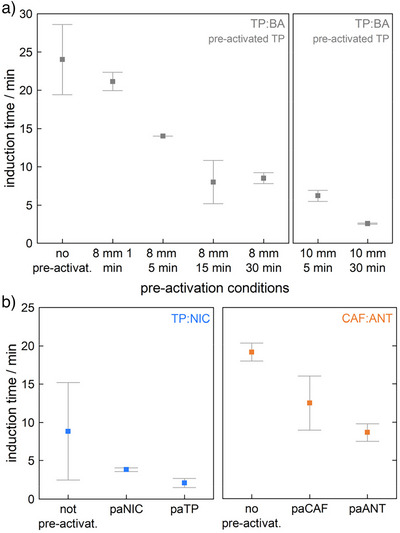 Figure 1
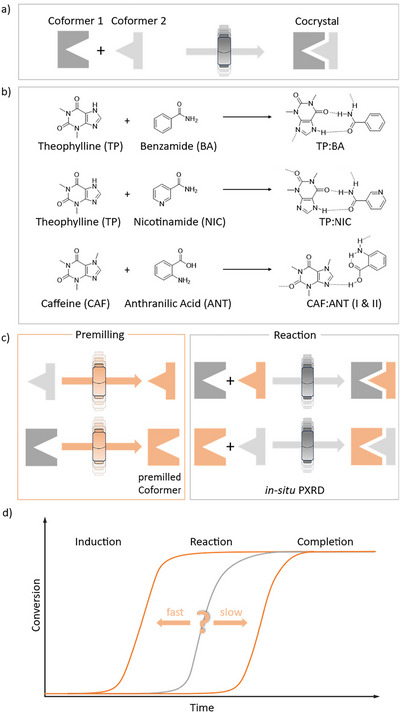 Figure 2
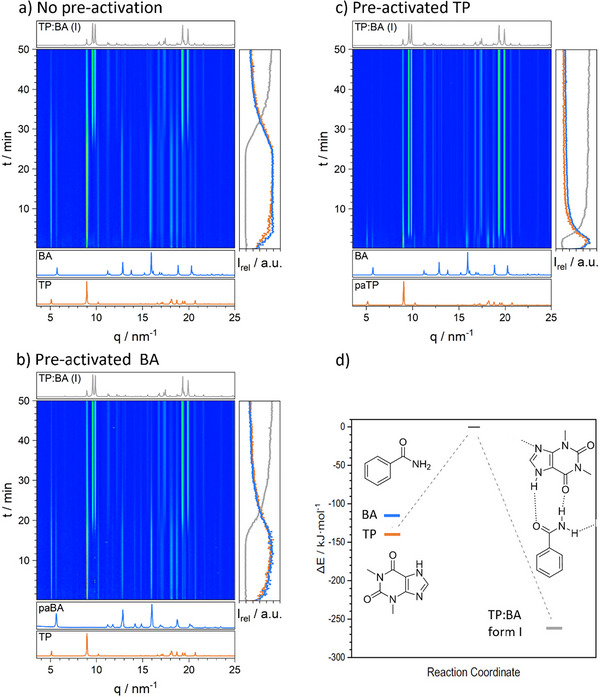 Figure 3
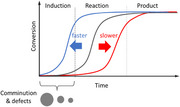 Figure 4
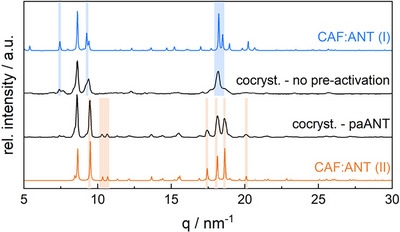 Figure 5
Peer Reviews
No public reviews on file for this paper yet. If you reviewed it on a platform where reviews are public (OpenReview, ICLR, NeurIPS, ICML), you can paste yours below so the community can read it here.
Videos
No videos yet. Explain this paper in a talk, walkthrough, or lecture? Add one.
Taxonomy
TopicsCrystallography and molecular interactions · Force Microscopy Techniques and Applications · Enzyme Structure and Function