A replication-competent deltavirus from the marsupial fat-tailed dunnart Sminthopsis crassicaudata
Zoé Denis, Valérie Courgnaud, Marcos de la Peña, Karim Majzoub

TL;DR
Researchers discovered a complete deltavirus genome in a marsupial and showed it can replicate in various cells, expanding our understanding of deltavirus hosts.
Contribution
The first complete deltavirus genome from a marsupial and a replication-competent clone for studying deltavirus biology.
Findings
FtDDeV is a 1,680-nt circular RNA with a canonical structure and encodes a delta antigen.
FtDDeV replicates in human, simian, rodent, and marsupial cells, with faster kinetics in rodents and marsupials.
Phylogenetic analysis links FtDDAg to sequences from the Tasmanian devil and a neotropical rodent.
Abstract
Deltaviruses are circular, negative-sense RNA agents that replicate autonomously but depend on heterologous envelope glycoproteins for spread. Only partial sequences of deltaviruses had been reported from marsupials. By reanalysing public metatranscriptomes from the Australian fat-tailed dunnart (Sminthopsis crassicaudata), we assemble the first complete marsupial deltavirus genome and test its replication in human and animal cells. The fat-tailed dunnart deltavirus (FtDDeV) is a 1,680-nt circular RNA that folds into a canonical unbranched rod-like structure and encodes a 195-aa delta antigen (FtDDAg). Genomic and antigenomic HDV-like ribozymes are present and conserve catalytic core motifs. Phylogenetic analyses cluster FtDDAg with the Tasmanian devil sequence, and both are quite close to RDAg from the neotropical rodent species Proechimys semispinosus. A dimeric FtDDeV cDNA replicon…
Genes, proteins, chemicals, diseases, species, mutations and cell lines named across the full text — each resolved to its canonical identifier and authoritative record.
Click any figure to enlarge with its caption.
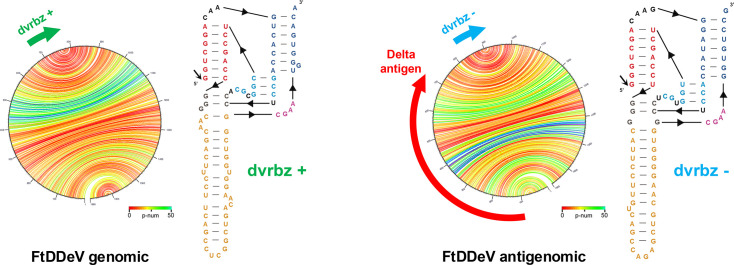 Figure 1
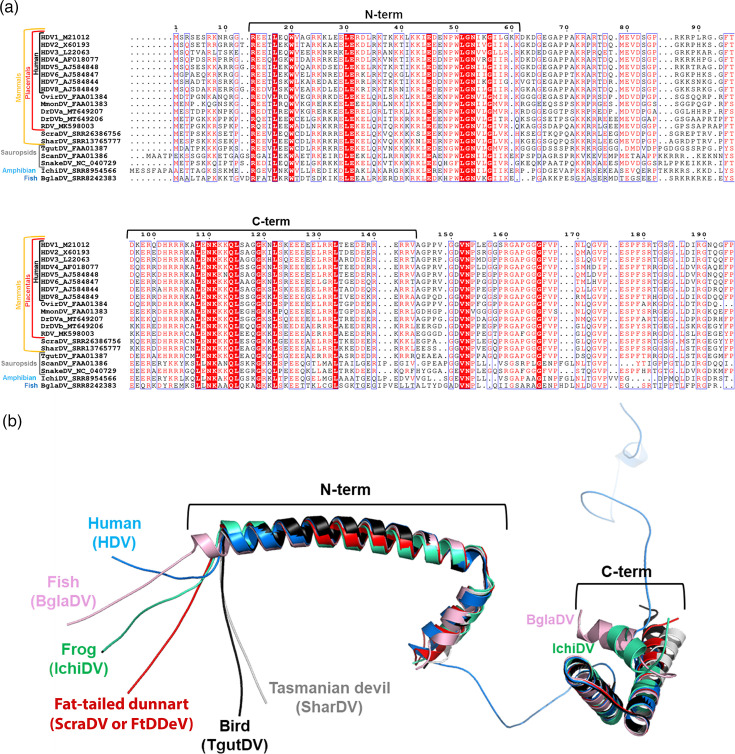 Figure 2
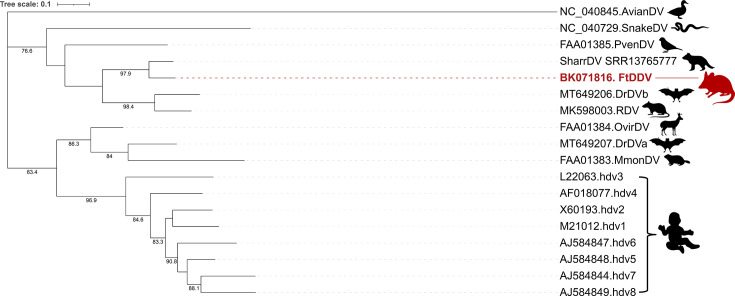 Figure 3
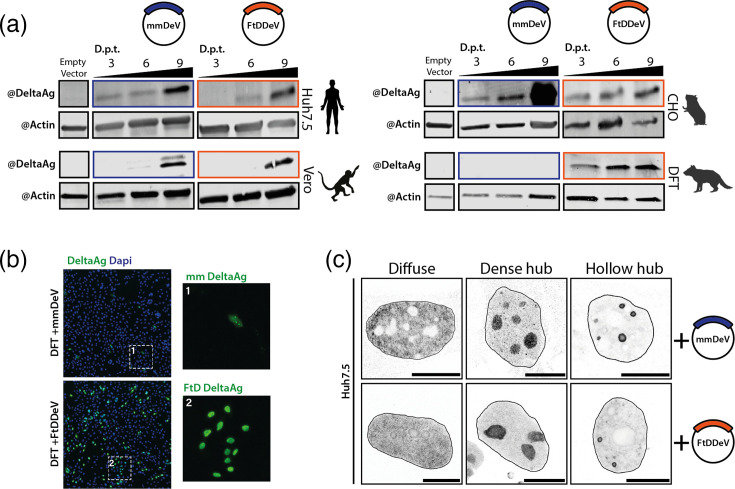 Figure 4
Peer Reviews
No public reviews on file for this paper yet. If you reviewed it on a platform where reviews are public (OpenReview, ICLR, NeurIPS, ICML), you can paste yours below so the community can read it here.
Videos
No videos yet. Explain this paper in a talk, walkthrough, or lecture? Add one.
Taxonomy
TopicsAnimal Virus Infections Studies · Poxvirus research and outbreaks · SARS-CoV-2 and COVID-19 Research