Applying a Network Approach To Characterize Gender Differences in Conduct Problems and Callous-Unemotional Traits among Children from Two Countries
María Álvarez-Voces, Natalie Goulter, Yael Paz, Beatriz Díaz-Vázquez, Laura López-Romero, Paula Villar, Amy L. Byrd, Samuel W. Hawes, Estrella Romero, Rebecca Waller

TL;DR
This study uses network analysis to explore gender and country differences in conduct problems and callous-unemotional traits among children in the US and Spain.
Contribution
The study introduces a network approach to characterize gender differences in conduct problems and callous-unemotional traits across two countries.
Findings
Boys younger than age 12 had higher conduct problem risk rates than girls in the US.
Network analysis showed stronger connectivity for callous-unemotional traits compared to conduct problem symptoms.
Relational aggression was more central among girls, while property destruction and theft were more central in the US.
Abstract
Callous-unemotional (CU) traits (i.e., low empathy, restricted guilt, limited prosociality) are associated with severe conduct problems (CP) across development. However, there is heterogeneity in how CP and CU traits manifest at different ages, between boys and girls, in different countries, and different measures. The current study investigated this heterogeneity by applying network analysis to two large mixed-gender samples from the United States (US) and Spain assessed at different ages, with parent ratings of CP, conduct disorder (CD) symptoms, and CU traits. Data were from the ABCD baseline study (US, N = 11,874, age M = 9.48, SD = 0.51, 47.8% girls) and social development sub-study (US, N = 2,426, age M = 11.52, SD = 0.73, 47.4% girls), as well as two waves of the ELISA study (Spain, N = 1,342, age M = 10.24, SD = 1.07, 50.2% girls; N = 1,259, age M = 10.92, SD = 1.01, 50% girls).…
Genes, proteins, chemicals, diseases, species, mutations and cell lines named across the full text — each resolved to its canonical identifier and authoritative record.
Click any figure to enlarge with its caption.
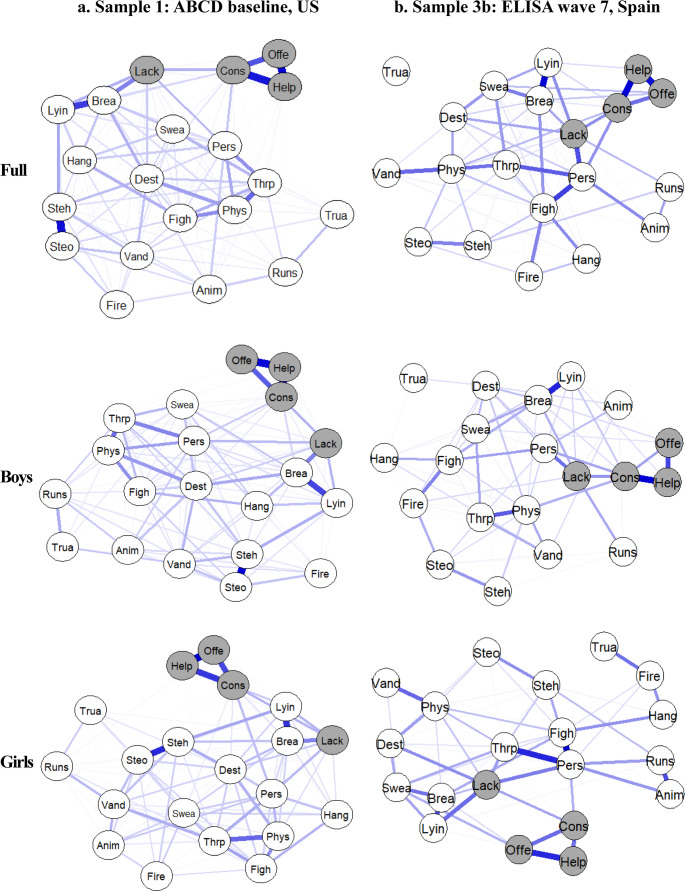 Figure 1
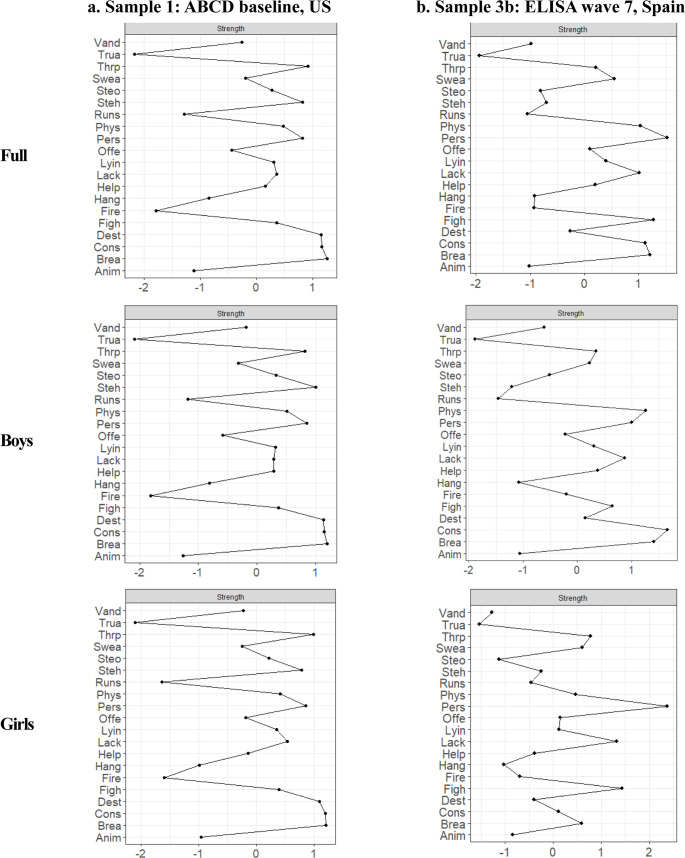 Figure 2
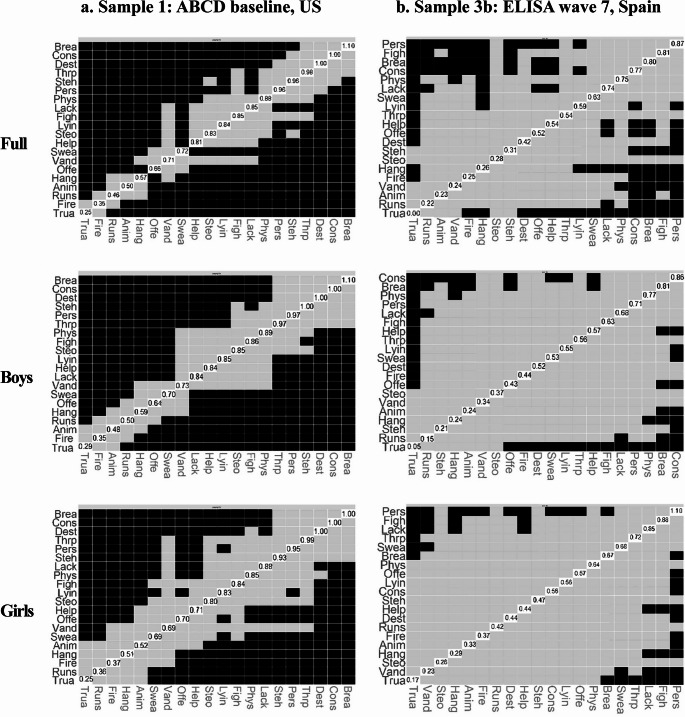 Figure 3
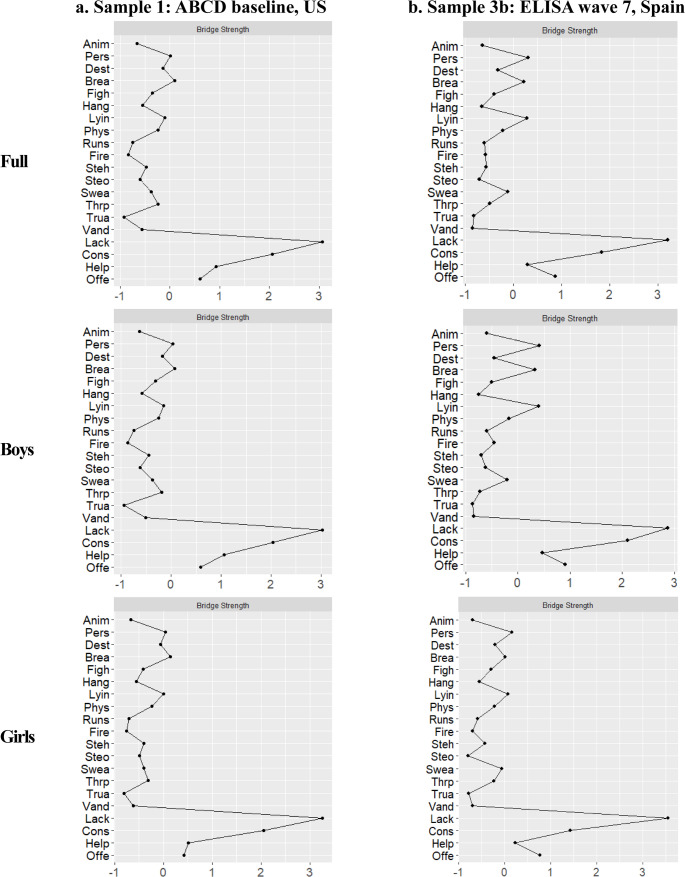 Figure 4
Peer Reviews
No public reviews on file for this paper yet. If you reviewed it on a platform where reviews are public (OpenReview, ICLR, NeurIPS, ICML), you can paste yours below so the community can read it here.
Videos
No videos yet. Explain this paper in a talk, walkthrough, or lecture? Add one.
Taxonomy
TopicsPsychopathy, Forensic Psychiatry, Sexual Offending · Child and Adolescent Psychosocial and Emotional Development · Mental Health Research Topics