Investigation of clinical and genetic characteristics of Alport syndrome using a national registry in Japan (JP-ALPS)
Yusuke Okuda, Naoaki Mikami, Riku Hamada, Hiroshi Hataya, Kazuki Tanaka, Chikako Terano, Naoya Fujita, Kenichiro Miura, Kiyonobu Ishizuka, Yoko Shirai, Koichi Kamei, Masao Ogura, Takayuki Okamoto, Ryota Suzuki, Shunsuke Shinozuka, Yuko Shima, Masafumi Oka, Wataru Shimabukuro

TL;DR
This study analyzed clinical and genetic data from a Japanese Alport syndrome cohort to understand disease progression and treatment effects.
Contribution
The paper provides new insights into the natural history and treatment response of Alport syndrome using a national Japanese cohort.
Findings
Kidney function in most patients was preserved during childhood and adolescence, except for some male patients with X-linked Alport syndrome.
RAS inhibitor use was associated with a slower decline in eGFR.
Early diagnosis through Japan's urinalysis screening program allows for earlier treatment initiation.
Abstract
Comprehensive epidemiological information regarding Alport syndrome, particularly from national cohorts, is limited. Utilizing a national Alport syndrome cohort in Japan established in October 2022, we analyzed clinical characteristics according to genotype. Only baseline data collected retrospectively at enrollment were used. We present longitudinal trends in estimated glomerular filtration rate (eGFR) and urine protein-to-creatinine ratio. Of the 121 patients included, 105 (86.8%) underwent genetic testing and 82 (67.8%) had a kidney biopsy. Among those with genetic testing, 77 (73.3%) had X-linked Alport syndrome. Kidney function was normal at disease onset, with a median eGFR of 112.9 (interquartile range, 99.3–131.1) mL/min/1.73 m2. Although a steep decline during adolescence was observed in some male patients with X-linked Alport syndrome, eGFR decline was relatively slow during…
Genes, proteins, chemicals, diseases, species, mutations and cell lines named across the full text — each resolved to its canonical identifier and authoritative record.
Click any figure to enlarge with its caption.
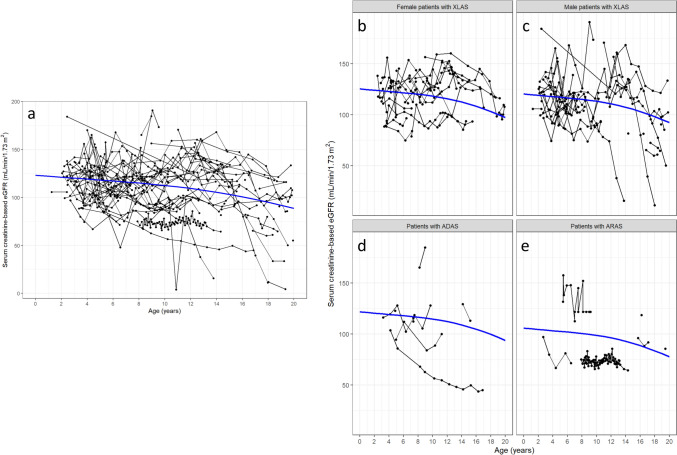 Figure 1
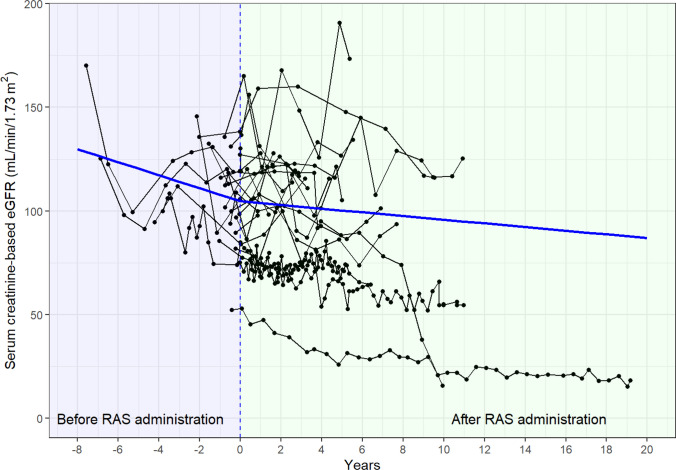 Figure 2
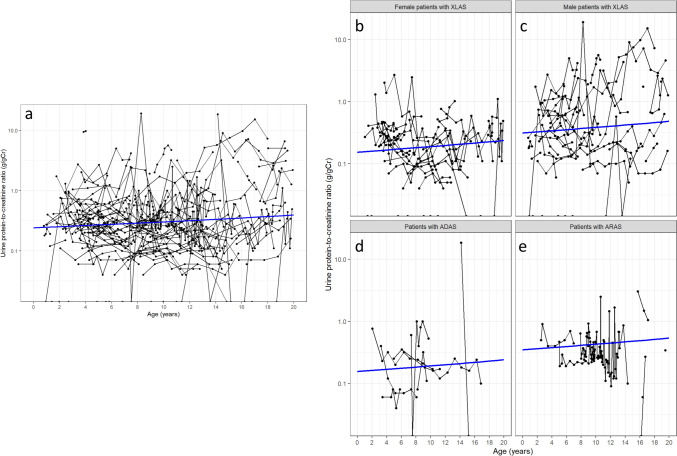 Figure 3
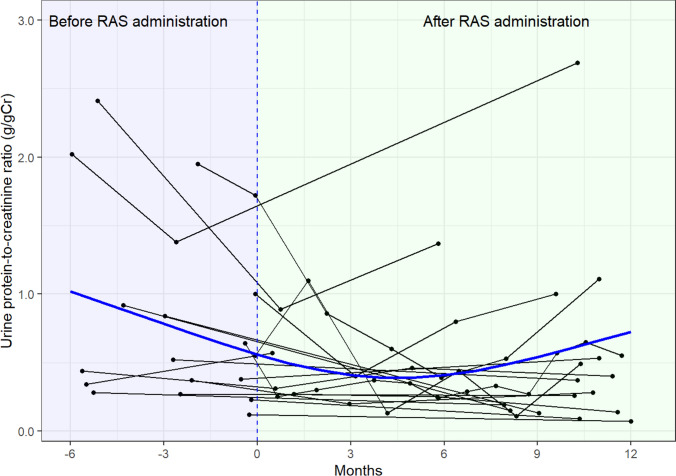 Figure 4
Peer Reviews
No public reviews on file for this paper yet. If you reviewed it on a platform where reviews are public (OpenReview, ICLR, NeurIPS, ICML), you can paste yours below so the community can read it here.
Videos
No videos yet. Explain this paper in a talk, walkthrough, or lecture? Add one.
Taxonomy
TopicsCell Adhesion Molecules Research · Peptidase Inhibition and Analysis · Connective tissue disorders research