Sex-related differences in the short and long-term outcome of internal pallidus stimulation for dystonia
Luigi M. Romito, Roberta Telese, Ahmet Kaymak, Fabiana Colucci, Antonio E. Elia, Sara Rinaldo, Grazia Devigili, Roberto Cilia, Giovanna Zorzi, Alberto Mazzoni, Valentina Leta, Michael Zech, Miryam Carecchio, Barbara Garavaglia, Vincenzo Levi, Nico Golfrè Andreasi, Roberto Eleopra

TL;DR
This study found that sex does not significantly affect the outcomes of deep brain stimulation for dystonia, with similar improvements in both men and women.
Contribution
The study provides evidence that sex is not a critical factor in the efficacy of internal pallidus stimulation for dystonia.
Findings
Male and female patients showed comparable motor improvements after GPi-DBS.
Females initially used less electrical energy but increased it significantly during follow-up.
The position of optimal stimulation did not differ significantly between sexes.
Abstract
The importance of sex as a determinant of Globus pallidus internus deep brain stimulation (GPi-DBS) outcome in adults with dystonia remains uncertain. We investigated whether sex is a determinant of the efficacy and safety of GPi-DBS in dystonia. In this double-center, retrospective cohort study, we followed patients with idiopathic, inherited, or secondary dystonia for at least 12 months after surgery. Dystonia was assessed using the Burke-Fahn-Marsden Dystonia Rating Scale (BFMDRS). Adverse events were recorded. Fifty-six consecutive patients (22 M/34F) were studied. GPi-DBS led to comparable improvements in both sexes. Male patients showed a motor improvement of 62.6 ± 42.4% at 1 year and 53.9 ± 20.9% at the last follow-up (8.6 ± 3.3 years), while female patients showed a motor improvement of 60.5%±29.0% at 1 year and 48.6 ± 28.3% at the last follow-up (at 7.1 ± 4.2 years).…
Genes, proteins, chemicals, diseases, species, mutations and cell lines named across the full text — each resolved to its canonical identifier and authoritative record.
Click any figure to enlarge with its caption.
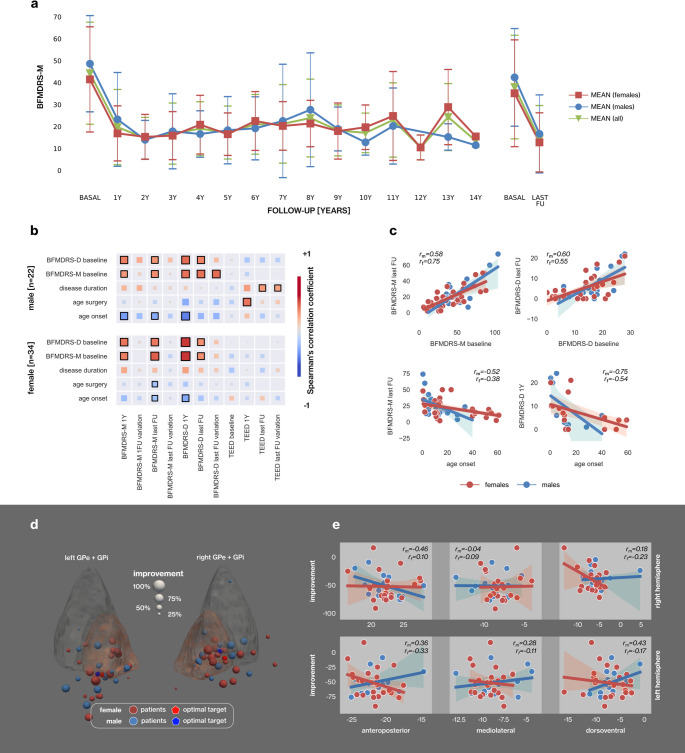 Figure 1
Peer Reviews
No public reviews on file for this paper yet. If you reviewed it on a platform where reviews are public (OpenReview, ICLR, NeurIPS, ICML), you can paste yours below so the community can read it here.
Videos
No videos yet. Explain this paper in a talk, walkthrough, or lecture? Add one.
Taxonomy
TopicsNeurological disorders and treatments · Transcranial Magnetic Stimulation Studies · Parkinson's Disease and Spinal Disorders