Virtual agents as a scalable tool for diverse, robust gesture recognition
Lisa Loy, James P. Trujillo, Floris Roelofsen

TL;DR
This paper introduces virtual agents as a scalable solution for training and testing gesture recognition algorithms, overcoming data limitations and enabling controlled experiments.
Contribution
The novel use of virtual agents for gesture recognition in multimodal communication research is proposed and demonstrated.
Findings
A model trained on virtual agents achieved 85.9% accuracy under optimal conditions.
Accuracy dropped to 71.6% with background clutter and reduced lighting.
The model achieved 72-95% accuracy when tested on human images.
Abstract
Gesture recognition technology is a popular area of research, offering applications in many fields, including behaviour research, human–computer interaction (HCI), medical research, and surveillance culture, among others. However, the large quantity of data needed to train a recognition algorithm is not always available, and differences between the training set and one’s own research data in factors such as recording conditions and participant characteristics may hinder transferability. To address these issues, we propose training and testing recognition algorithms on virtual agents, a tool that has not yet been used for this purpose in multimodal communication research. We provide an example use case with step-by-step instructions, using mocap data to animate a virtual agent and create customised lighting conditions, backgrounds, and camera angles, creating a virtual agent-only dataset…
Genes, proteins, chemicals, diseases, species, mutations and cell lines named across the full text — each resolved to its canonical identifier and authoritative record.
Click any figure to enlarge with its caption.
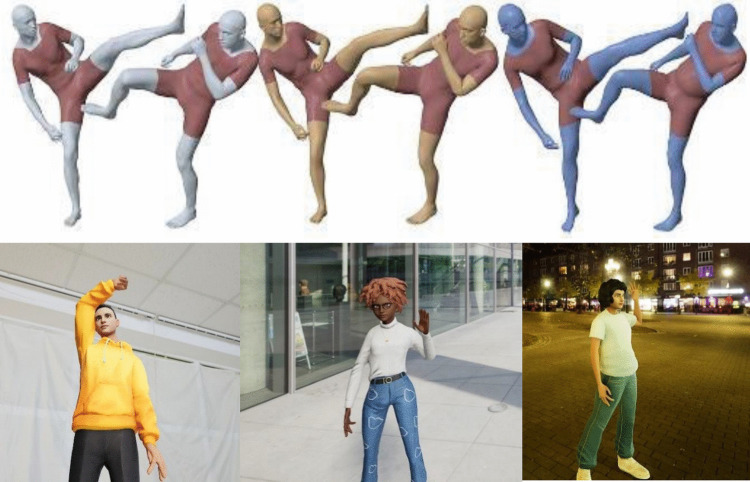 Figure 1
 Figure 2
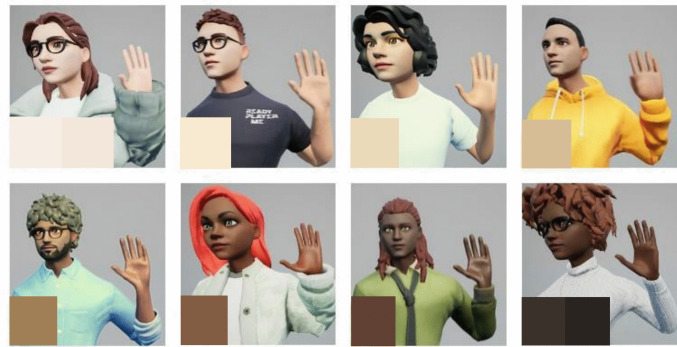 Figure 3
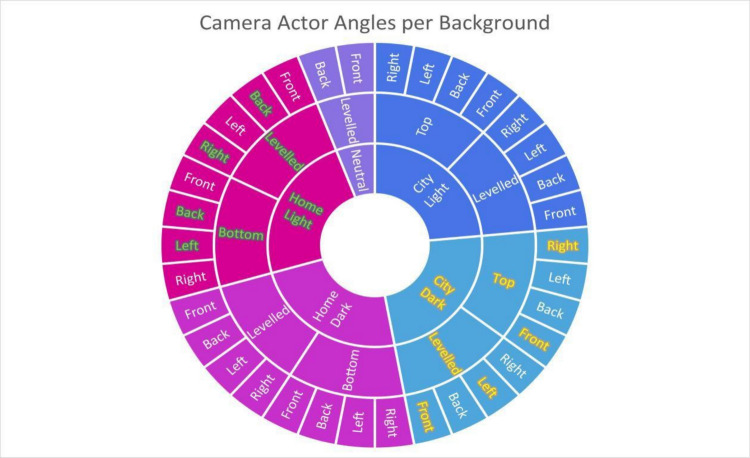 Figure 4
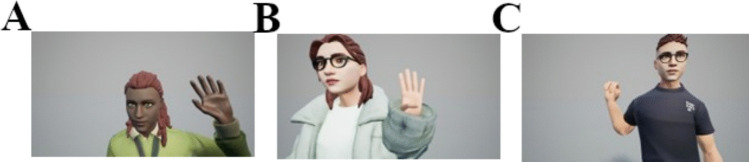 Figure 5
 Figure 6
 Figure 7
Peer Reviews
No public reviews on file for this paper yet. If you reviewed it on a platform where reviews are public (OpenReview, ICLR, NeurIPS, ICML), you can paste yours below so the community can read it here.
Videos
No videos yet. Explain this paper in a talk, walkthrough, or lecture? Add one.
Taxonomy
TopicsHand Gesture Recognition Systems · Face recognition and analysis · Human Pose and Action Recognition