Oral cancer risk stratification: A cross‐sectional population‐based screening study in Northeast India
Kunal Oswal, Satirtha Barman, Alexandar R. Kerr, Murad Zaman, Jnyanashree Patowary, Debasis D. Barali, Nipam Barman, Ashok Das, Umakant Nadkar, Rajesh Dikshit, Jennifer E. Gallagher, Mark W. Lingen, Richard Muwonge, Philip E. Castle, Li C. Cheung, Kelly J. Yu, Anil K. Chaturvedi

TL;DR
This study developed a risk model for oral cancer in Northeast India, showing it works well locally but poorly in other regions, suggesting the need for region-specific models.
Contribution
The study highlights the importance of region-specific oral cancer risk models due to poor transportability of the Northeast India model to Southern India.
Findings
The risk model had good internal discrimination (AUC = 0.83) but poor external calibration in Southern India (E/O ratio = 0.52).
Tobacco pouch keratosis was identified as an early carcinogenic event that could be targeted for behavioral intervention.
30% of individuals at highest risk accounted for 81.8% of prevalent lesions in the study population.
Abstract
We conducted a cross‐sectional oral cancer screening study in Northeast India to develop and validate an oral precancer/cancer risk prediction model. We compared epidemiologic profiles between tobacco pouch keratosis and oral precancer/cancer. During 2018–2022, we recruited 14,749 participants who underwent an interviewer‐administered questionnaire and oral examination (visual inspection and autofluorescence). Logistic regression was used to compare risk factors between tobacco pouch keratosis and precancer/cancer and risk model development for prevalent lesions (keratosis and oral precancer/cancer, combined). Model validation was conducted internally and externally (Kerala oral cancer screening trial). Among the 14,749 participants, as per dentists' diagnosis, 1365 lesions were identified. These included 249 benign lesions (prevalence = 1.6%), 795 tobacco pouch keratosis (prevalence =…
Genes, proteins, chemicals, diseases, species, mutations and cell lines named across the full text — each resolved to its canonical identifier and authoritative record.
Click any figure to enlarge with its caption.
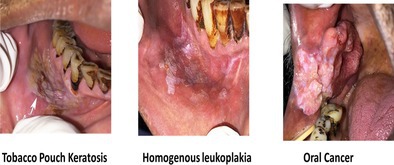 Figure 1
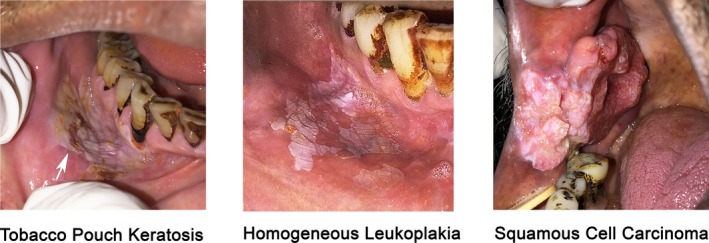 Figure 2
Peer Reviews
No public reviews on file for this paper yet. If you reviewed it on a platform where reviews are public (OpenReview, ICLR, NeurIPS, ICML), you can paste yours below so the community can read it here.
Videos
No videos yet. Explain this paper in a talk, walkthrough, or lecture? Add one.
Taxonomy
TopicsOral Health Pathology and Treatment · Head and Neck Cancer Studies · Oral and Maxillofacial Pathology