Head‐to‐head comparison of TKI and CPI first‐line treatment strategies in advanced renal cell carcinoma—Real‐world data from the German research platform CARAT
Peter J. Goebell, Martin Bögemann, Arnd Nusch, Viktor Grünwald, Lothar Müller, Eyck von der Heyde, Uwe M. Martens, Carolin Lennartz, Michaela Koska, Karin Potthoff, Anja Kaiser‐Osterhues, Carsten Grüllich, Michael Staehler, Martina Jänicke, Dominik Marschner

TL;DR
This study compares real-world effectiveness of different first-line treatments for advanced kidney cancer using data from a German registry, finding that combining immunotherapy and a drug called TKI may offer better survival than other combinations.
Contribution
The study provides real-world evidence comparing CPI+TKI, CPI+CPI, and TKI monotherapy for aRCC using a large registry and IPTW analysis.
Findings
CPI+TKI showed better progression-free and overall survival compared to CPI+CPI and TKI monotherapy.
TKI monotherapy remains a viable option for selected patients, especially those who cannot tolerate immunotherapy.
Quality of life deterioration times were similar across all treatment strategies.
Abstract
The combination of two immune checkpoint inhibitors (CPI) or a CPI with a tyrosine kinase inhibitor (TKI) has expanded the therapeutic options for advanced/metastatic renal cell carcinoma (aRCC) beyond TKI monotherapy. In the absence of head‐to‐head randomized trials comparing these strategies, we estimate their real‐world effectiveness by emulating a hypothetical randomized trial. A total of 936 patients with aRCC from the prospective, observational, multicenter clinical registry CARAT (NCT03374267) starting first‐line treatment after January 15, 2019, were included. Inverse probability of treatment weighting (IPTW) was used to compare first‐line CPI + TKI (n = 447), CPI + CPI (n = 257), and TKI monotherapy (n = 166). Real‐world progression‐free survival (rwPFS), overall survival (OS), and time‐to‐deterioration (TTD) of health‐related quality of life (HRQoL) were analyzed, also…
Genes, proteins, chemicals, diseases, species, mutations and cell lines named across the full text — each resolved to its canonical identifier and authoritative record.
Click any figure to enlarge with its caption.
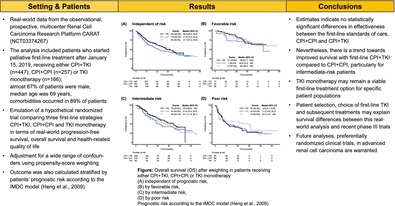 Figure 1
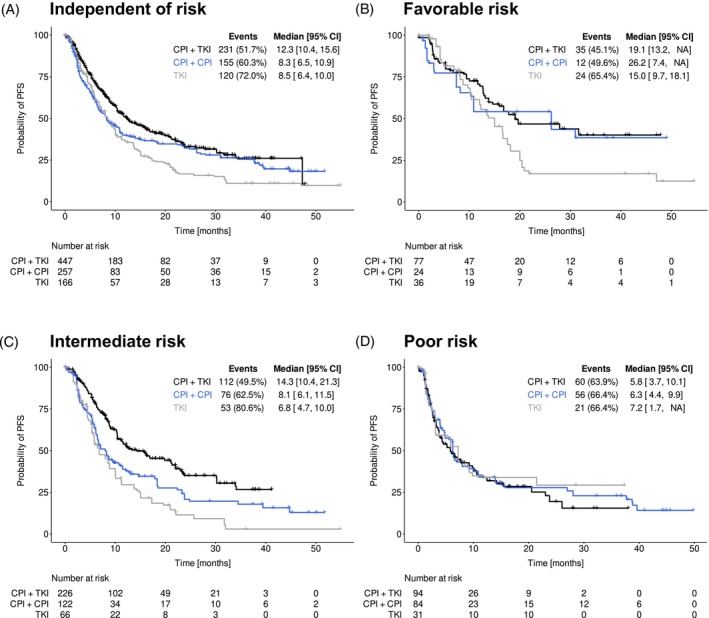 Figure 2
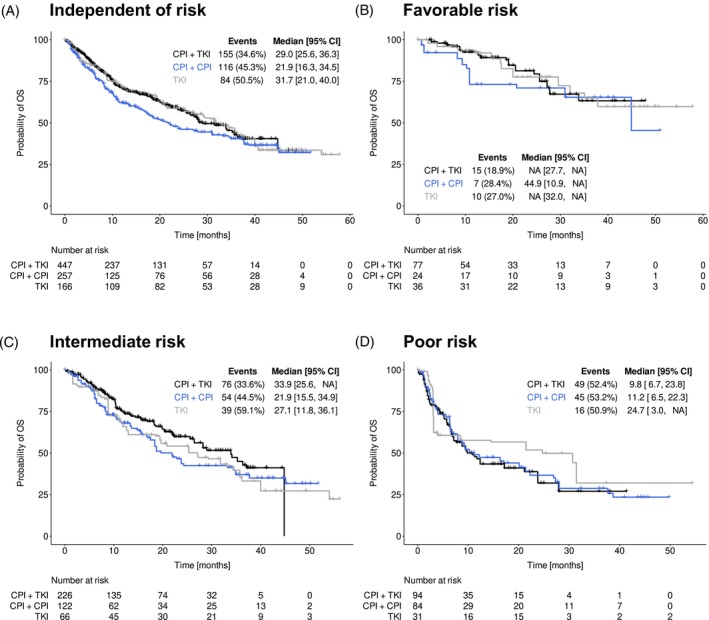 Figure 3
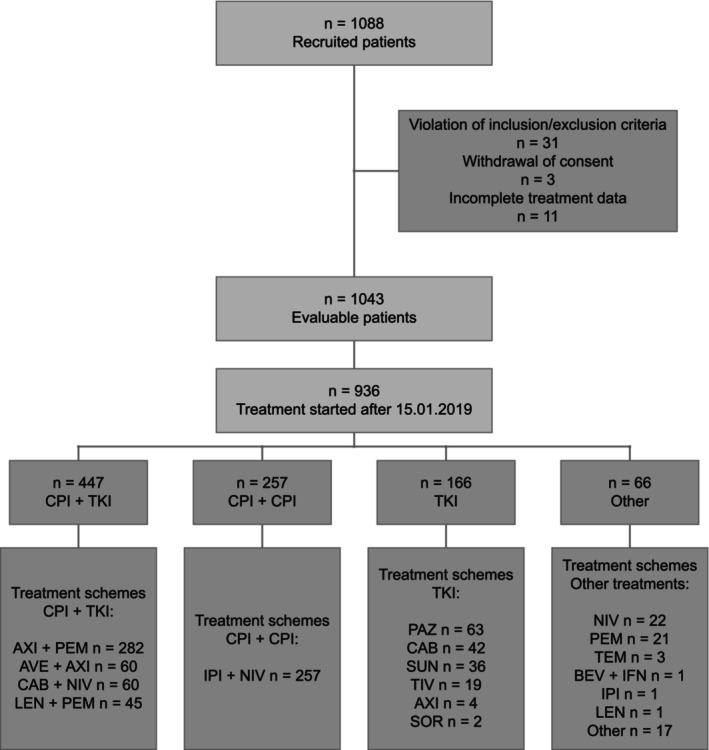 Figure 4
Peer Reviews
No public reviews on file for this paper yet. If you reviewed it on a platform where reviews are public (OpenReview, ICLR, NeurIPS, ICML), you can paste yours below so the community can read it here.
Videos
No videos yet. Explain this paper in a talk, walkthrough, or lecture? Add one.
Taxonomy
TopicsRenal cell carcinoma treatment · Ferroptosis and cancer prognosis · Bladder and Urothelial Cancer Treatments