Identity Matching and Stimulus Equivalence Learning Paradigms for Memory Rehabilitation of Explicit Memory Deficits: A Scoping Review
Josefine Schedlowski, Joseph H. R. Maes, Ruth J. van Asselt, Dirk Bertens, Jos I. M. Egger, Roy P. C. Kessels

TL;DR
This review explores how relational learning methods like stimulus equivalence could help rehabilitate explicit memory deficits, such as those in Alzheimer's, but finds current evidence inconclusive due to methodological issues.
Contribution
The paper provides a scoping review of relational learning paradigms for memory rehabilitation, highlighting methodological gaps and guiding future research.
Findings
Findings were mixed regarding the success of training procedures like identity matching and arbitrary matching.
Positive outcomes were observed under the differential outcome procedure (DOP), with efficacy depending on impairment severity.
Current evidence remains inconclusive due to uncontrolled study designs and weak statistical analysis.
Abstract
Explicit memory dysfunction, such as in Alzheimer’s dementia, impairs learning and daily functioning, requiring effective rehabilitation strategies to promote functional independence. Relational learning paradigms such as stimulus equivalence learning (SEL) imply the formation of networks of relations in which trained relations give rise to emergent relations, potentially providing a novel approach to addressing deficits in remembering and stimulus control. We evaluated the scope and nature of research on the application of relational learning paradigms for memory rehabilitation. In particular, we outline the evidence for the efficacy of identity matching and SEL in specific disorders, the associated effective strategies, and challenges to guide future research. A systematic search following the PRISMA-ScR guidelines identified 23 reports categorized into identity matching, arbitrary…
Genes, proteins, chemicals, diseases, species, mutations and cell lines named across the full text — each resolved to its canonical identifier and authoritative record.
Click any figure to enlarge with its caption.
 Figure 1
 Figure 2
 Figure 3
 Figure 4
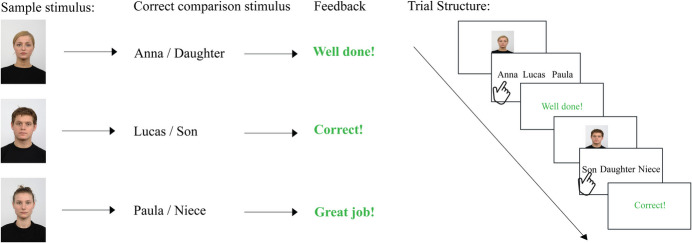 Figure 5
Peer Reviews
No public reviews on file for this paper yet. If you reviewed it on a platform where reviews are public (OpenReview, ICLR, NeurIPS, ICML), you can paste yours below so the community can read it here.
Videos
No videos yet. Explain this paper in a talk, walkthrough, or lecture? Add one.
Taxonomy
TopicsAutism Spectrum Disorder Research · Attention Deficit Hyperactivity Disorder · Behavioral and Psychological Studies