The role of multimodality imaging in selection, response assessment, and follow-up of patients receiving 177Lutetium-PSMA-therapy
Aditi Ranjan, Minal Padden-Modi, Hoda Abdel-Aty, Joao Galante, Simon Wan, Azzra Maricar, Adetokunbo Adesina, Brent Drake, Siraj Yusuf, Gary Cook, Nicholas James, Sola Adeleke

TL;DR
This review discusses how different imaging techniques help select patients for 177Lu-PSMA therapy and monitor treatment response in advanced prostate cancer.
Contribution
The paper highlights the evolving role of multimodal imaging in improving patient selection and treatment monitoring for 177Lu-PSMA therapy.
Findings
PSMA-PET/CT is the primary imaging method for selecting patients for 177Lu-PSMA therapy.
18F-FDG PET and whole-body diffusion-weighted MRI can help identify PSMA-negative or treatment-resistant disease.
AI and radiomics may improve prognostication and personalize dosimetry in the future.
Abstract
Prostate cancer is the most commonly diagnosed cancer among men in 112 countries, accounting for approximately 15% of all cancer cases. Whilst the 5-year survival rate for localised disease exceeds 90%, there is a significant drop to 50% if metastases are present. Following the VISION and TheraP trials, 177Lu-PSMA-therapy was approved for treatment of metastatic castrate resistant prostate cancer by the FDA and EMA 2022. Patient selection for 177Lu-PSMA-therapy is now relatively well defined, guided by PSMA-PET/CT criteria established in pivotal trials. Nevertheless, clinical consensus on appropriate criteria is still evolving, and additional imaging modalities such as 18F-FDG PET, post-therapy SPECT/CT, or emerging techniques such as whole-body diffusion-weighted MRI may serve as valuable adjuncts to identify PSMA-negative or treatment-resistant disease that may not be apparent on…
Genes, proteins, chemicals, diseases, species, mutations and cell lines named across the full text — each resolved to its canonical identifier and authoritative record.
Click any figure to enlarge with its caption.
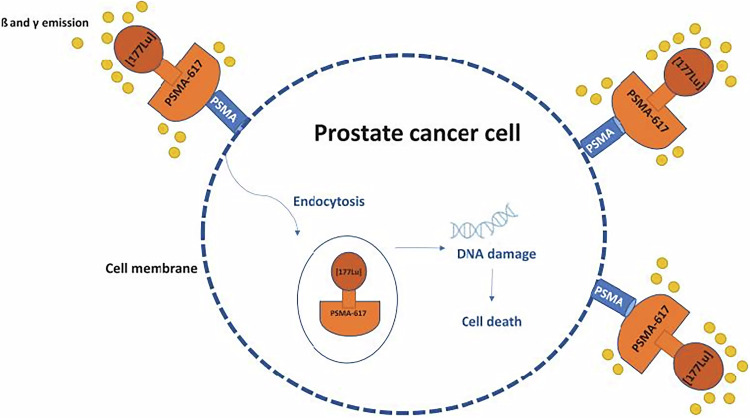 Figure 1
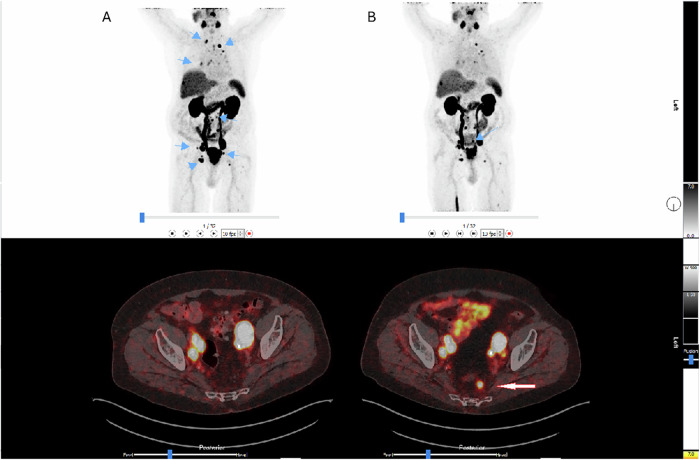 Figure 2
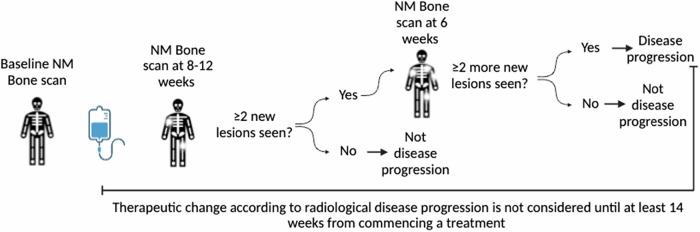 Figure 3
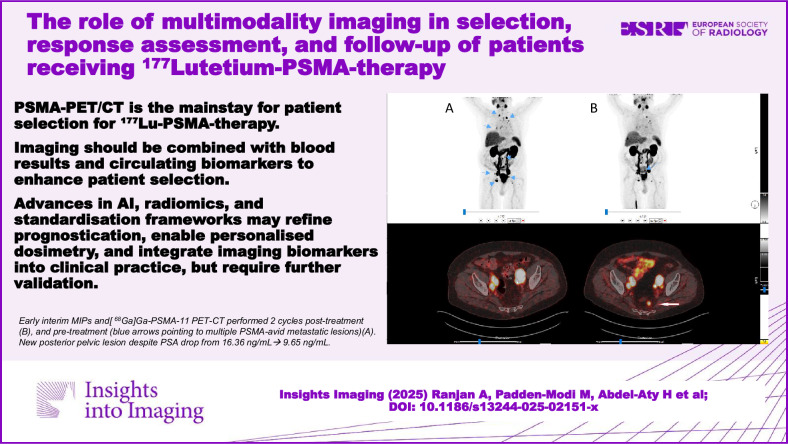 Figure 4
Peer Reviews
No public reviews on file for this paper yet. If you reviewed it on a platform where reviews are public (OpenReview, ICLR, NeurIPS, ICML), you can paste yours below so the community can read it here.
Videos
No videos yet. Explain this paper in a talk, walkthrough, or lecture? Add one.
Taxonomy
TopicsProstate Cancer Treatment and Research · Prostate Cancer Diagnosis and Treatment · Radiopharmaceutical Chemistry and Applications