Identifying the Initiation of Oshikatsu and Health‐Promoting Activities Through Oshikatsu Among Older Adults: A Trajectory Equifinality Approach
Kengo Hosaka, Tomoki Tanaka, Katsuya Iijima, Misato Nihei

TL;DR
This study explores how older adults begin participating in oshikatsu and how it motivates them to adopt healthier lifestyles.
Contribution
The study introduces a novel application of the Trajectory Equifinality Approach to understand oshikatsu initiation among older adults.
Findings
Six phases were identified in the initiation and engagement process of oshikatsu.
Social enablers like family support and accessible venues facilitate participation.
Identifying with an oshi motivates health-promoting activities.
Abstract
Oshikatsu, supporting a specific individual or group, has been linked to enhanced well‐being and physical activity motivation. However, few studies have explored how this practice begins, particularly among older adults. This study applied the Trajectory Equifinality Approach (TEA) to investigate how individuals aged 50 and above initiate oshikatsu and subsequently engage in health‐promoting activities, and to identify influencing factors. Semi‐structured interviews were conducted with nine participants (men and women aged in their 50s–80s), and their narratives were analyzed using TEA. Six phases were identified: formative experience, encounter, event participation, social interaction, lifestyle improvement, and psychological fulfillment. Social enablers that facilitated these processes included relatives or friends who were fans, regular performances, venues close to home,…
Genes, proteins, chemicals, diseases, species, mutations and cell lines named across the full text — each resolved to its canonical identifier and authoritative record.
Click any figure to enlarge with its caption.
 Figure 1
 Figure 2
 Figure 3
 Figure 4
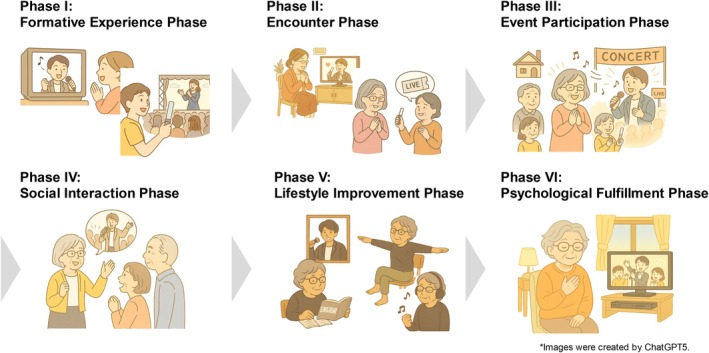 Figure 5
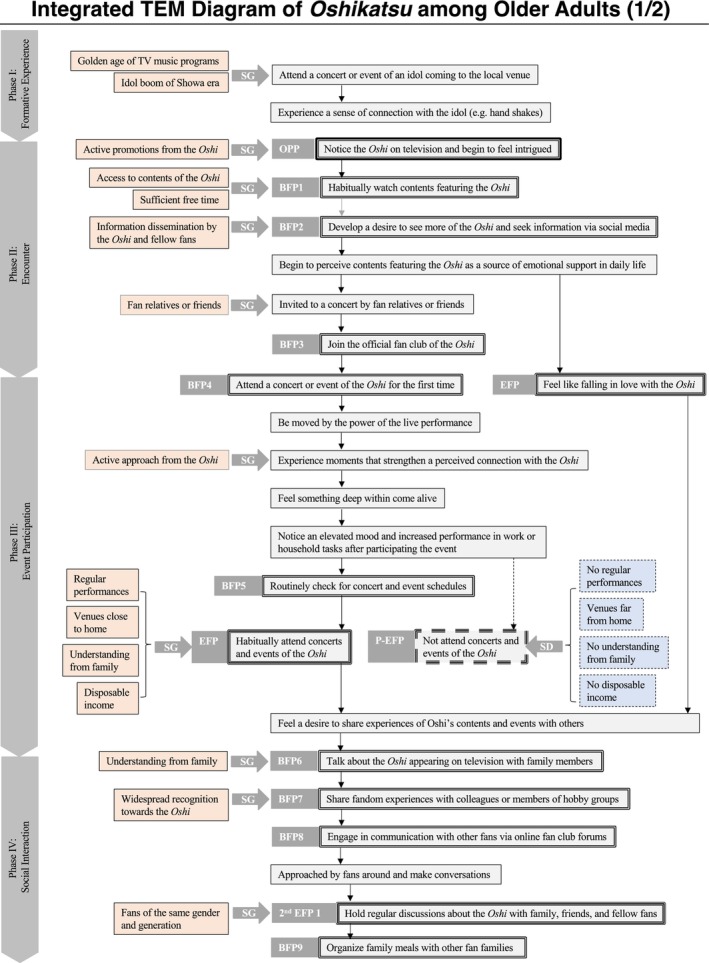 Figure 6
 Figure 7
 Figure 8
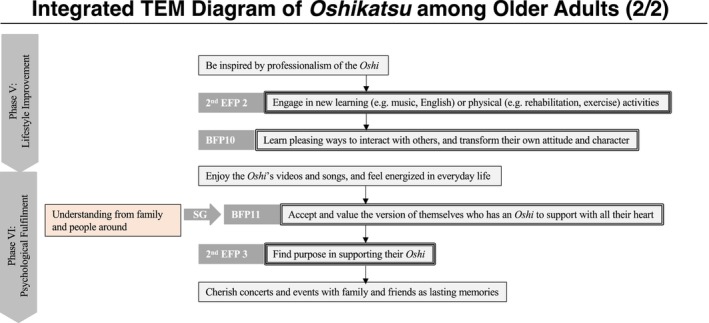 Figure 9
 Figure 10
 Figure 11
Peer Reviews
No public reviews on file for this paper yet. If you reviewed it on a platform where reviews are public (OpenReview, ICLR, NeurIPS, ICML), you can paste yours below so the community can read it here.
Videos
No videos yet. Explain this paper in a talk, walkthrough, or lecture? Add one.
Taxonomy
TopicsPhysical Activity and Health · Art Therapy and Mental Health · Flow Experience in Various Fields