Open Versus Closed Reduction in Subtrochanteric Femur Fractures: The Critical Role of Acceptable Reduction in Healing Outcomes
Pedro Seabra, Daniel Gonçalves, Pedro Barra Simões, Margarida Gomes, Miguel Pimentel, José Oliveira, Henrique Sousa, André Sarmento

TL;DR
This study finds that achieving good bone alignment during surgery for subtrochanteric femur fractures is more important than the surgical method used for healing outcomes.
Contribution
The study demonstrates that reduction quality, rather than open versus closed surgical technique, is the key factor in healing outcomes for subtrochanteric femur fractures.
Findings
Acceptable reduction was achieved more frequently with open reduction (94.9%) compared to closed reduction (68.0%).
Patients with acceptable reduction had significantly faster union times and lower rates of delayed union and nonunion.
Nonunion occurred exclusively in patients with non-acceptable reductions.
Abstract
Introduction Subtrochanteric femur fractures are challenging injuries due to high mechanical stress and compromised vascularization, resulting in higher complication rates compared with other proximal femur fractures. While intramedullary nailing is the treatment of choice, controversy persists regarding whether open or closed reduction provides superior outcomes. Some evidence suggests that open reduction may achieve better alignment, whereas others highlight risks of impaired biology, blood loss, and infection. This study aimed to compare open versus closed reduction in subtrochanteric fractures treated with intramedullary nailing and to assess the influence of reduction quality on bone healing outcomes. Methods We performed a retrospective cohort study including 190 patients with subtrochanteric fractures treated surgically between 2017 and 2024. After exclusions, 114 patients met…
Genes, proteins, chemicals, diseases, species, mutations and cell lines named across the full text — each resolved to its canonical identifier and authoritative record.
Click any figure to enlarge with its caption.
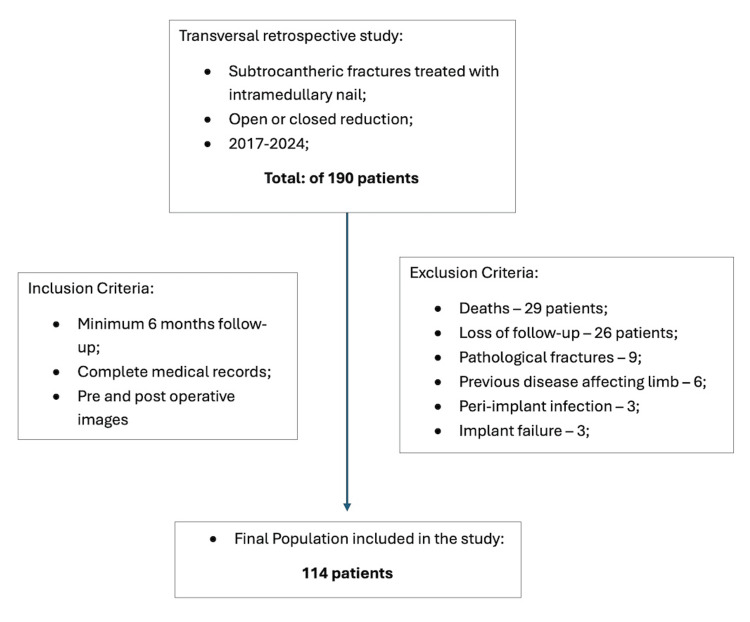 Figure 1
Peer Reviews
No public reviews on file for this paper yet. If you reviewed it on a platform where reviews are public (OpenReview, ICLR, NeurIPS, ICML), you can paste yours below so the community can read it here.
Videos
No videos yet. Explain this paper in a talk, walkthrough, or lecture? Add one.
Taxonomy
TopicsHip and Femur Fractures · Bone fractures and treatments · Cardiac, Anesthesia and Surgical Outcomes