The role of ducks in detecting Highly Pathogenic Avian Influenza in small-scale backyard poultry farms
Steven Xingyu Wu, Christopher N. Davis, Mark Arnold, Michael J. Tildesley, Jennifer A. Flegg, Qiangguo Jin, Jennifer A. Flegg, Qiangguo Jin, Jennifer A. Flegg, Qiangguo Jin, Jennifer A. Flegg, Qiangguo Jin

TL;DR
This paper shows that ducks can silently carry bird flu in small farms, making detection harder and increasing outbreak risks.
Contribution
A computational model is developed to quantify HPAI detection effectiveness in mixed-species backyard flocks.
Findings
Ducks can delay detection of H5N1 and increase infection burden in backyard flocks.
Flock infection dynamics depend heavily on species composition, with ducks posing higher transmission risks.
Asymptomatic ducks may amplify transmission risks between flocks and sites.
Abstract
Previous research efforts on highly pathogenic H5N1 avian influenza (HPAI) suggest that different avian species exhibit a varied severity of clinical signs after infection. Waterfowl, such as ducks or geese, can be asymptomatic and act as silent carriers of H5N1, making detection harder and increasing the risk of further transmission, potentially leading to significant economic losses. For backyard hobby farmers, passive reporting is a common HPAI detection strategy. We aim to develop a computational, mechanistic model to quantify the effectiveness of this strategy by simulating the spread of H5N1 in a mixed-species, small-population backyard flock. Quantities such as detection time and undetected burden of infection in various scenarios are compared. Our results indicate that the presence of ducks can lead to a higher risk of an outbreak and a higher burden of infection. If most ducks…
Genes, proteins, chemicals, diseases, species, mutations and cell lines named across the full text — each resolved to its canonical identifier and authoritative record.
Click any figure to enlarge with its caption.
 Figure 1
 Figure 2
 Figure 3
 Figure 4
 Figure 5
 Figure 6
 Figure 7
 Figure 8
 Figure 9
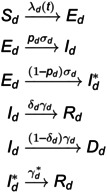 Figure 10
 Figure 11
 Figure 12
 Figure 13
 Figure 14
 Figure 15
 Figure 16
 Figure 17
 Figure 18
 Figure 19
 Figure 20
 Figure 21
 Figure 22
 Figure 23
 Figure 24
 Figure 25
 Figure 26
 Figure 27
 Figure 28
 Figure 29
 Figure 30
 Figure 31
 Figure 32
 Figure 33
 Figure 34
 Figure 35
 Figure 36
 Figure 37
 Figure 38
 Figure 39
 Figure 40
 Figure 41
 Figure 42
 Figure 43
 Figure 44
 Figure 45
 Figure 46
 Figure 47
 Figure 48
 Figure 49
 Figure 50
Peer Reviews
No public reviews on file for this paper yet. If you reviewed it on a platform where reviews are public (OpenReview, ICLR, NeurIPS, ICML), you can paste yours below so the community can read it here.
Videos
No videos yet. Explain this paper in a talk, walkthrough, or lecture? Add one.
Taxonomy
TopicsInfluenza Virus Research Studies · Livestock and Poultry Management · Animal Disease Management and Epidemiology