Severe anaphylactic reaction to contrast agent: teams are well prepared but should simulate the situations regularly
Karl-Christian Pape, Matthias Meissnitzer, Zoe Strüby, Thomas Sartoretti, Dorothee Harder, Simon Matoori, Johannes M Froehlich, Sebastian Schindera, Simin Laures, Christophe Hälg, Klaus Hergan, Stefan Hecht, Christoph Konrad, Oliver Hausmann, Jochen Elfgen, Arash Najafi

TL;DR
Doctors can diagnose severe anaphylaxis but struggle with proper treatment and using adrenaline autoinjectors, suggesting a need for more training.
Contribution
The study reveals gaps in physicians' ability to manage anaphylaxis despite correct diagnosis, emphasizing the need for regular simulation training.
Findings
All 95 doctors correctly diagnosed anaphylaxis, but 66% were uncertain about first-line therapy.
68% of doctors had difficulty using the adrenaline autoinjector correctly.
Abstract
Anaphylactic reactions are dramatic and life-threatening. According to international guidelines, the immediate intramuscular administration of adrenaline is the most important first step for acute management. The aim of this study is to determine whether doctors can recognize and treat severe anaphylactic reactions to contrast agents adequately. In this study, 95 doctors were interviewed between January and June 2023 in European clinics that are not affiliated with the authors. Ninety-five doctors from radiology, internal medicine, and anaesthesia departments were randomly selected for interviews. A video was prepared simulating a male patient developing a severe anaphylactic reaction during CT after intravenous administration of an iodinated contrast medium. After the video, 95 doctors were interviewed (59 radiologists, 19 internists, and 17 anaesthesiologists). The doctors were asked…
Genes, proteins, chemicals, diseases, species, mutations and cell lines named across the full text — each resolved to its canonical identifier and authoritative record.
Click any figure to enlarge with its caption.
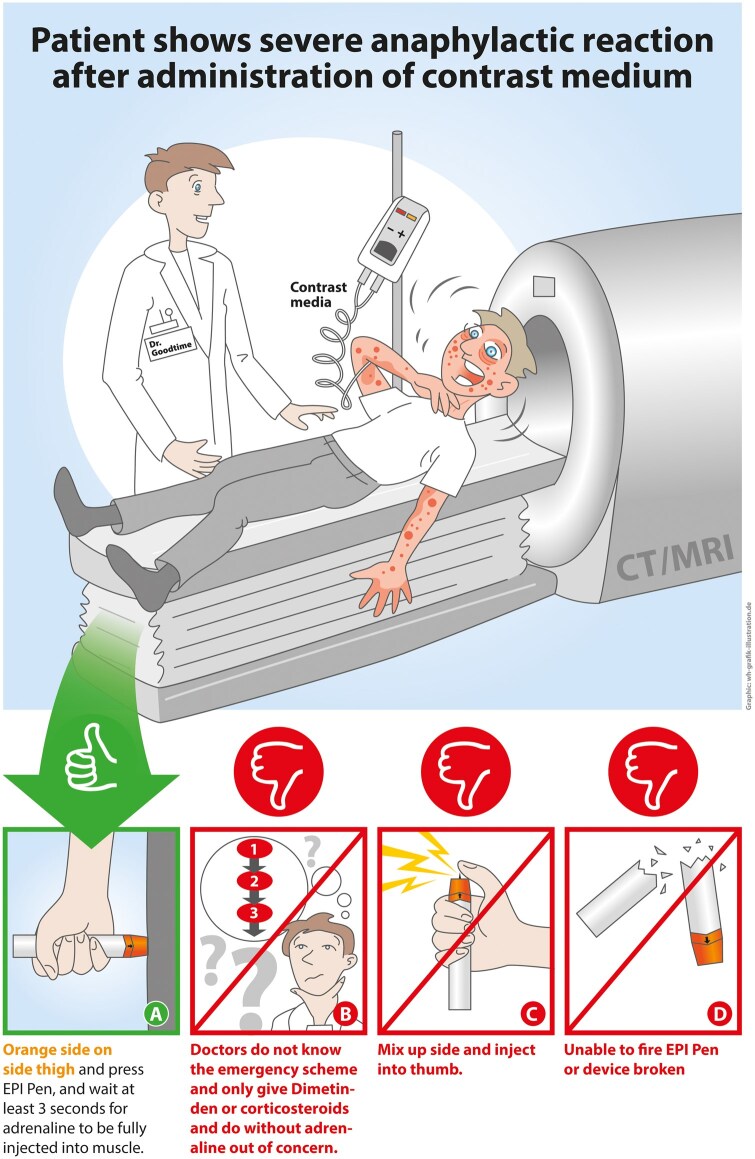 Figure 1
Peer Reviews
No public reviews on file for this paper yet. If you reviewed it on a platform where reviews are public (OpenReview, ICLR, NeurIPS, ICML), you can paste yours below so the community can read it here.
Videos
No videos yet. Explain this paper in a talk, walkthrough, or lecture? Add one.
Taxonomy
TopicsFood Allergy and Anaphylaxis Research · Acute Kidney Injury Research · Drug-Induced Adverse Reactions