Assessing territorial disparities in snakebite surveillance data in Brazil: Implications for public health
Alexandre Vilhena Silva-Neto, Gabriel dos Santos Mouta, Thaís Pinto Nascimento, Antônio Alcirley da S. Balieiro, Jady Shayenne Mota Cordeiro, Jefferson Valente, André Sachett, Patrícia Carvalho da Silva Balieiro, Djane Clarys Baia-da-Silva, Fernando Almeida-Val

TL;DR
Brazil's snakebite surveillance data is incomplete and inconsistent, especially in remote regions, which hinders effective public health responses and antivenom distribution.
Contribution
The study provides the first comprehensive evaluation of Brazil's snakebite surveillance data quality across multiple dimensions and regions.
Findings
Basic demographic data is well reported, but clinical and treatment details are often missing or inconsistent.
Antivenom use frequently deviates from national guidelines in regions with high snakebite burdens.
Data quality issues are most severe in the Amazon and other remote areas with high disease incidence.
Abstract
Snakebite envenoming (SBE) is a neglected tropical disease with high incidence and impact in rural and remote areas of Brazil. Although the country maintains a national reporting system (SINAN) for SBE, few studies have systematically evaluated the quality of these surveillance data, which are essential for informing public health planning and antivenom distribution strategies. This is a descriptive study analyzing all snakebite notifications recorded in SINAN between 2007 and 2023. Data quality was evaluated across three dimensions: completeness, internal consistency, and reliability. Sociodemographic, clinical, and treatment-related variables were assessed by region using standardized classifications. Inter-database agreement for fatal outcomes was analyzed between SINAN and the Mortality Information System (SIM) using the Intraclass Correlation Coefficient (ICC). The results showed…
Genes, proteins, chemicals, diseases, species, mutations and cell lines named across the full text — each resolved to its canonical identifier and authoritative record.
Click any figure to enlarge with its caption.
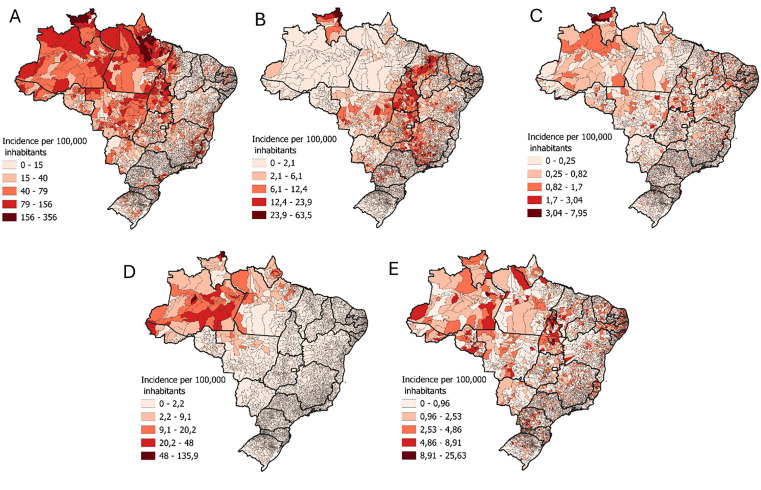 Figure 1
 Figure 2
 Figure 3
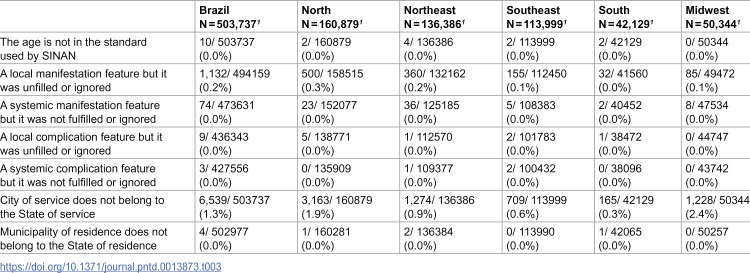 Figure 4
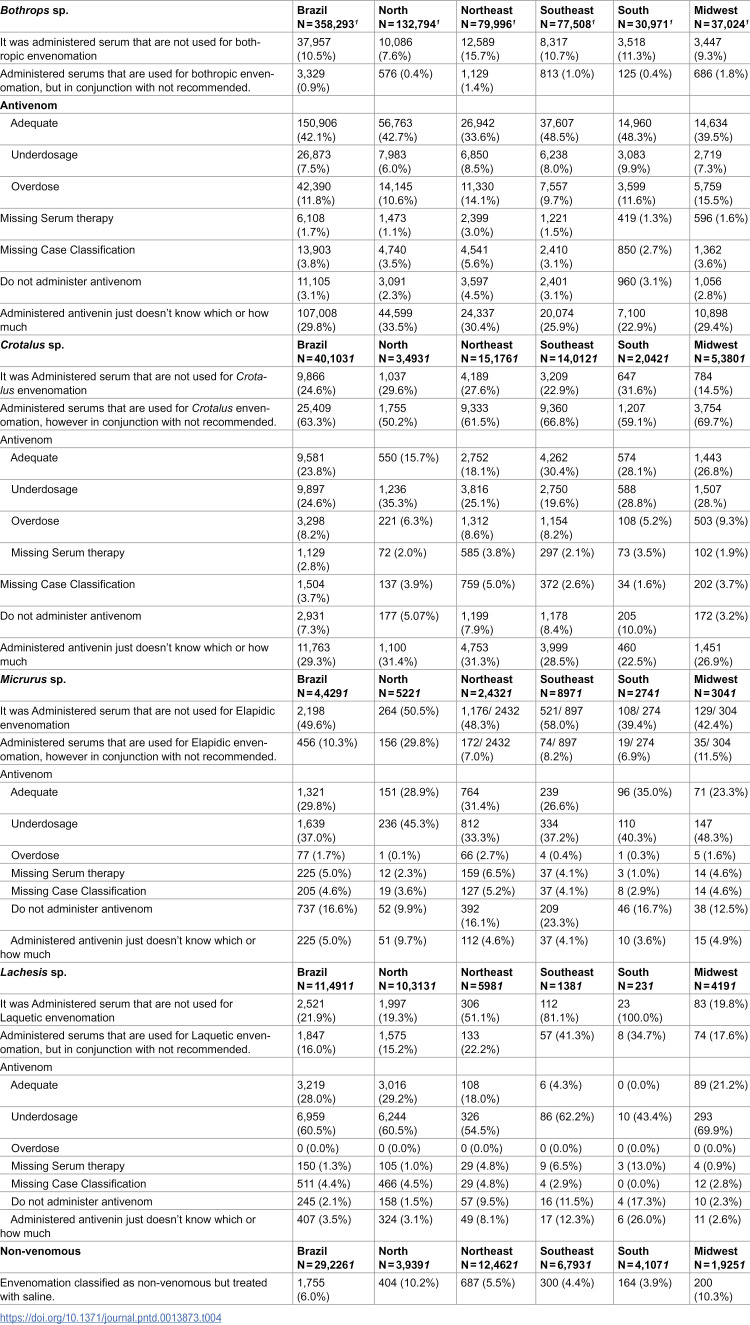 Figure 5
Peer Reviews
No public reviews on file for this paper yet. If you reviewed it on a platform where reviews are public (OpenReview, ICLR, NeurIPS, ICML), you can paste yours below so the community can read it here.
Videos
No videos yet. Explain this paper in a talk, walkthrough, or lecture? Add one.
Taxonomy
TopicsVenomous Animal Envenomation and Studies · Healthcare and Venom Research · Entomological Studies and Ecology