Safety and feasibility of one-stage neonatal approach for short-segment Hirschsprung’s disease
Quynh Anh Tran, Hien Duy Pham, Dung Boi Ly, Minh Quang Ngo, Nhung Thi Nguyen, Liem Thanh Nguyen, Quang Thanh Nguyen

TL;DR
This study compares three surgical techniques for treating Hirschsprung’s disease in newborns, finding they are all safe and effective with similar long-term outcomes.
Contribution
The study provides comparative data on minimally invasive surgical approaches for neonatal Hirschsprung’s disease with short-segment involvement.
Findings
All three techniques (SILEP, CLEP, TERPT) had comparable long-term bowel function and low major complication rates.
SILEP and TERPT had shorter operative times compared to CLEP.
SILEP showed a trend toward better cosmetic outcomes than CLEP.
Abstract
Early definitive surgery for Hirschsprung disease (HD) in neonates is increasingly adopted to reduce preoperative morbidity and preserve long term bowel function. However, comparative data across minimally invasive approaches in neonates with short segment disease remain limited. This study compared outcomes of single incision laparoscopic assisted endorectal pull through (SILEP), conventional laparoscopic assisted endorectal pull through (CLEP), and complete transanal endorectal pull through (TERPT) for rectosigmoid HD. We conducted a retrospective cohort study of 55 neonates who underwent one stage definitive surgery before 28 days of age at a high volume center between January 2019 and December 2021. The primary outcome was long term bowel function assessed using the Rintala Bowel Function Score (BFS) after a minimum of 4 years of follow up. Secondary outcomes included operative…
Genes, proteins, chemicals, diseases, species, mutations and cell lines named across the full text — each resolved to its canonical identifier and authoritative record.
Click any figure to enlarge with its caption.
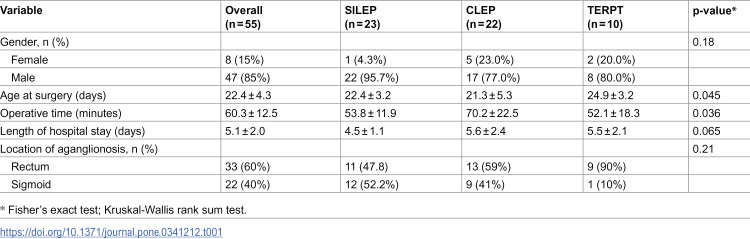 Figure 1
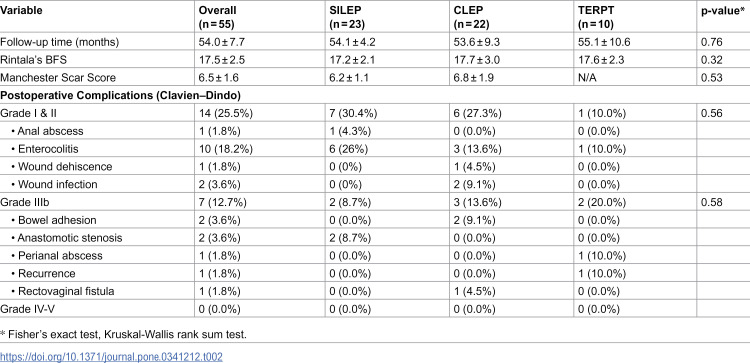 Figure 2
Peer Reviews
No public reviews on file for this paper yet. If you reviewed it on a platform where reviews are public (OpenReview, ICLR, NeurIPS, ICML), you can paste yours below so the community can read it here.
Videos
No videos yet. Explain this paper in a talk, walkthrough, or lecture? Add one.
Taxonomy
TopicsCongenital gastrointestinal and neural anomalies · Intestinal Malrotation and Obstruction Disorders · Congenital Anomalies and Fetal Surgery