Isotopic constraints on the origin of reactive chlorine in the troposphere
Zheng Zong, Men Xia, Chunshui Lin, Xiaorui Chen, Likun Xue, Qinyi Li, Yifan Jiang, Chongguo Tian, Xuehua Fan, Qi Yuan, Xinfeng Wang, Yujiao Zhu, Jisheng Zhang, Shuncheng Lee, Yujing Mu, Jun Li, Xiao Fu, Chuanhua Ren, Xin Huang, Chao Yan, Wei Nie, Alba Badia, Gan Zhang

TL;DR
This study uses isotopic analysis to distinguish oceanic and anthropogenic sources of reactive chlorine in the troposphere, revealing their distinct signatures and impact on air pollution.
Contribution
The study identifies distinct isotopic signatures of ClNO2 from oceanic and anthropogenic sources, enabling better source attribution in the troposphere.
Findings
ClNO2 isotopic values (δ37Cl) range from −21 to +39‰ in China, broader than previously known.
Sea-salt emissions show δ37Cl of −9 ± 4‰, while anthropogenic combustion sources show +20 ± 7‰.
Oceanic chlorine influences air pollution, affecting both coastal and inland regions.
Abstract
Oceanic and anthropogenic processes, such as sea-salt emissions and combustion activities, release substantial amount of reactive chlorine into the troposphere, affecting air quality, ozone depletion, and climate change. However, distinguishing between these sources for reactive chlorine remains challenging. Here, we establish isotopic constraints on the origin of tropospheric reactive chlorine using chemical ionization mass spectrometry to analyze nitryl chloride (ClNO2). Field observations from four regions in China reveal a much broader isotopic value (δ37Cl) range for ClNO2 (−21 to +39‰) than previously documented for Earth’s chlorine reservoirs. Notably, significant δ37Cl differences for ClNO2 from sea-salt emissions (−9 ± 4‰) and anthropogenic combustion sources (+20 ± 7‰) were identified. These distinct isotopic signatures, combined with field data, highlight the important role…
Genes, proteins, chemicals, diseases, species, mutations and cell lines named across the full text — each resolved to its canonical identifier and authoritative record.
Click any figure to enlarge with its caption.
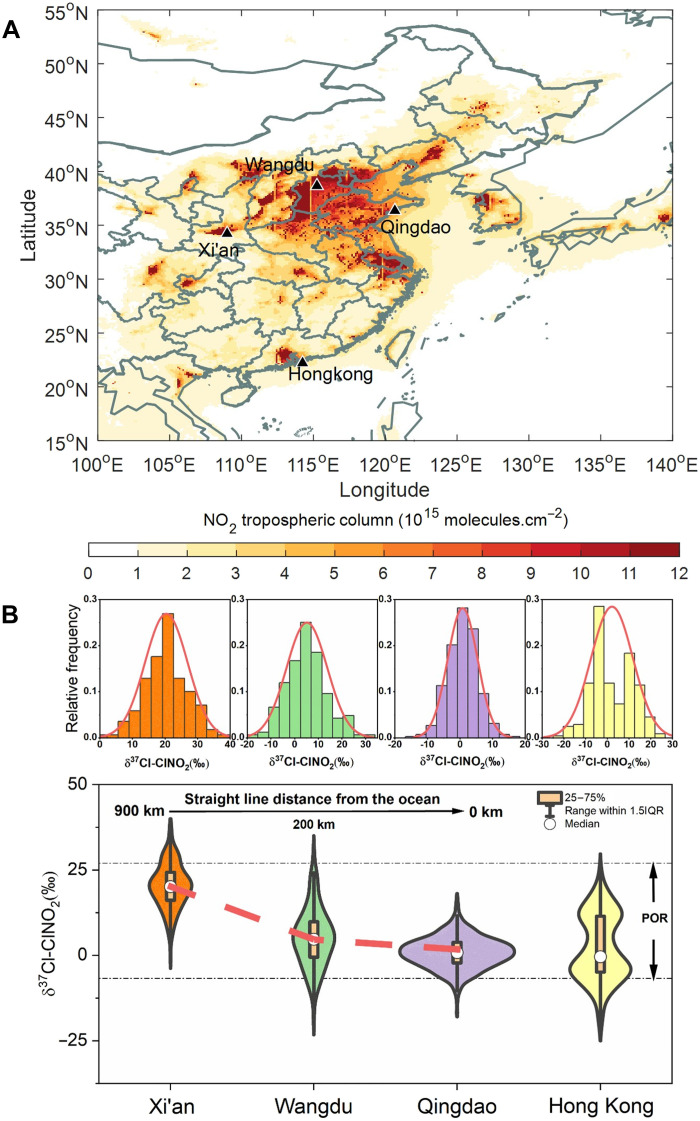 Figure 1
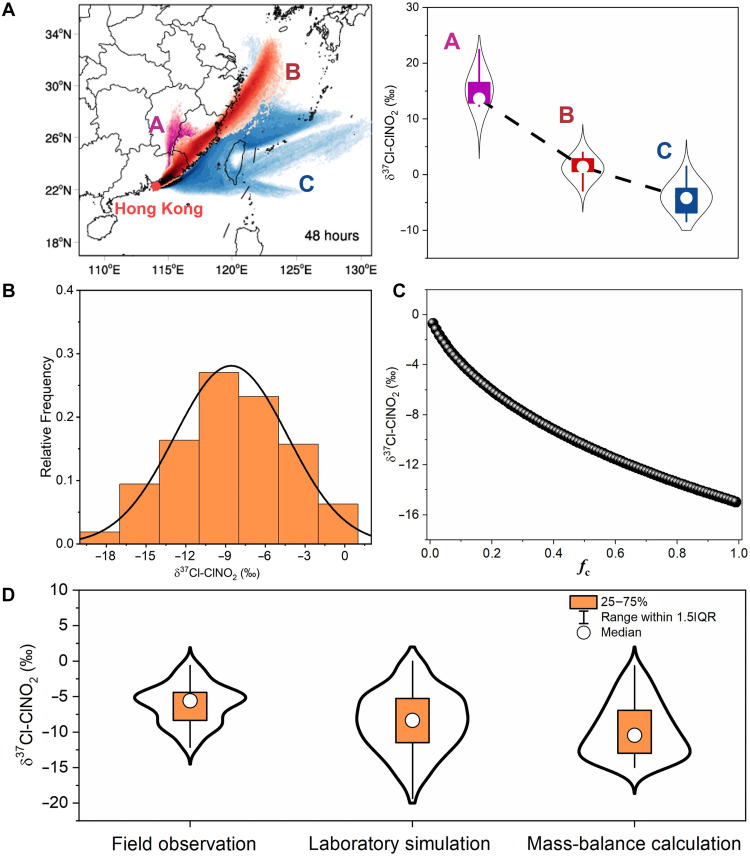 Figure 2
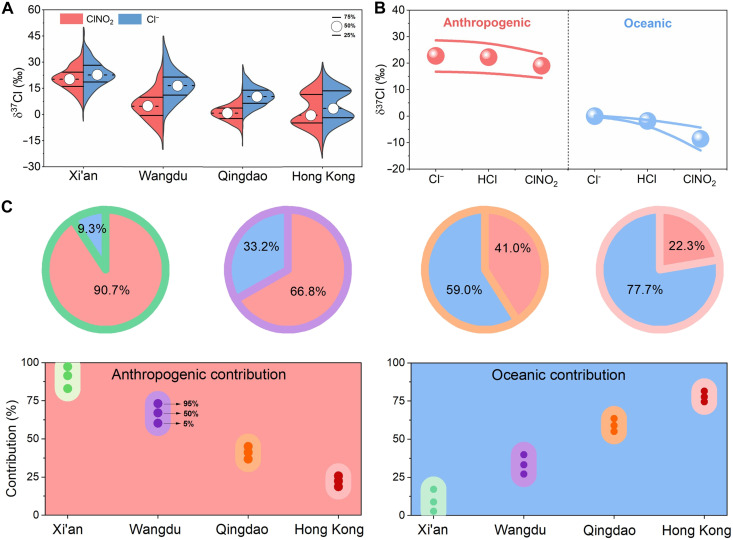 Figure 3
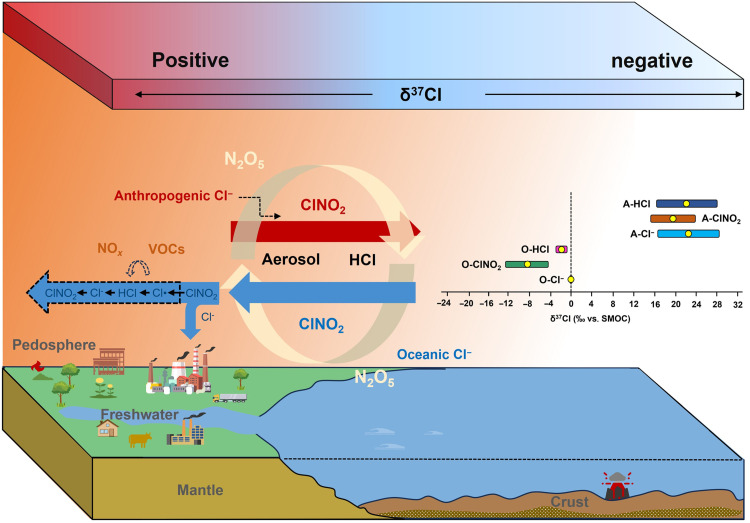 Figure 4
Peer Reviews
No public reviews on file for this paper yet. If you reviewed it on a platform where reviews are public (OpenReview, ICLR, NeurIPS, ICML), you can paste yours below so the community can read it here.
Videos
No videos yet. Explain this paper in a talk, walkthrough, or lecture? Add one.
Taxonomy
TopicsAtmospheric chemistry and aerosols · Atmospheric Ozone and Climate · Marine and coastal ecosystems