Braking Distance and Reaction Time Unchanged Across Hand-Use Conditions in Healthy Volunteers
Jacob Farley, Andrew Gaetano, Samuel Mircoff, Andrew Chen, Krishin Shivdasani, Dane Salazar, Nickolas Garbis

TL;DR
This study found that braking performance in healthy people does not change based on whether they use one or both hands while driving.
Contribution
It introduces a driving simulator method to evaluate braking performance under different hand-use conditions.
Findings
No significant differences in braking distance or reaction time across hand-use conditions.
Driving simulators can be useful for assessing driving abilities in rehabilitation contexts.
Abstract
Purpose The purpose of this study was to utilize driving simulator technology to evaluate braking time and distance, controlling for variables such as hand dominance and single versus both hand use. Methods This prospective observational study included healthy volunteers aged 18 and older with no recent upper extremity surgery. Data collected included age, hand dominance, and driving experience. Braking distance and reaction time were measured using Carnetsoft driving simulator software (Groningen, the Netherlands). The participants were instructed to use both hands, their dominant hand, or their non-dominant hand for each trial, accelerating to 60 miles per hour (mph) and decelerating to a stop, with 15 trials per participant, five per hand position. Linear mixed models were used to assess the association between hand use and braking time, accounting for multiple trials. Results…
Genes, proteins, chemicals, diseases, species, mutations and cell lines named across the full text — each resolved to its canonical identifier and authoritative record.
Click any figure to enlarge with its caption.
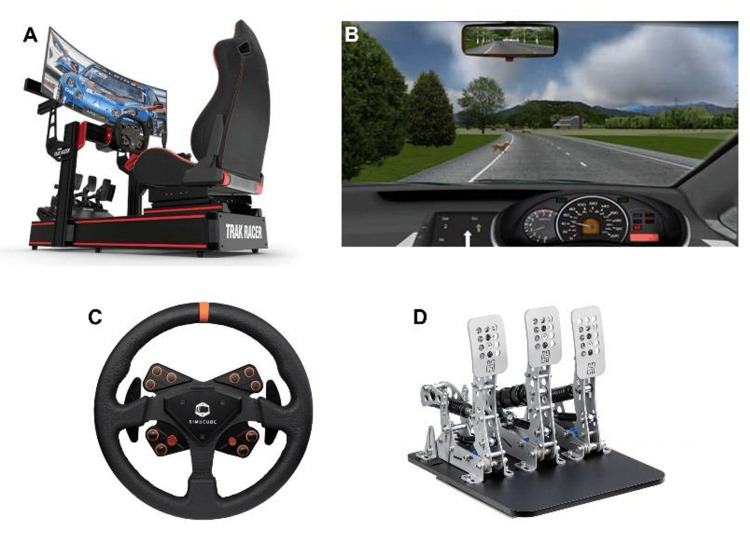 Figure 1
Peer Reviews
No public reviews on file for this paper yet. If you reviewed it on a platform where reviews are public (OpenReview, ICLR, NeurIPS, ICML), you can paste yours below so the community can read it here.
Videos
No videos yet. Explain this paper in a talk, walkthrough, or lecture? Add one.
Taxonomy
TopicsOlder Adults Driving Studies · Human-Automation Interaction and Safety · Spatial Neglect and Hemispheric Dysfunction