Nondestructive, fatigue cyclic, and ramped cyclic biomechanical testing of surgical techniques for stabilization of the lumbosacral junction in dogs
Lucas A. Smolders, Raphael Arz, Frank Steffen, Antonio Pozzi, Brian Park

TL;DR
This study compares three surgical techniques for stabilizing the lumbosacral junction in dogs and finds they all provide similar biomechanical stability.
Contribution
The study introduces a direct comparison of three stabilization methods using nondestructive and cyclic biomechanical testing in canine spines.
Findings
All three stabilization methods reduced range of motion equally in flexion/extension.
Fatigue and ramped cyclic testing showed similar performance across all groups.
Progressive screw loosening was the main failure mode for all techniques.
Abstract
To compare transarticular screw fixation (TSF), pedicle screw‐rod fixation (PSRF), and screws and polymethylmethacrylate (SPMMA) for stabilization of the canine lumbosacral junction (LSJ). Ex vivo biomechanical study. Twenty‐one L7‐S1 canine spine specimens collected from adult, large‐breed dogs. Specimens were subjected to nondestructive biomechanical testing in flexion/extension (FE), lateral bending (LB), and axial rotation (AR). Subsequently, the L7‐S1 joint was destabilized by dorsal laminectomy and partial discectomy of L7‐S1 and then stabilized by (1) TSF, (2) PSRF, or (3) SPMMA (n = 7 specimens/group). Stabilized specimens were subjected to nondestructive biomechanical testing, fatigue cyclic testing, and ramped cyclic testing. For nondestructive and fatigue cyclic testing, range of motion (ROM) was calculated for each testing condition/stabilization method, while for ramped…
Genes, proteins, chemicals, diseases, species, mutations and cell lines named across the full text — each resolved to its canonical identifier and authoritative record.
Click any figure to enlarge with its caption.
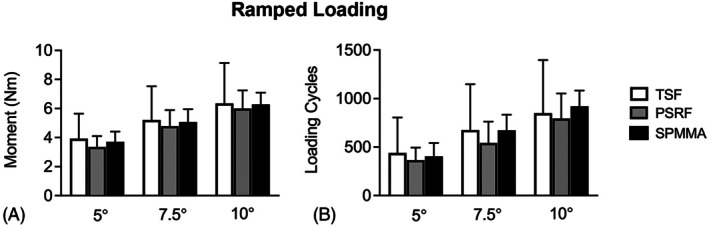 Figure 1
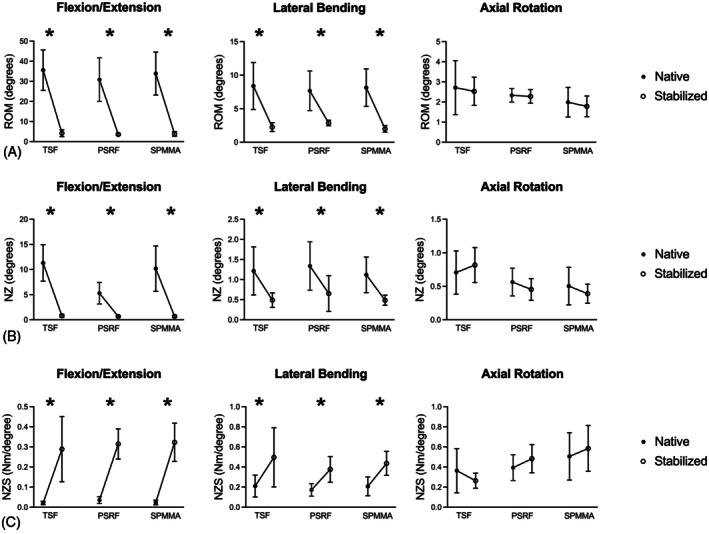 Figure 2
 Figure 3
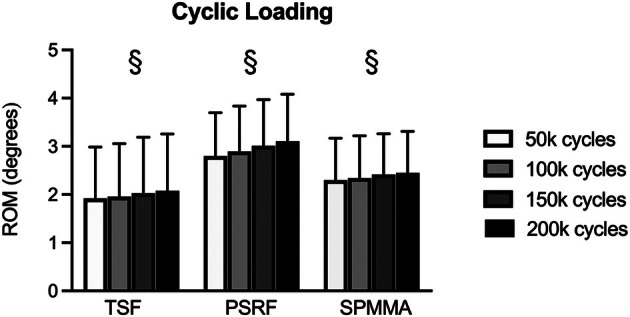 Figure 4
Peer Reviews
No public reviews on file for this paper yet. If you reviewed it on a platform where reviews are public (OpenReview, ICLR, NeurIPS, ICML), you can paste yours below so the community can read it here.
Videos
No videos yet. Explain this paper in a talk, walkthrough, or lecture? Add one.
Taxonomy
TopicsVeterinary Orthopedics and Neurology · Veterinary Oncology Research · Bone fractures and treatments