Beyond change scores: Employing an improved statistical approach to analyze the impact of entry fitness on physical performance during British Army basic training in men and women
Tessa D. Maroni, Andrew G. Siddall, Carla A. Rue, Sarah C. Needham‐Beck, Faye S. Walker, Julie P. Greeves, Sophie L. Wardle, Anne Fieldhouse, Stephen D. Myers, Sam D. Blacker

TL;DR
This study examines how initial physical fitness affects performance improvements in men and women during British Army basic training using a statistical approach.
Contribution
The study introduces an improved statistical method to analyze physical performance changes, revealing gender-specific responses to training.
Findings
Recruits with lower initial fitness showed greater improvements in physical performance during training.
Men demonstrated greater improvements than women when matched for initial fitness levels.
Training effectiveness is influenced by factors like age, maturity, and course duration.
Abstract
The aim was to use a robust statistical approach to examine whether physical fitness at entry influences performance changes between men and women undertaking British Army basic training (BT). Performance of 2 km run, seated medicine ball throw (MBT) and isometric mid‐thigh pull (MTP) were assessed at entry and completion of Standard Entry (SE), Junior Entry‐Short (JE‐Short), and Junior Entry‐Long (JE‐Long) training for 2350 (272 women) recruits. Performance change was analyzed with entry performance as a covariate (ANCOVA), with an additional interaction term allowing different slopes for courses and genders (p < 0.05). Overall, BT courses saw average improvements in 2 km run performance (SE: −6.8% [−0.62 min], JE‐Short: −4.6% [−0.43 min], JE‐Long: −7.7% [−0.70 min]; all p < 0.001) and MBT (1.0–8.8% [0.04–0.34 m]; all p < 0.05) and MTP (4.5–26.9% [6.5–28.8 kg]; all p < 0.001).…
Genes, proteins, chemicals, diseases, species, mutations and cell lines named across the full text — each resolved to its canonical identifier and authoritative record.
Click any figure to enlarge with its caption.
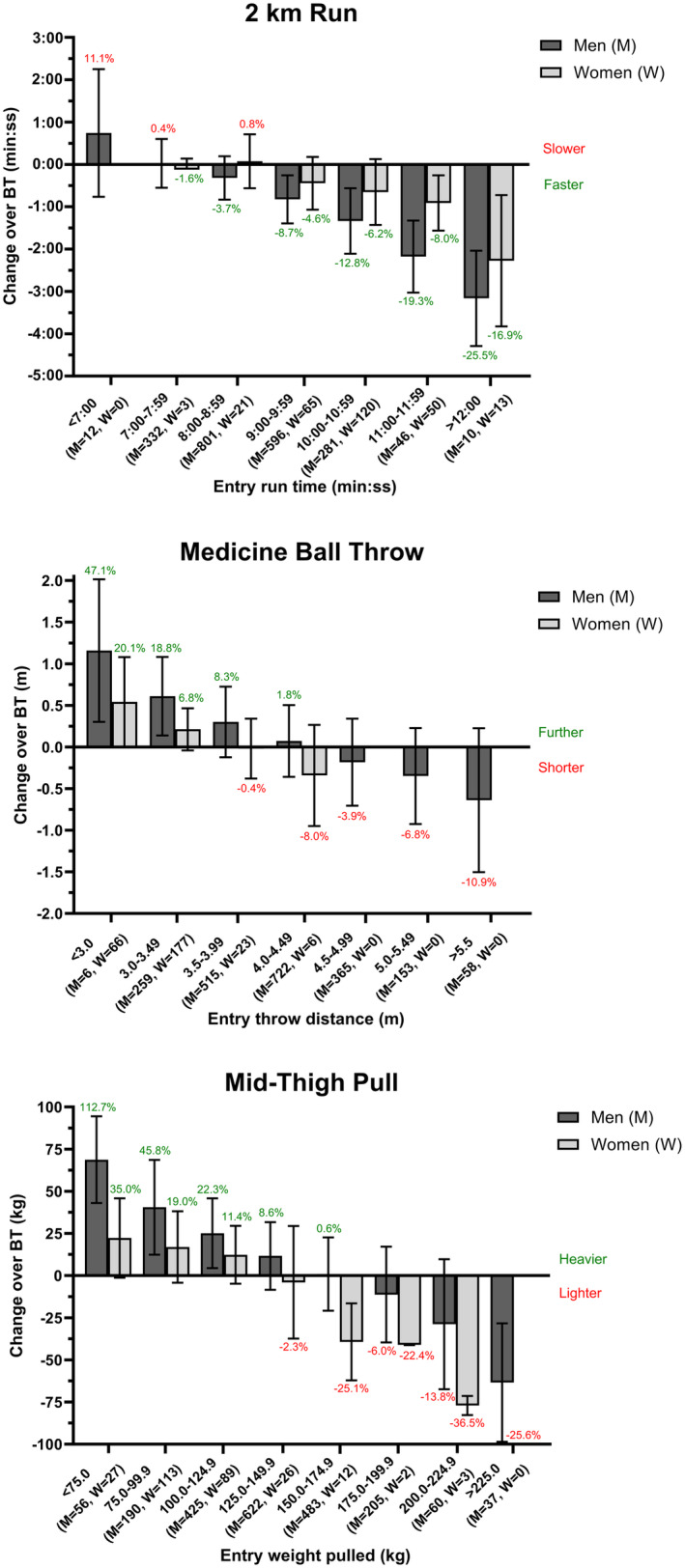 Figure 1
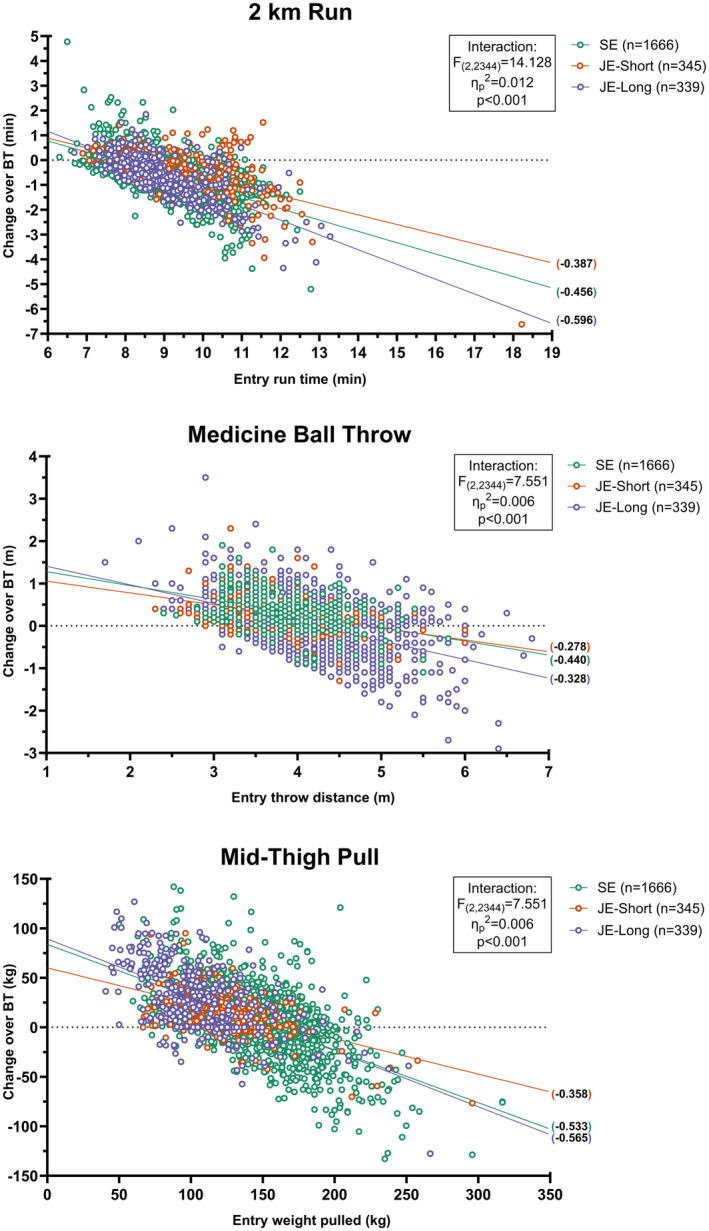 Figure 2
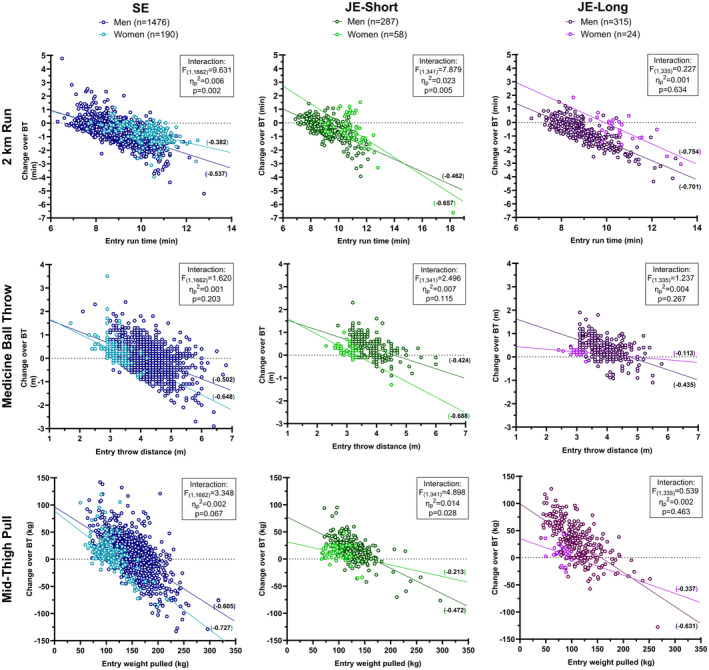 Figure 3
Peer Reviews
No public reviews on file for this paper yet. If you reviewed it on a platform where reviews are public (OpenReview, ICLR, NeurIPS, ICML), you can paste yours below so the community can read it here.
Videos
No videos yet. Explain this paper in a talk, walkthrough, or lecture? Add one.
Taxonomy
TopicsSports Performance and Training · Occupational Health and Performance · Sports injuries and prevention