Revisiting CN− Formation Mechanisms in Electron Collisions with Benzonitrile
Rodrigo Rodrigues, Mónica Mendes, Daniel Bou‐Debes, João Ameixa, Ali Kamali, Oddur Ingólfsson, Samuel Eden, Lucas M. Cornetta, Filipe Ferreira da Silva

TL;DR
This study investigates how CN− ions form when electrons collide with benzonitrile, revealing key energy thresholds and chemical pathways important for interstellar chemistry.
Contribution
The paper provides the first G4(MP2) threshold energies and CASPT2 calculations for CN− formation in benzonitrile, revealing resonance coupling mechanisms.
Findings
CN− formation occurs at 3.0 eV and 7–10 eV via π4* and σ* resonance coupling.
Threshold energies for dissociation channels are reported at the G4(MP2) level for the first time.
Core excited π4* and σ* resonances contribute strongly to CN− formation in the 7–10 eV range.
Abstract
Radiation‐induced processes in the aromatic cyano compound benzonitrile have attracted renewed interest since its detection in the interstellar medium in 2018, and recent studies have elucidated dissociative ionization pathways leading to species such as CN• and HCN, which can play important roles in interstellar chemistry. This work explores negative ion formation from benzonitrile upon electron attachment with mass spectrometry experiments and the most extensive theoretical study to date of the underlying negative ion states and their respective dissociative relaxation pathways. The measurements confirm the previously reported CN− formation at a collision energy of 3.0 eV as well as formation of the dehydrogenated parent anion and phenyl anion and CN− formation in the 7–10 eV energy range. Threshold energies for these dissociation channels are reported at the G4(MP2) level of theory…
Genes, proteins, chemicals, diseases, species, mutations and cell lines named across the full text — each resolved to its canonical identifier and authoritative record.
Click any figure to enlarge with its caption.
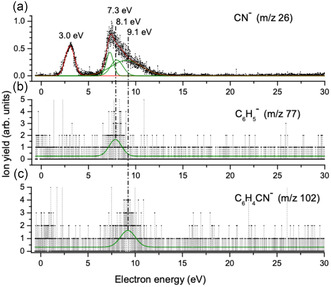 Figure 1
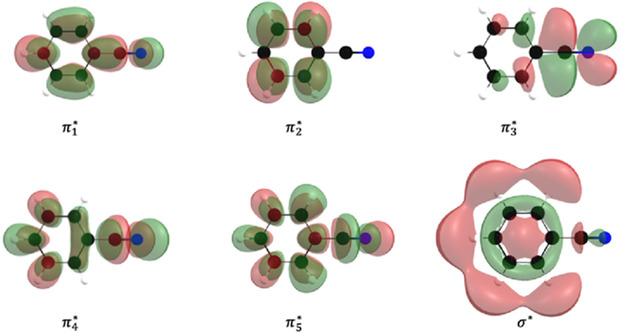 Figure 2
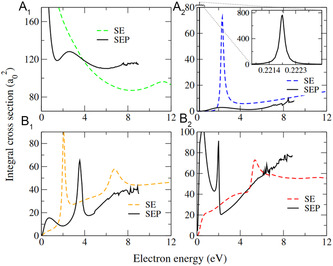 Figure 3
 Figure 4
Peer Reviews
No public reviews on file for this paper yet. If you reviewed it on a platform where reviews are public (OpenReview, ICLR, NeurIPS, ICML), you can paste yours below so the community can read it here.
Videos
No videos yet. Explain this paper in a talk, walkthrough, or lecture? Add one.
Taxonomy
TopicsAdvanced Chemical Physics Studies · Atmospheric Ozone and Climate · Molecular Spectroscopy and Structure