Assessing Pathways to Carbon Neutrality in the Ceramic Sector: A Prospective Life Cycle Assessment under Energy System Projections and Technology Scenarios
Ángel Galán-Martín, Richard Cabrera-Jimenez, Salvador Bueno-Rodríguez, Rosendo Jesús Galán-Arboledas, Gonzalo Guillén-Gosálbez

TL;DR
This study explores ways to reduce carbon emissions in ceramic brick production by evaluating different technologies and energy scenarios.
Contribution
The study introduces a prospective life cycle assessment of decarbonization pathways in the ceramic sector using detailed industrial data and energy projections.
Findings
Using heat pumps for low-temperature drying can reduce global warming potential by up to 24%.
Fuel-switching to hydrogen or biogas can reduce global warming potential by around 85% under net-zero conditions.
Biogas combustion with carbon capture and storage achieves net-negative emissions, reaching up to −73.05 kg CO2-eq per tonne by 2050.
Abstract
Ceramic manufacturing is a hard-to-abate industry given its intrinsic reliance on high-temperature operations and fossil-based thermal energy. Capitalizing on detailed industrial data, this study presents a prospective life cycle assessment of decarbonization pathways for ceramic brick production grounded in forward-looking energy system projections. Six technology adoption scenarios are evaluated for 2020 and 2050 under both current policy and net-zero trajectories. Results show that integrating heat pumps today for low-temperature drying can reduce the global warming potential (GWP) by up to 24% compared to continued natural gas use. Fuel-switching to hydrogen or biogas enables substantial reductions in the GWP of around 85% under net-zero conditions. Notably, coupling biogas combustion with carbon capture and storage (CCS) already achieves net-negative emissions, reaching −29.95 kg…
Genes, proteins, chemicals, diseases, species, mutations and cell lines named across the full text — each resolved to its canonical identifier and authoritative record.
Click any figure to enlarge with its caption.
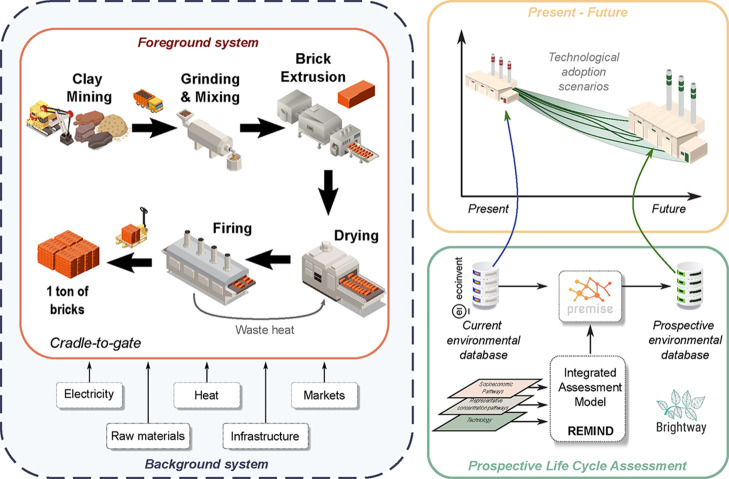 Figure 1
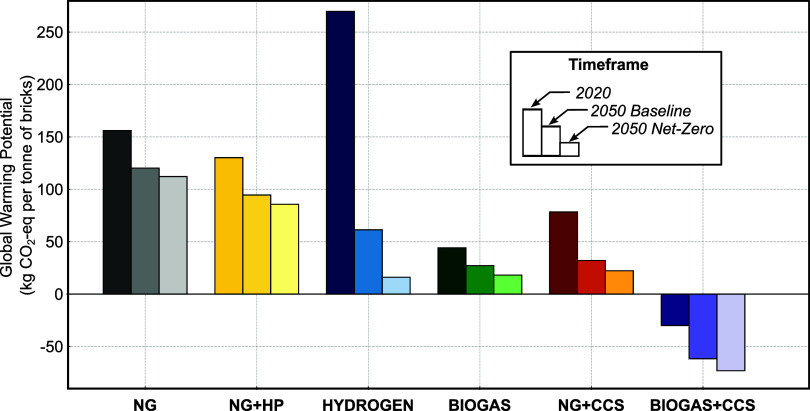 Figure 2
 Figure 3
 Figure 4
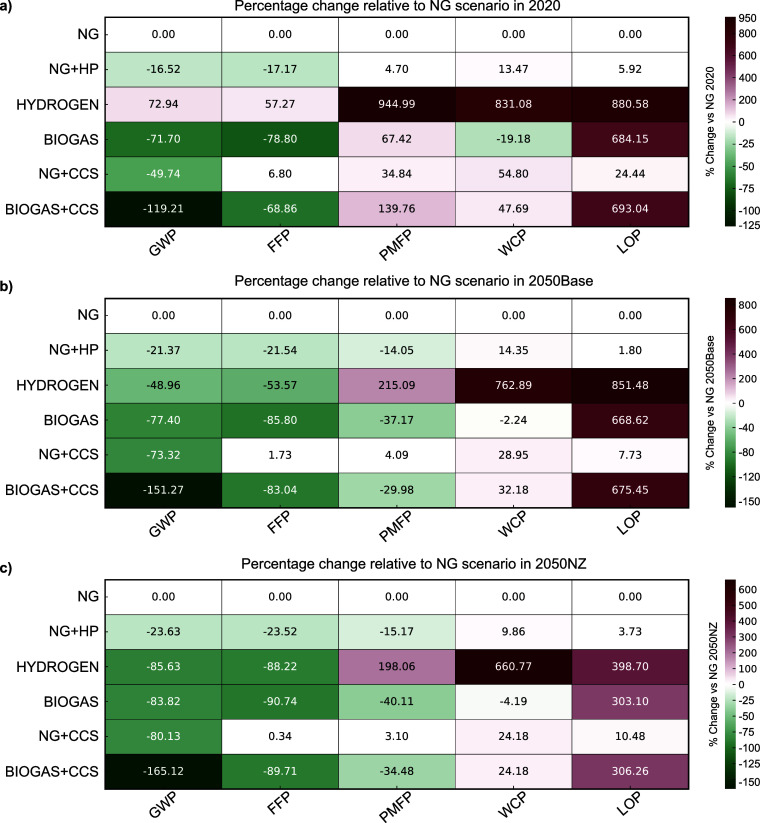 Figure 5
 Figure 6
 Figure 7
Peer Reviews
No public reviews on file for this paper yet. If you reviewed it on a platform where reviews are public (OpenReview, ICLR, NeurIPS, ICML), you can paste yours below so the community can read it here.
Videos
No videos yet. Explain this paper in a talk, walkthrough, or lecture? Add one.
Taxonomy
TopicsEnvironmental Impact and Sustainability · Thermodynamic and Exergetic Analyses of Power and Cooling Systems · Integrated Energy Systems Optimization