Bridging the gaps for women in substance use treatment
Nancy Poole

TL;DR
This paper highlights gaps in substance use treatment for women and suggests focusing on four gender-specific elements to improve care.
Contribution
The paper identifies four key elements for gender-specific treatment to address existing gaps for women in substance use care.
Findings
Gaps in treatment and support persist for women with substance use concerns.
Four elements of gender-specific treatment could help improve outcomes for women.
Discussions with Canadian treatment providers informed the identified gaps and solutions.
Abstract
This perspective provides an overview of a rapid review of research, and discussions held with Canadian treatment providers, that together illustrate how gaps persist in treatment and support for women with substance use concerns; and how attention to four elements of gender-specific treatment for women could ameliorate the situation.
Genes, proteins, chemicals, diseases, species, mutations and cell lines named across the full text — each resolved to its canonical identifier and authoritative record.
Click any figure to enlarge with its caption.
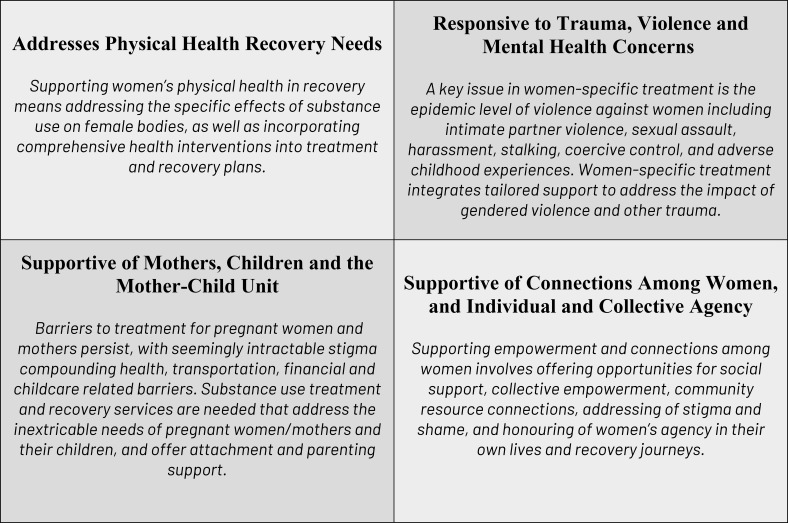 Figure 1
- —Canadian Institutes of Health Research10.13039/501100000024
Peer Reviews
No public reviews on file for this paper yet. If you reviewed it on a platform where reviews are public (OpenReview, ICLR, NeurIPS, ICML), you can paste yours below so the community can read it here.
Videos
No videos yet. Explain this paper in a talk, walkthrough, or lecture? Add one.
Taxonomy
TopicsSubstance Abuse Treatment and Outcomes · Sex and Gender in Healthcare · Prenatal Substance Exposure Effects
Introduction
1
In 2004, the United Nations Office on Drugs and Crime (UNODC) released the Substance Use Treatment and Care for Women report, which captured case studies and lessons learned in efforts to develop and improve substance use treatment globally. In this report, the authors defined “gender responsive” substance use treatment programs as those that considered the needs of women in all aspects of their design and delivery (1). Guiding principles for gender responsive treatment included: creating supportive environments; initiating relational practices and policies; integrating mental health, substance use and trauma/violence services; improving the social determinants of health; and creating community based comprehensive care (1).
Over twenty years later, action is still needed on gender responsive treatment, that addresses both the sex-related (biological) and gender-related (social) factors affecting the health and wellbeing of women who use substances, and their children. Such action is now critical, as the prevalence of substance use by women and girls continues to increase (2–4), and there is increased evidence of the harms of substance use on women’s health (5, 6).
In 2024, the Centre of Excellence for Women’s Health invited Canadian researchers and service providers interested in women’s substance use treatment and recovery to three virtual meetings to discuss research and service delivery priorities for the advancement of gender specific treatment and recovery. In addition, we conducted a rapid review of best practices in sex- and gender-informed treatment and recovery for women and girls, and an environmental scan of gender-specific treatment and recovery programs for women across the country.
This perspective article provides an overview of the research and discussions, that illustrate how gaps persist in treatment and support for women with substance use concerns, and how attention to four elements of gender-specific treatment for women could ameliorate the situation.
Women’s substance use treatment requiring action
2
Canadian treatment providers identified four elements of women’s substance use treatment (see Figure 1) requiring further attention and action. Underlying these four elements are social and structural determinants of health, and Indigenous cultural wellness principles of generating a sense of purpose and belonging, and introducing meaning and hope to women who are using substances (7, 8).
Four elements of women’s substance use treatment and recovery.
Addresses physical health needs
2.1
Women constitute a vulnerable population in need of tailored substance use treatment and recovery support because women in treatment often have sex- and gender-specific co-occurring physical illnesses and health conditions (9, 10), such as liver, kidney, gastrointestinal, and heart diseases; difficulties with ovulation and menstruation; cancers; increased risk of sexual victimization; and anxiety, depressive, posttraumatic stress, and related health issues (5, 10–13). Women in treatment also report higher rates of chronic pain and are prescribed, and rely on, opioid medications more often than men (14). Thus, in treatment settings it is important to provide education and programming that is responsive to the impacts of substance use on female bodies, and to proactively support physical health recovery.
In Canada, researchers have identified ways in which treatment programs have integrated physical health interventions such as primary care, obstetrics and gynecology services, dental care, physiotherapy, complementary therapies, and fitness/exercise programs, as part of women’s treatment (15–18). Elsewhere, treatment and recovery programs have also integrated physical health topics into programming, addressing themes such as the effects of substances on women’s health, sexually transmitted and blood borne diseases, nutrition, and women’s health issues overall (19–22). However, it is still not a standard response to offer integrated physical health supports or sex-specific health education in women’s treatment and recovery.
Treatment providers and researchers in our meetings discussed the need to advance both research and practice to better address women’s physical health in recovery. They emphasized the importance of coordinated care, greater access to health care professionals, and the benefits and opportunities of partnering with recreational organizations to integrate physical exercise in therapy. Participants also called for free and trauma-informed dental care, along with training in motivational interviewing and trauma-informed care for medical and dental professionals in order to create a more supportive healthcare environment for women in recovery. In summary, they highlighted the need for increased efforts to improve service integration and the provision and evaluation of physical health interventions.
Responsive to trauma, violence, and mental health concerns
2.2
A key issue in women-specific treatment is the high rates of endemic violence against women including intimate partner violence, sexual assault, harassment, stalking, coercive control, and adverse childhood experiences. However, there remains limited programming that addresses violence related and substance use recovery issues together (23). A recent systematic review that mapped strategies for addressing gender-based violence in substance use treatment for women found that risk factors for gender-based violence and addiction included: partner’s substance use, polysubstance use, substance use in sexual relations, lack of social support, financial dependence, childhood sexual abuse, ongoing trauma, recent imprisonment, mental health issues, sex work, and sex with the risk of HIV or pregnancy (24). The systematic review further identified barriers to treatment, such as partner’s substance use, coercive control, fear of child removal, interpersonal stigma, poor communication by health care providers, and a lack of understanding of the mechanisms of violence. Conversely, the most important protective factors included abstinence, family support, and concern for children (24).
While responses to concurrent violence and substance use are much needed, there has been more exhaustive research and practice responses for women experiencing co-occurring mental health and substance use challenges. For example, in our rapid review, a systematic review was identified that described gender-responsive substance use disorder treatment programs for women with co-occurring disorders that suggested that integrated interventions performed similarly, or were more effective, than standard treatment programming, particularly when addressing trauma and mental health issues (21). Integrated interventions such as Seeking Safety (25) and Helping Women Recover (26) showed better outcomes in trauma and psychiatric symptoms, and higher client satisfaction and treatment adherence, compared to standard treatments (21). Several studies also examined the outcomes from a sober living home model that integrates trauma-informed care, gender-responsive and transitional housing, with peer mentoring, gender-based violence support groups, case management, and skills training (27, 28). The findings indicated that women report reduced depression and an increased sense of community, an important factor in women’s recovery.
In the meetings with Canadian treatment providers and researchers, participants described the ways in which they were addressing violence, trauma, and mental health so as to better support women who use substances. Treatment providers noted how they focus on relationship building and creating safe, supportive environments through offering both trauma-informed and trauma-specific services to meet clients’ various needs. Despite these promising practices, they also identified a pressing need for further research into effective prevention and healing intervention strategies to be offered during treatment (29), as well as advanced, accessible trauma-informed training for staff (30). In addition, aftercare interventions that address trauma, violence and substance use concerns in an integrated way (23), and systemic improvements were identified such as those related to housing and poverty that will prevent re-traumatization, support health recovery, and increase stability after treatment.
Supportive of mothers, children, and the mother-child unit
2.3
Treatment that is welcoming, accessible, and tailored to pregnant women and gender diverse individuals and new mothers with substance use concerns, and their children is critically needed. Stigma and fear of losing child custody have long acted as very strong barriers to women disclosing substance use and accessing help (31). Treatment programming designed and tailored to meet the needs of mothers and children in an integrated way has not been accessible, and instead systems have historically viewed the needs of mothers with substance use concerns and their children as in conflict and disconnected, and therefore not worthy of connected support and treatment (32).
Research is emerging that documents how to provide treatment that effectively meets the needs of pregnant and parenting women with substance use concerns, including codesigned programs (33). Treatment and recovery services that recognize the mother, child, and mother-child bond as three unique foci may be best able to support important attachment and parenting needs, and enhance women’s relational skills and capacity to connect to treatment providers (34, 35). While limited in availability, family centered treatment options, such as those that offer live-in programming for women and their children, often act as a facilitator to women’s treatment access and retention (36, 37). Modalities are essential such as day or outpatient treatment that can ameliorate barriers to care, and integrated, wraparound services that bring together multidisciplinary service providers (38).
Integrated and wraparound programs, including those that offer primary, prenatal and pediatric care; psychiatry; midwifery; counselling; case management; outreach; food and nutritional support; child development and care workers; cultural supports; family supports; peer workers; and housing, employment and income workers have been evidenced in Canada (16, 38–40). Outpatient treatment, community-based services, and modalities such as home visitation and case management have also been found effective to reduce substance use, respond to complex and interconnected social determinants of health, support parenting, and foster the mother-child bond (41–43).
All of these interventions are dependent upon the recognition of the capacity and right of mothers with substance use concerns to parent, and active collaboration between child welfare authorities and substance use treatment systems of care (32, 44).
In our three-part meeting with Canadian treatment providers and researchers, the need for all these approaches were confirmed. The programs that are available echo the research, in that they integrate treatment and comprehensive support. However, while there are some specialized programs dedicated to supporting pregnant and newly parenting women, these are not readily available. Strategies remain very much needed that can facilitate and strengthen linkages between governments and community organizations to support the provision of comprehensive care that addresses maternal health, mental health, child health, substance use, housing, Indigenous-wellness and other wraparound programming elements.
Supportive of connections among women, and individual and collective agency
2.4
A final critical area of action in women’s treatment is that which is supportive of women’s empowerment, agency, and connections among women.
Early research from the Women, Co-occurring Disorders and Violence Study (WCDVS) brought together representatives from nine study sites and project consultants to define an empowerment model (45, 46). In doing so, they highlighted that an empowerment model: recognized the partnership between service users and providers, where treatment goals are collaboratively developed; women’s issues are addressed in a wider socioenvironmental context including the pervasiveness of violence and trauma; women’s choices are validated; and women are provided space to support each other, learn from their experiences, and build skills (45). This research was pivotal, as it demonstrated the principles that underly an empowerment model, while also illustrating for the various ways in which empowerment and agency are fostered.
The fostering of connections and community among women has emerged as an important mechanism of empowerment and recovery, with research demonstrating the importance of group cohesion and building a sense of belonging and community (47) - a sentiment also reflected in research on culture-informed approaches to treatment for Indigenous Peoples (8). Peer support models are uniquely positioned to support connections among diverse women and promote empowerment (48–50). Such models provide the context for discussing women’s common “social pain” and inspiring paths to recovery (51, 52).
Empowerment, and the building of networks and support, emerge as key themes in research and practice. Service providers want to be able to offer treatment programs that focus on building self-confidence, assertiveness, and that support women to develop social networks and a more positive self-identity (53, 54). However, more research is needed that considers how experiences of empowerment, connection, and agency are influenced by race/ethnicity, ability, age, income, and other equity factors.
Further, finding measurement tools to accurately reflect women’s experiences and feelings of connection is needed. While qualitative measures, such as client testimonials and journey mapping were highlighted as important for amplifying women’s voices and experiences, quantitative measures were also seen as important for capturing the impact of services in this domain. Documentation of recovery journeys, demonstration of the value of multiple types of support, longitudinal outcomes, and relational measurement tools were all suggested as potential enhancements to current evaluation practices, so that the emphasis on empowerment, connection, and agency continues.
Discussion
3
In the late 1990s and early 2000s, advances were made in research and practice on gender responsive substance use treatment for women. In the interim, we have seen increased rates of alcohol and other substance use by women, advances in sex and gender science, attention to social and structural determinants of health, increased understanding of trauma informed care, and emergent wisdom as to Indigenous culture as intervention for addiction, that can all inform sex/gender and equity informed approaches to substance use treatment and recovery. We urgently need a resurgence of interest in gender responsive treatment options that incorporate and reflect the influence of these sex/gender and equity-related factors affecting the health and wellbeing of women who use substances, and their children in Canada and beyond. In a rapid review of evidence and with Canadian service providers, we identified four key areas of women’s treatment that constitute a place to start in making a difference to the lives of women and their children as they navigate substance use treatment and recovery pathways. However, much more research and practice improvement remains to be achieved if we are to address all the sex/gender and equity-related factors influencing substance use by women, the significant barriers to care and recovery, and create overall system improvements that will provide wider access to tailored approaches for a broad range of women and their children.
The reference list from the paper itself. Each links out to its DOI / PubMed record.
- 1United Nations Office on Drugs and Crime . Substance Abuse Treatment and Care for Women: Case Studies and Lessons Learned. Vienna, Austria: United Nations Office on Drugs and Crime. (2004).
- 2Canadian Centre on Substance Use and Addiction . Alcohol. (2019). Available online at: https://www.ccsa.ca/sites/default/files/2020-10/CCSA-Canadian-Drug-Summary-Alcohol-2019-en.pdf (Accessed November 11, 2025).
- 3Greaves L Hemsing N . Sex and gender interactions on the use and impact of recreational cannabis. Int J Environ Res Public Health. (2020) 17:509. doi: 10.3390/ijerph 17020509., PMID: 31947505 PMC 7014129 · doi ↗ · pubmed ↗
- 4Keyes KM Jager J Mal-Sarkar T Patrick ME Rutherford C Hasin D . Is there a recent epidemic of women’s drinking? A critical review of national studies. Alcohol Clin Exp Res. (2019) 43:1344–59. doi: 10.1111/acer.14082, PMID: 31074877 PMC 6602861 · doi ↗ · pubmed ↗
- 5Greaves L Poole N Brabete AC . Sex, gender and alcohol use: Implications for women and low risk drinking guidelines. Int J Environ Res Public Health. (2023) 19:4523. doi: 10.3390/ijerph 19084523, PMID: 35457389 PMC 9028341 · doi ↗ · pubmed ↗
- 6National Institute on Drug Abuse . Sex Differences in Substance Use. National Institute on Drug Abuse website. (2020). Available online at: https://nida.nih.gov/publications/research-reports/substance-use-in-women/sex-differences-in-substance-use (Accessed November 11, 2025).
- 7Rowan M Poole N Shea B Gone JP Myota D Farag M . Cultural interventions to treat addictions in Indigenous populations: Findings from a scoping study. Subst Abuse Treatment Prevention Policy. (2014) 9:1–26. doi: 10.1186/1747-597X-9-34, PMID: 25179797 PMC 4158387 · doi ↗ · pubmed ↗
- 8Thunderbird Partnership Foundation . Indigenous wellness framework reference guide (2020). Available online at: https://www.thunderbirdpf.org/IWF (Accessed November 11, 2025).