Mapping the global public health intelligence landscape: a multiregional cross-sectional survey
Alba Méndez-Brito, Romy Kerber, Gianfranco Spiteri, Kyeng Mercy Tetuh, Angela Fehr, Christine Manthey, Kokou Nouwame Alinon, Sarah Esquevin, Neil Squires, Andreas Jansen, Carlos L. Correa-Martínez

TL;DR
This study maps global public health intelligence teams to improve collaboration and threat detection by analyzing their activities and challenges.
Contribution
The paper provides the first comprehensive global survey of public health intelligence teams, highlighting their roles and opportunities for collaboration.
Findings
132 public health intelligence teams from 87 countries were identified, primarily in public health institutions and ministries.
Most teams focus on communicable diseases and antimicrobial resistance, with significant interest in capacity building and networking.
Only 43% of teams are part of early event detection networks, indicating a need for improved coordination and resource sharing.
Abstract
Public health intelligence (PHI) allows for timely detection of public health threats. Exchange and close cooperation between PHI teams are crucial for early threat detection and standards harmonization, yet a comprehensive overview documenting their activities is lacking. We aimed to enhance mutual awareness and collaboration possibilities by mapping and characterizing PHI teams. We developed and distributed an online survey through network sampling (June-November 2023) via regional Centres for Disease Prevention and Control (Africa CDC, ECDC, US CDC), the International Association of National Public Health Institutes (IANPHI), the Robert Koch-Institute, and the World Health Organization (WHO). We identified and described PHI teams and their activities, including implementation of PHI processes, workforce, capacity building, priorities and perspectives on challenges and opportunities,…
Genes, proteins, chemicals, diseases, species, mutations and cell lines named across the full text — each resolved to its canonical identifier and authoritative record.
Click any figure to enlarge with its caption.
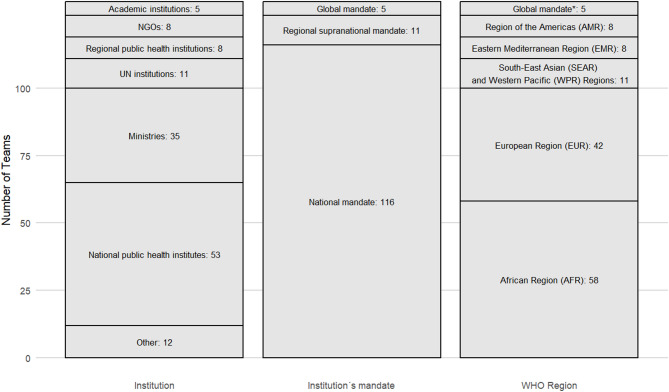 Figure 1
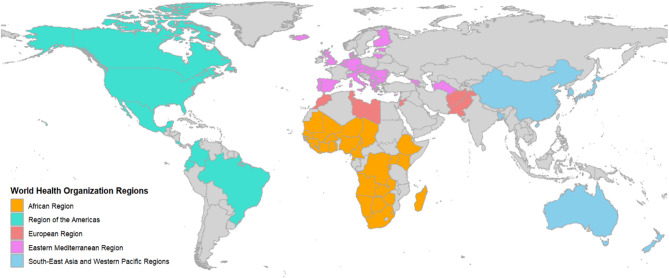 Figure 2
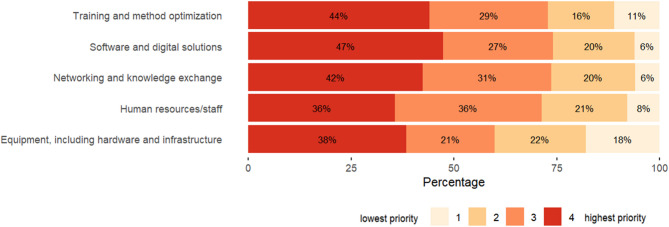 Figure 3
Peer Reviews
No public reviews on file for this paper yet. If you reviewed it on a platform where reviews are public (OpenReview, ICLR, NeurIPS, ICML), you can paste yours below so the community can read it here.
Videos
No videos yet. Explain this paper in a talk, walkthrough, or lecture? Add one.
Taxonomy
TopicsData-Driven Disease Surveillance · Viral Infections and Outbreaks Research · Bacillus and Francisella bacterial research