Repeatability of Relative Free Energy Calculations in Solution with ANI-2x and MACE-OFF23
Sara Tkaczyk, Thierry Langer, Marcus Wieder, Andrea Rizzi, Stefan Boresch

TL;DR
The study examines how well neural network potentials can predict tautomeric states in water, finding that one model is reliable while another shows inconsistent results due to poor sampling.
Contribution
A novel energy mixing approach for alchemical free energy calculations using NNPs, revealing performance differences between ANI-2x and MACE-OFF23.
Findings
MACE-OFF23 produced converged free energy results, while ANI-2x showed significant variability.
ANI-2x's issues stem from slow water dynamics and overstabilization of metastable states.
The energy mixing method is generalizable to other alchemical transformations.
Abstract
We investigate the feasibility and challenges of using neural network potentials (NNPs) for alchemical free energy calculations, employing a single-coordinate dual-topology approach. As a model application, we compute free energy differences between tautomer pairs to predict the preferred tautomeric state in aqueous solution. A central aspect of our approach is based on energy mixing via the selective masking of interactions involving dummy atoms, enabling a smooth interpolation between tautomeric states. This methodology is independent of the specific NNP architecture and holds potential for broader application to larger alchemical transformations. We tested this framework using two well-known NNPs: ANI-2x and MACE-OFF23(small). While MACE-OFF23(small) produced converged free energy results, simulations with ANI-2x showed significant variability across repeated runs. Our analysis…
Genes, proteins, chemicals, diseases, species, mutations and cell lines named across the full text — each resolved to its canonical identifier and authoritative record.
Click any figure to enlarge with its caption.
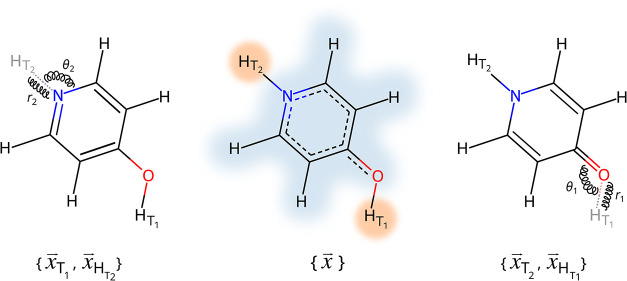 Figure 1
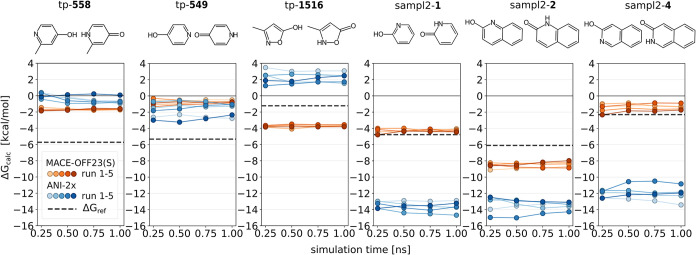 Figure 2
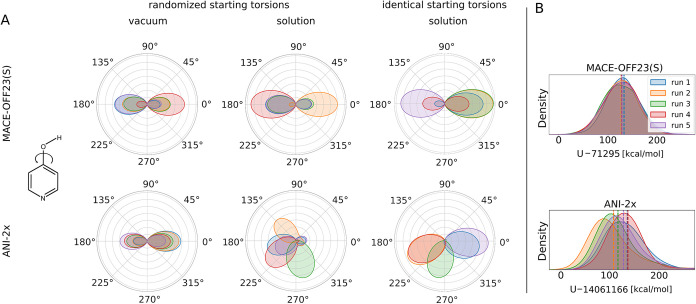 Figure 3
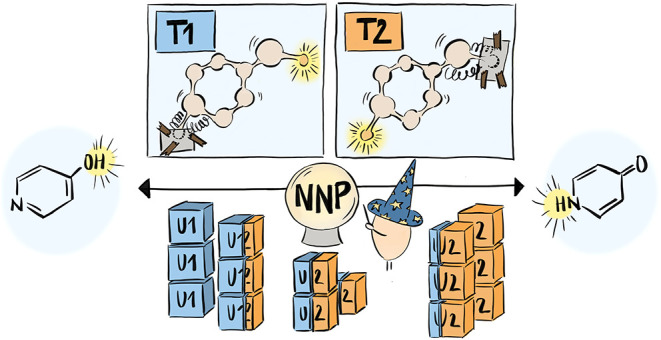 Figure 4
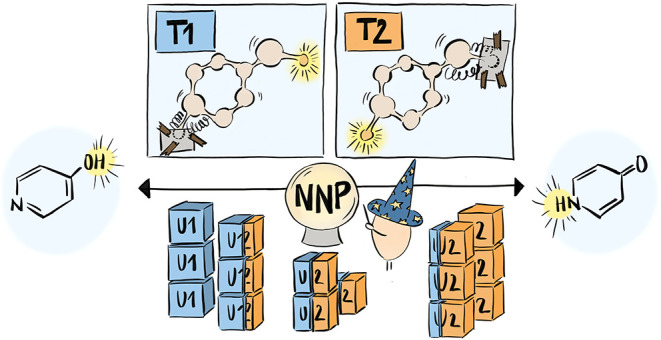 Figure 5
 Figure 6
 Figure 7
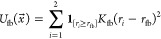 Figure 8
Peer Reviews
No public reviews on file for this paper yet. If you reviewed it on a platform where reviews are public (OpenReview, ICLR, NeurIPS, ICML), you can paste yours below so the community can read it here.
Videos
No videos yet. Explain this paper in a talk, walkthrough, or lecture? Add one.
Taxonomy
TopicsMachine Learning in Materials Science · Spectroscopy and Quantum Chemical Studies · Quantum many-body systems