Estimating the causal effect of redlining on present-day air pollution
Xiaodan Zhou, Shu Yang, Brian J Reich

TL;DR
This study investigates how historical redlining policies caused long-term air pollution disparities in present-day neighborhoods.
Contribution
The paper introduces a novel spatial and non-spatial latent factor framework to estimate the causal effects of redlining on air pollution.
Findings
Historically redlined neighborhoods are exposed to notably higher NO₂ concentrations.
Disparities in PM₂.₅ between redlined and non-redlined neighborhoods are less pronounced.
Los Angeles and Atlanta show the most significant pollution effects for both NO₂ and PM₂.₅.
Abstract
Recent studies have shown associations between redlining policies (1935–1974) and present-day fine particulate matter (PM\documentclass[12pt]{minimal} \usepackage{amsmath} \usepackage{wasysym} \usepackage{amsfonts} \usepackage{amssymb} \usepackage{amsbsy} \usepackage{upgreek} \usepackage{mathrsfs} \setlength{\oddsidemargin}{-69pt} \begin{document} \end{document}) and nitrogen dioxide (NO\documentclass[12pt]{minimal} \usepackage{amsmath} \usepackage{wasysym} \usepackage{amsfonts} \usepackage{amssymb} \usepackage{amsbsy} \usepackage{upgreek} \usepackage{mathrsfs} \setlength{\oddsidemargin}{-69pt} \begin{document} \end{document}) air pollution concentrations. In this paper, we move beyond associations and investigate the causal effects of redlining using spatial causal inference. Redlining policies were enacted in the 1930s, so there is very limited documentation of…
Genes, proteins, chemicals, diseases, species, mutations and cell lines named across the full text — each resolved to its canonical identifier and authoritative record.
Click any figure to enlarge with its caption.
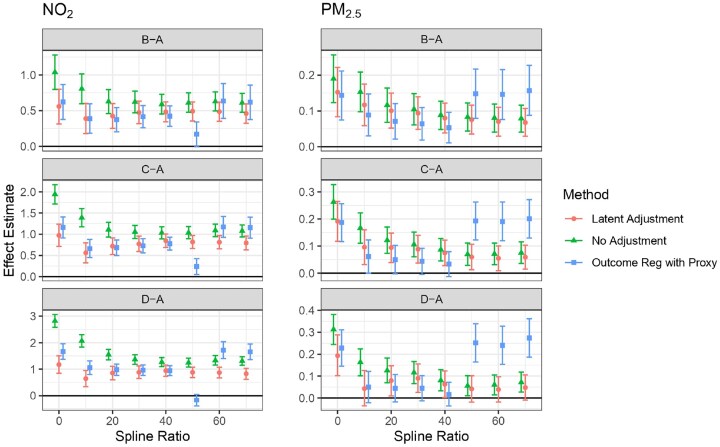 Figure 1
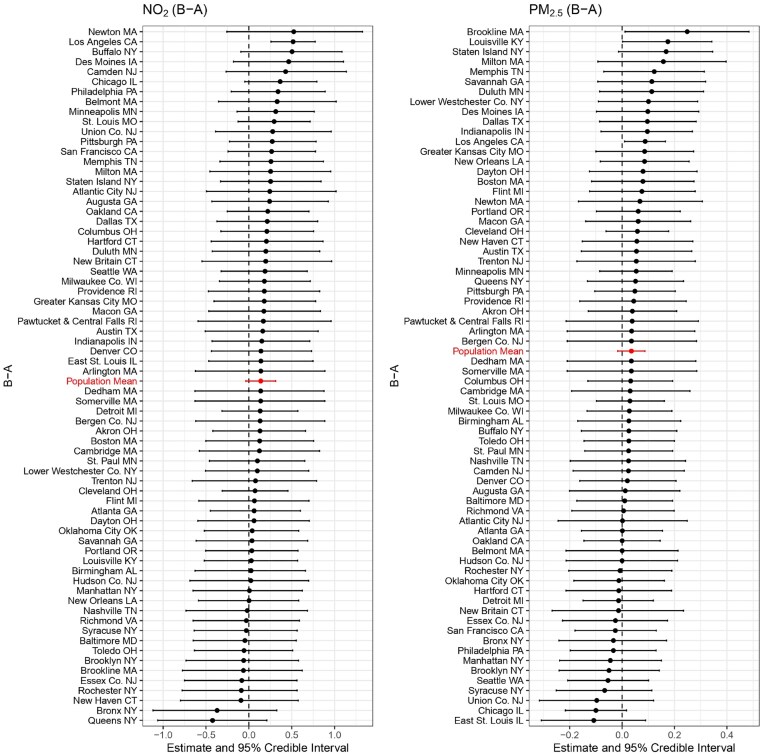 Figure 2
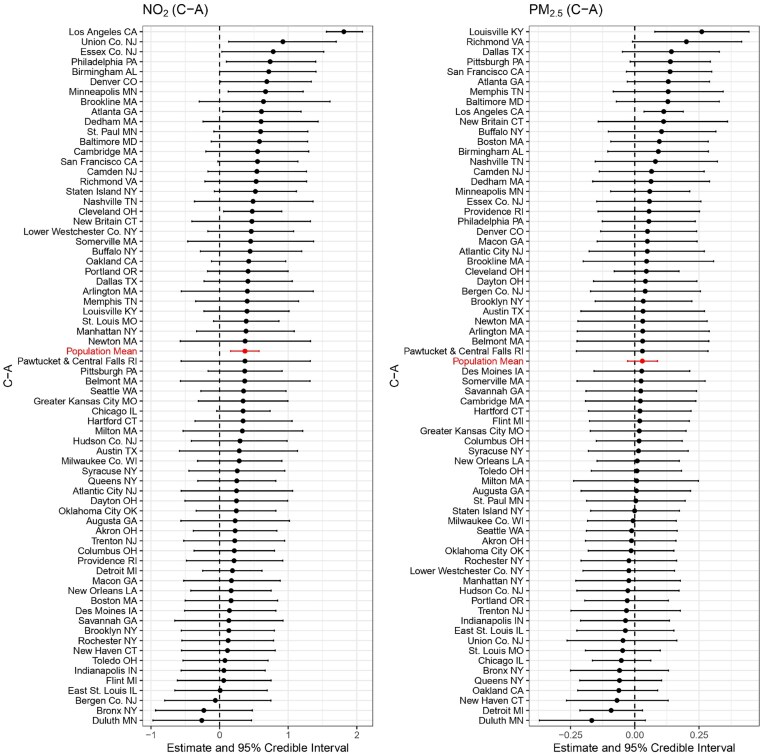 Figure 3
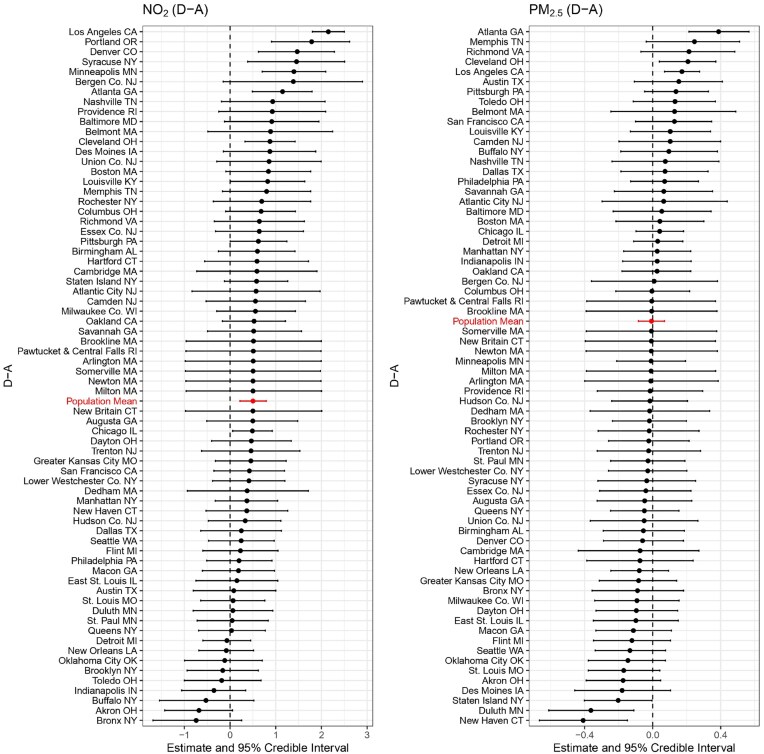 Figure 4
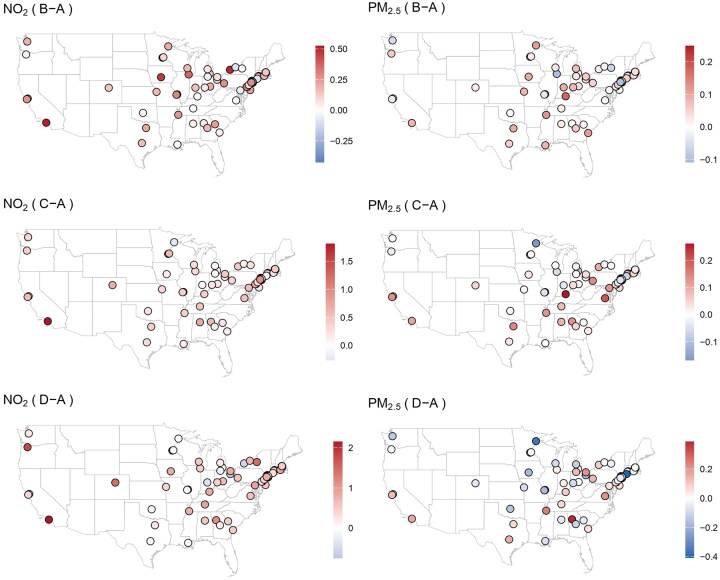 Figure 5
Peer Reviews
No public reviews on file for this paper yet. If you reviewed it on a platform where reviews are public (OpenReview, ICLR, NeurIPS, ICML), you can paste yours below so the community can read it here.
Videos
No videos yet. Explain this paper in a talk, walkthrough, or lecture? Add one.
Taxonomy
TopicsSpatial and Panel Data Analysis · Advanced Causal Inference Techniques · Air Quality and Health Impacts