Determining the Ensemble N‑Representability of Reduced Density Matrices
Ofelia B. Oña, Gustavo E. Massaccesi, Pablo Capuzzi, Luis Lain, Alicia Torre, Juan E. Peralta, Diego R. Alcoba, Gustavo E. Scuseria

TL;DR
This paper introduces a new method to determine if a reduced density matrix can represent an ensemble of quantum states, using purification and variational algorithms.
Contribution
A practical framework for ensemble N-representability using purification and variational quantum algorithms.
Findings
The purification strategy successfully embeds ensemble states into pure states for N-representability analysis.
The algorithm effectively minimizes the Hilbert-Schmidt distance to determine N-representability.
Numerical simulations on multi-electron systems confirm the method's robustness and applicability.
Abstract
The N-representability problem for reduced density matrices remains a fundamental challenge in electronic structure theory. Following our previous work that employs a unitary-evolution algorithm based on an adaptive derivative-assembled pseudo-Trotter variational quantum algorithm to probe pure-state N-representability of reduced density matrices [J. Chem. Theory Comput. 2024, 20, 9968], in this work we propose a practical framework for determining the ensemble N-representability of a p-body matrix. This is accomplished using a purification strategy that embeds an ensemble state into a pure state defined on an extended Hilbert space, such that the reduced density matrices of the purified state reproduce those of the original ensemble. By iteratively applying variational unitaries to an initial purified state, the proposed algorithm minimizes the Hilbert-Schmidt distance between its…
Genes, proteins, chemicals, diseases, species, mutations and cell lines named across the full text — each resolved to its canonical identifier and authoritative record.
Click any figure to enlarge with its caption.
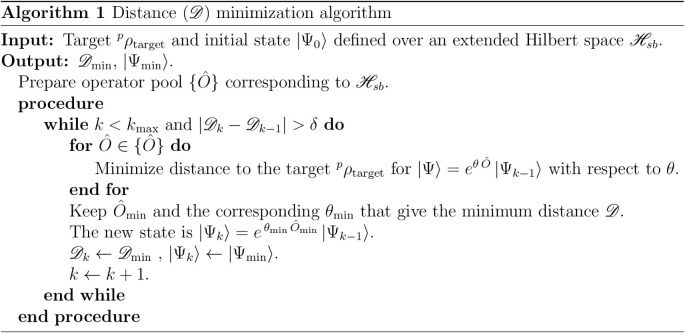 Figure 1
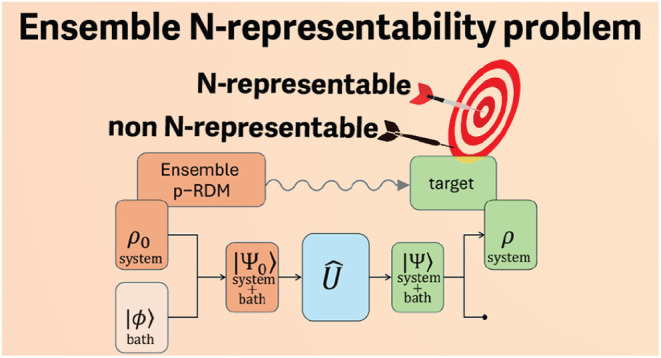 Figure 2
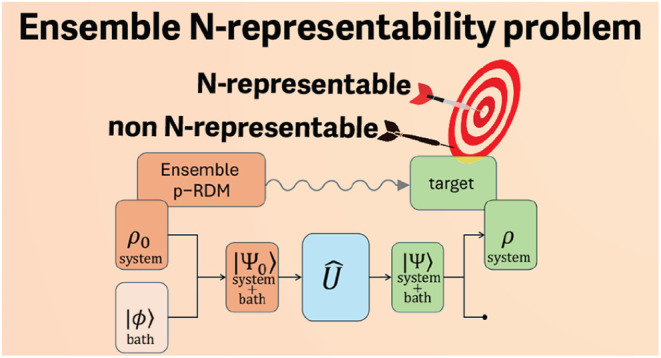 Figure 3
 Figure 4
 Figure 5
 Figure 6
 Figure 7
 Figure 8
 Figure 9
 Figure 10
 Figure 11
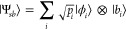 Figure 12
 Figure 13
 Figure 14
 Figure 15
 Figure 16
 Figure 17
 Figure 18
 Figure 19
 Figure 20
 Figure 21
 Figure 22
 Figure 23
 Figure 24
 Figure 25
 Figure 26
 Figure 27
 Figure 28
 Figure 29
 Figure 30
 Figure 31
 Figure 32
 Figure 33
 Figure 34
 Figure 35
 Figure 36
 Figure 37
 Figure 38
 Figure 39
 Figure 40
 Figure 41
 Figure 42
 Figure 43
 Figure 44
 Figure 45
 Figure 46
 Figure 47
 Figure 48
 Figure 49
 Figure 50
Peer Reviews
No public reviews on file for this paper yet. If you reviewed it on a platform where reviews are public (OpenReview, ICLR, NeurIPS, ICML), you can paste yours below so the community can read it here.
Videos
No videos yet. Explain this paper in a talk, walkthrough, or lecture? Add one.
Taxonomy
TopicsQuantum Computing Algorithms and Architecture · Quantum many-body systems · Spectroscopy and Quantum Chemical Studies