Using CEST NMR to discover previously unobserved states on the free energy surface of proteins: Application to the L99A cavity mutant of T4 lysozyme
Ved Prakash Tiwari, Nihar Pradeep Khandave, D. Flemming Hansen, Guillaume Bouvignies, Lewis E. Kay, Pramodh Vallurupalli

TL;DR
This study uses CEST NMR to detect rare protein conformations in L99A T4 lysozyme that were previously undetected by other methods.
Contribution
The study introduces CEST NMR as a novel method to detect rare, compact protein states with lifetimes ranging from 100 ms to 100 μs.
Findings
A rare state (I) populated to ~0.2% was detected in addition to the E and B states.
All three states are compact and interconvert via compact transition states.
CEST NMR provides better sensitivity to rare conformers than CPMG relaxation dispersion.
Abstract
Carr-Purcell-Meiboom-Gill (CPMG) relaxation dispersion experiments establish that at room temperature, the L99A cavity mutant of T4 lysozyme (L99A T4L) interconverts between two compact folded conformations on the millisecond timescale. These include the native state in which the sidechain of Phe114 is exposed to solvent (E state) and a near-native minor state in which the aromatic moiety of Phe114 is buried in the core of the protein (B state, ∼2%). Molecular dynamics simulations that have captured the E to B interconversion in L99A T4L and related mutants suggest that these proteins adopt compact folded conformations other than E and B, yet extensive CPMG studies have not detected such states. In an effort to detect these more elusive conformers experimentally, we have recorded Chemical Exchange Saturation Transfer (CEST) experiments, as the widths of minor state dips in the resulting…
Genes, proteins, chemicals, diseases, species, mutations and cell lines named across the full text — each resolved to its canonical identifier and authoritative record.
Click any figure to enlarge with its caption.
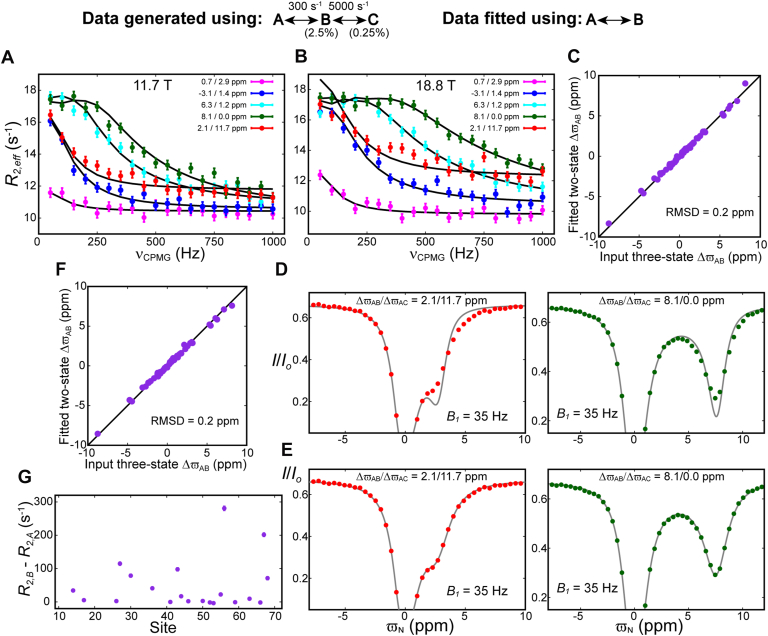 Figure 1
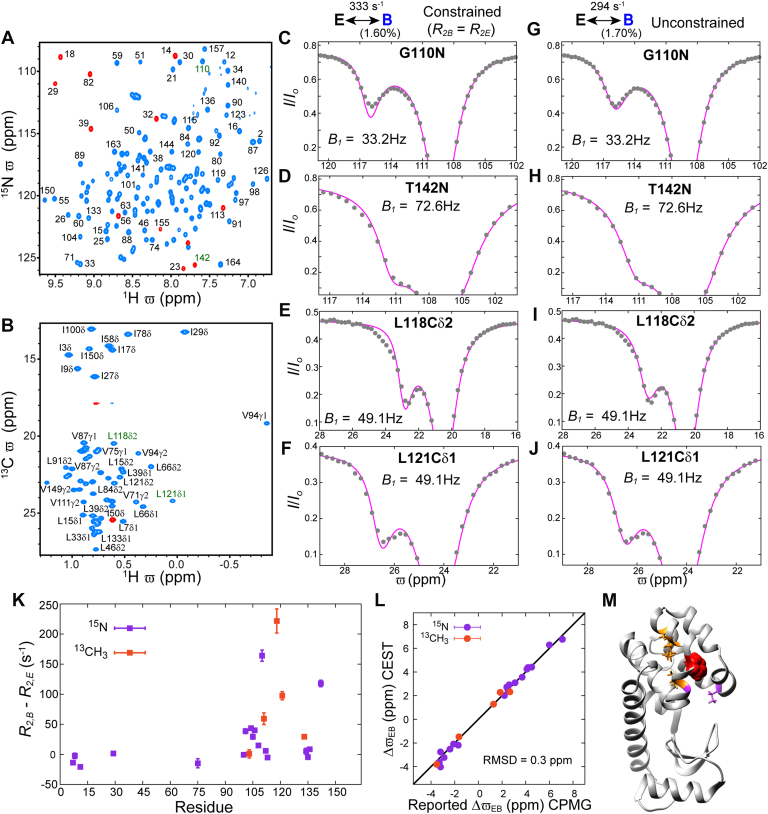 Figure 2
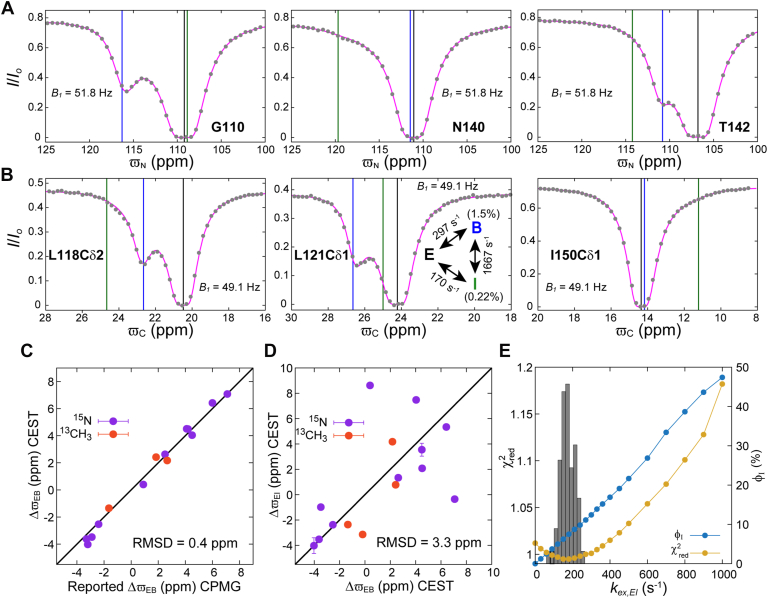 Figure 3
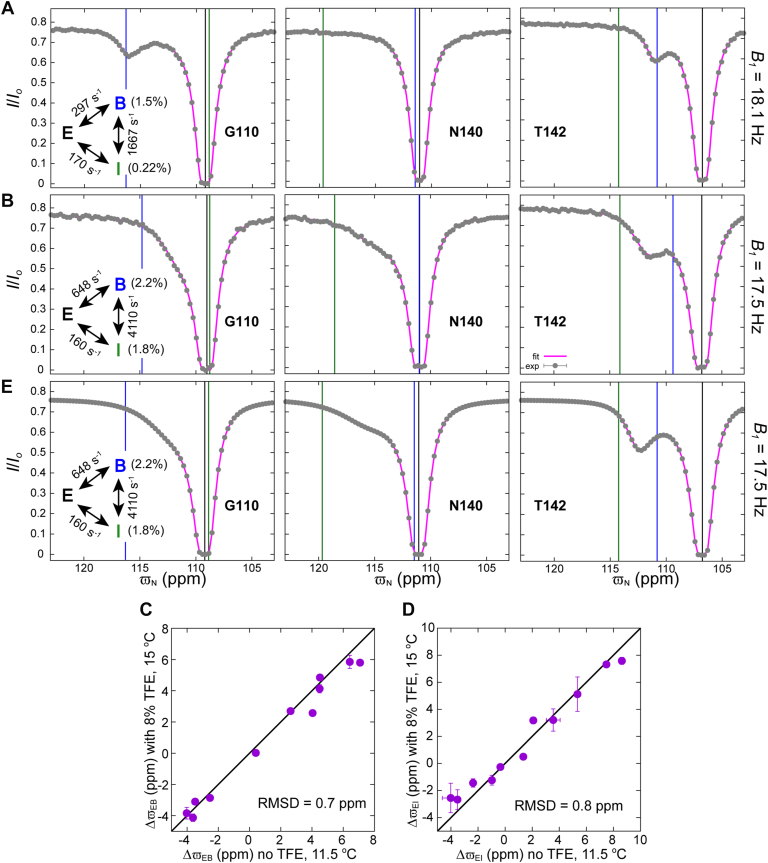 Figure 4
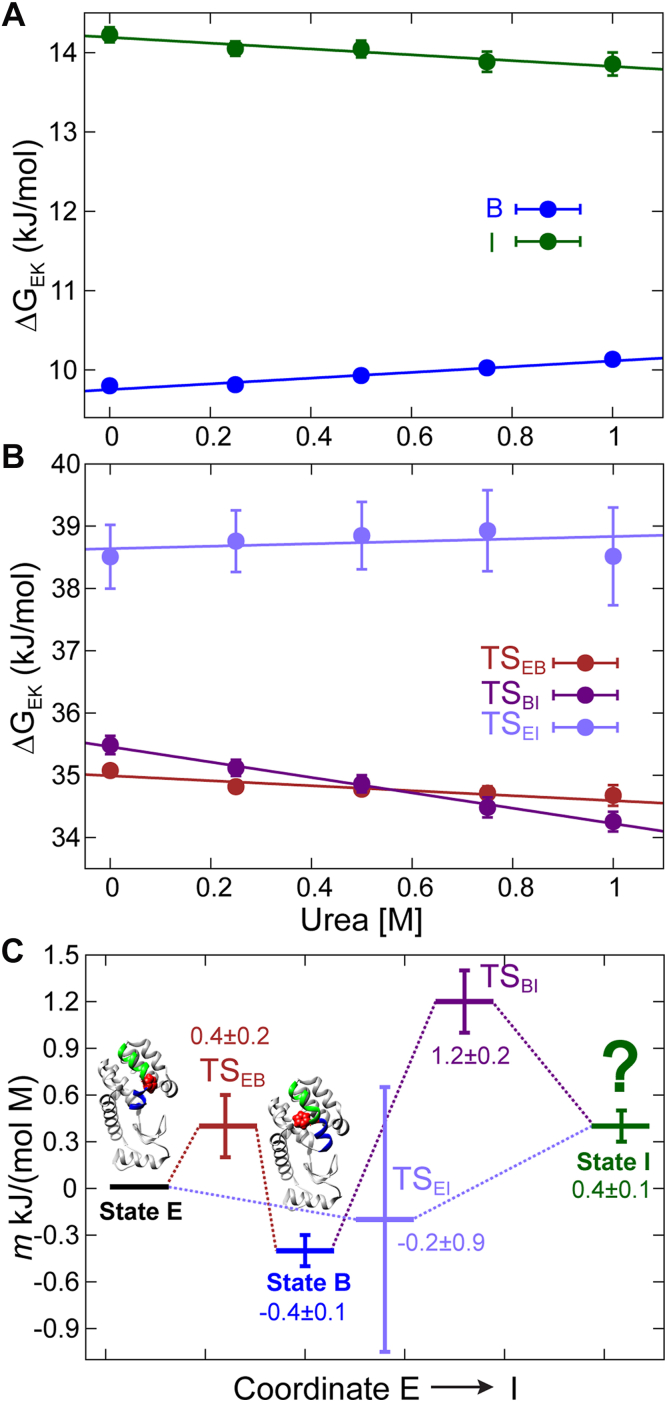 Figure 5
Peer Reviews
No public reviews on file for this paper yet. If you reviewed it on a platform where reviews are public (OpenReview, ICLR, NeurIPS, ICML), you can paste yours below so the community can read it here.
Videos
No videos yet. Explain this paper in a talk, walkthrough, or lecture? Add one.
Taxonomy
TopicsProtein Structure and Dynamics · Advanced NMR Techniques and Applications · Protein Interaction Studies and Fluorescence Analysis