Added value of tumor–stroma ratio to postsurgery circulating tumor DNA and pTN stage in risk stratification of patients with stage III colon cancer treated with adjuvant chemotherapy
I.A. Franken, F. Heilijgers, M.-C.E. Bakker, C. Rubio-Alarcón, F.H. van der Baan, M. Lemmens, P. Delis-van Diemen, M. Sausen, G.A. Meijer, M. Koopman, G.R. Vink, R.J.A. Fijneman, W.E. Mesker, J.M.L. Roodhart

TL;DR
This study shows that combining tumor-stroma ratio with circulating tumor DNA and tumor stage improves risk prediction for colon cancer patients after surgery and chemotherapy.
Contribution
The study demonstrates that tumor-stroma ratio adds value to circulating tumor DNA and pTN stage in risk stratification of stage III colon cancer patients.
Findings
Postsurgery ctDNA-positive patients have a 65% 3-year recurrence risk.
Within ctDNA-negative patients, those with pT4/N2 and stroma-high tumors have a 40% recurrence risk.
One-third of patients with ctDNA-negative, pT1-3N1, and stroma-low tumors have <3% recurrence risk.
Abstract
Patients with stage III colon cancer (CC) are routinely treated with resection followed by adjuvant chemotherapy (ACT). Half of patients are cured by surgery alone and overtreated with ACT, yet another ∼30% experience disease recurrence. Upfront risk stratification requires biomarkers beyond the conventional pathological stage (pTN). Detection of postsurgery circulating tumor DNA (ctDNA) is indicative of minimal residual disease and prognostic of recurrence. However, its negative predictive value is insufficient to guide treatment de-escalation. This study aimed to investigate whether adding tumor–stroma ratio (TSR) can improve patient risk stratification. This study included 206 patients from PLCRC-PROVENC3 based on radical resection of stage III CC followed by ACT. Postsurgery ctDNA status was determined using Labcorp® Plasma Detect™. On a hematoxylin–eosin resection section, the TSR…
Genes, proteins, chemicals, diseases, species, mutations and cell lines named across the full text — each resolved to its canonical identifier and authoritative record.
Click any figure to enlarge with its caption.
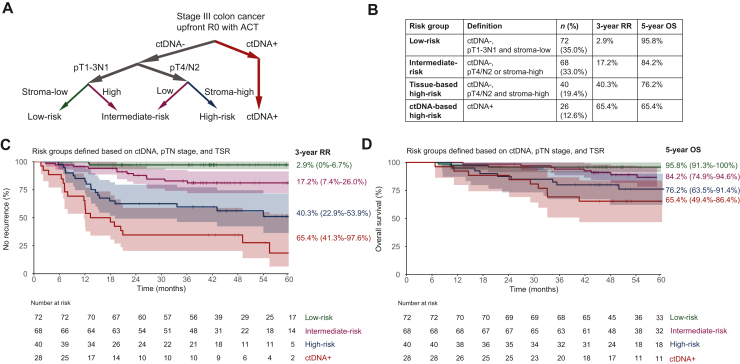 Figure 1
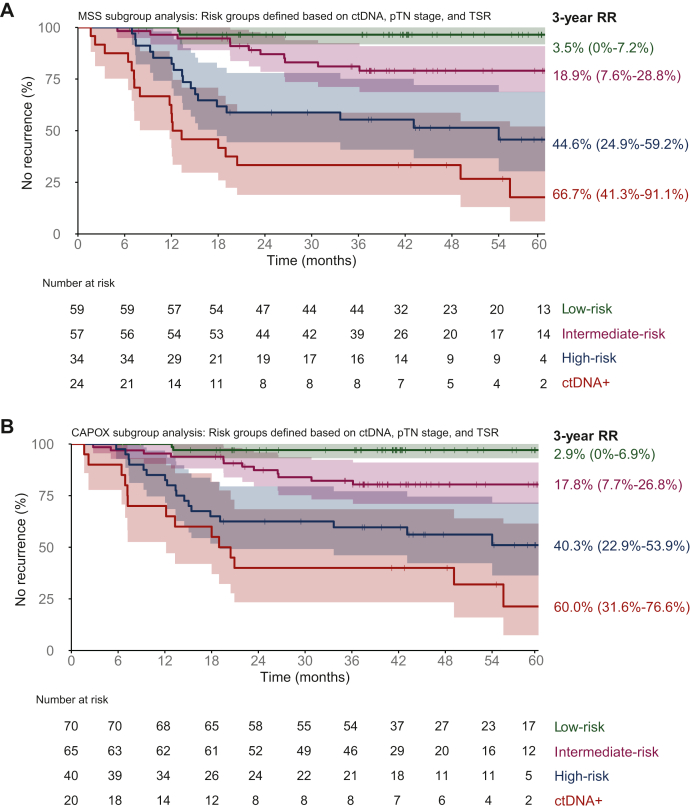 Figure 2
Peer Reviews
No public reviews on file for this paper yet. If you reviewed it on a platform where reviews are public (OpenReview, ICLR, NeurIPS, ICML), you can paste yours below so the community can read it here.
Videos
No videos yet. Explain this paper in a talk, walkthrough, or lecture? Add one.
Taxonomy
TopicsCancer Genomics and Diagnostics · Genetic factors in colorectal cancer · Colorectal Cancer Treatments and Studies