Multidimensional Generalized Partial Preference Model for Forced-Choice Items
Daniel C. Furr, Jianbin Fu

TL;DR
This paper introduces a new IRT model for forced-choice items that offers more flexibility and statistical elegance compared to existing methods.
Contribution
The paper proposes the multidimensional generalized partial preference model (MGPPM) for forced-choice items.
Findings
MGPPM shows satisfactory parameter recovery in simulations with triplet and tetrad data.
MGPPM is more statistically elegant than the Thurstonian IRT and Triplet-2PLM models.
The new model provides more flexible IRT modeling under different assumptions.
Abstract
A ranking pattern approach is proposed to build item response theory (IRT) models for forced-choice (FC) items. This new approach is an addition to the two existing approaches, sequential selection and Thurstone’s law of pairwise comparison. A new dominance IRT model, the multidimensional generalized partial preference model (MGPPM), is proposed for FC items with any number (greater than 1) of statements. The maximum marginal likelihood estimation using an expectation-maximization algorithm (MML-EM) and Markov chain Monte Carlo (MCMC) estimation are developed. A simulation study is conducted to show satisfactory parameter recovery on triplet and tetrad data. The relationships between the newly proposed approach/model and the existing approaches/models are described, and the MGPPM, Thurstonian IRT (TIRT) model, and Triplet-2PLM are compared when applied to simulated and real triplet…
Genes, proteins, chemicals, diseases, species, mutations and cell lines named across the full text — each resolved to its canonical identifier and authoritative record.
Click any figure to enlarge with its caption.
 Figure 1
 Figure 2
 Figure 3
 Figure 4
 Figure 5
 Figure 6
 Figure 7
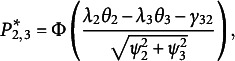 Figure 8
 Figure 9
 Figure 10
 Figure 11
 Figure 12
 Figure 13
 Figure 14
 Figure 15
 Figure 16
 Figure 17
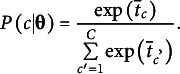 Figure 18
 Figure 19
 Figure 20
 Figure 21
 Figure 22
 Figure 23
 Figure 24
 Figure 25
 Figure 26
 Figure 27
 Figure 28
 Figure 29
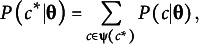 Figure 30
 Figure 31
 Figure 32
 Figure 33
 Figure 34
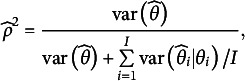 Figure 35
 Figure 36
 Figure 37
 Figure 38
 Figure 39
 Figure 40
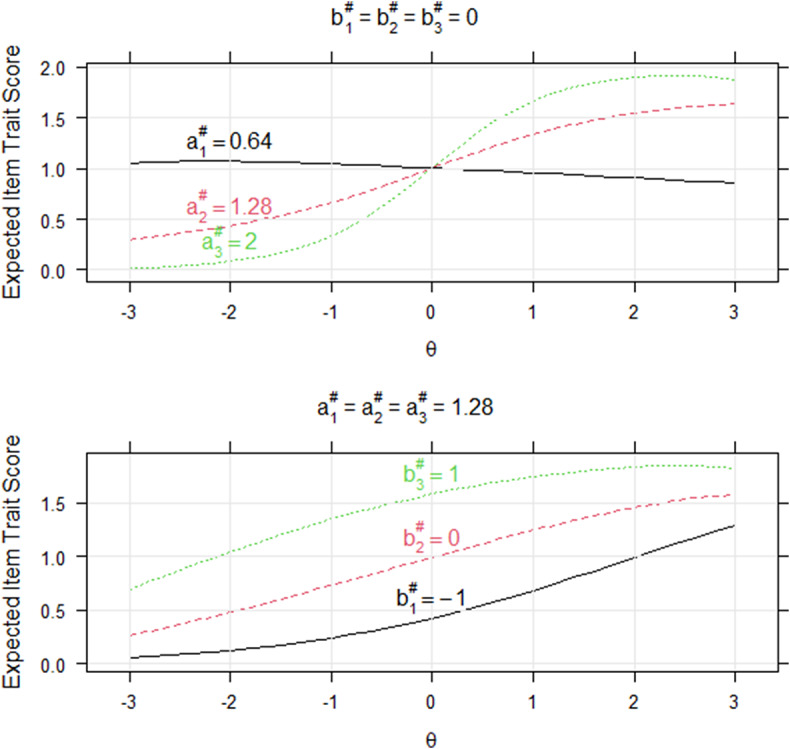 Figure 1
 Figure 42
 Figure 43
 Figure 44
 Figure 45
 Figure 46
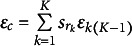 Figure 47
 Figure 48
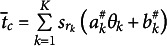 Figure 49
 Figure 50
Peer Reviews
No public reviews on file for this paper yet. If you reviewed it on a platform where reviews are public (OpenReview, ICLR, NeurIPS, ICML), you can paste yours below so the community can read it here.
Videos
No videos yet. Explain this paper in a talk, walkthrough, or lecture? Add one.
Taxonomy
TopicsEconomic and Environmental Valuation · Sensory Analysis and Statistical Methods · Psychometric Methodologies and Testing